

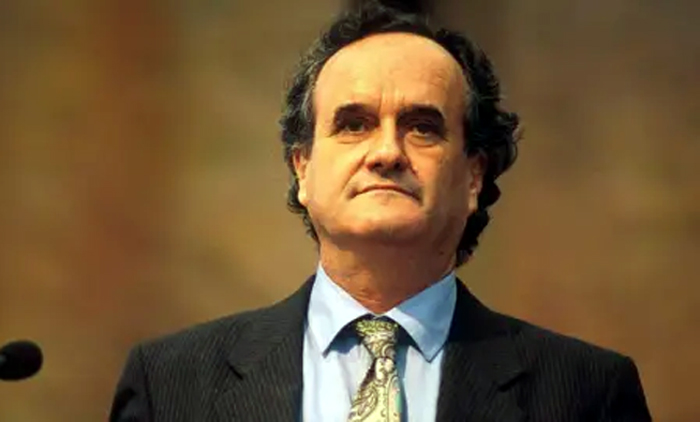
NEW DELHI, Jan 25: Sir William Mark Tully, or ‘Mark Tully’ as he was popularly known while covering India for the British Broadcasting Corporation (BBC), died on Sunday in a private hospital in New Delhi. He was 90 years old.
Over the last six decades Tully became one of the most trusted and recognisable chroniclers of India for generations of radio listeners.
Tully served as chief of the BBC bureau in India for 22 years and became a household name here for his objective, in-depth and authentic reporting. His measured voice and refusal to sensationalise brought credibility to the airwaves at critical moments in modern Indian history.
As a reporter he covered momentous events like the 1971 India-Pakistan War, imposition of Emergency, the Bhopal Gas Tragedy, ‘Operation Blue Star’, the assassination of former Prime Ministers Indira Gandhi and later Rajiv Gandhi, the demolition of Babri Masjid.
Expelled from India during the Emergency (only to be allowed back later), criticised by both Indian nationalists and sections of the British establishment, Tully never wavered from his commitment to fair-minded journalism.
After resigning from the BBC in 1994, he continued to work as a freelance journalist and broadcaster, choosing to remain in New Delhi, the city he considered his home.
Tully authored several critically acclaimed books including ‘India in Slow Motion’, ‘The Heart of India’, ‘India’s Unending’, ‘Non Stop India’ etc.
A highly respected broadcaster, he was the recipient of the Indian government’s civilian honors – Padma Shri and later Padma Bhushan. He was also Knighted by the British government for his services as a journalist.
Even after resigning from the BBC he hosted the channel’s Radio programme ‘Something Understood’ till 2019.
Born on Oct. 24, 1935, in Tollygunge, in what was then Calcutta, to British parents, Tully spent his earliest years in India before being sent to England for his education. He studied at prestigious institutions – Marlborough College and later Trinity Hall, Cambridge.
However, India never receded into the background of his imagination. In 1964, he returned as the BBC’s India correspondent, beginning an association with the country that would shape the rest of his professional and personal life.
Tully is survived by his partner Gillian Wright.
Tully lived much of his later life in New Delhi and McLeod Ganj, walking the streets daily, engaging with ordinary people, and maintaining an abiding curiosity about the country’s complexities.
To many Indians, he was not simply a foreign correspondent but a powerful, friendly voice that sympathetically understood the country’s contradictions without condescension.
He did not claim to speak for India, however, with a unique understanding and a lifetime of inquisitive reporting, he helped India speak out to the world at large.
(UNI)
 Follow our WhatsApp channel
