

A Highly Revered Yet Unexplored Abode of Lord Shiva
Dr Hari Dutt Shishu and Aana Jamwal
hariduttshishu@gmail.com
Airawati Tirathsthan, commonly known as the Airwan Shiv Temple, is located in Village Airwan, Tehsil Nagri Parole, District Kathua tucked away barely seven kilometres from the Rajbagh bus stop on the Jammu-Pathankot NH44 and about fifteen kilometres from Kalibari, Kathua. Despite such easy accessibility, this ancient shrine remains one of the most revered yet unexplored sacred destinations of the region.
Tracing the Roots: Shaivism in the Duggar Land
To understand the genesis of Airwan, one must travel back into the early religious history of the Jammu region. References in the Puranas, quoting Rishi Vashisht, reveal that the inhabitants of the land between the rivers Ravi and Chenab were ardent worshippers of the Lingam, the phallic symbol of Lord Shiva. With the arrival of the Aryans through the Punjab plains and the Shivalik hills, older tribes such as the Nagas, Yakshas, and Khasas were assimilated, and the Shaivite tradition gained further prominence.
This cultural synthesis resulted in the construction of numerous shrines dedicated to Lord Shiva across the region. The Airwan Tirthsthan is believed to be one such ancient shrine, traditionally attributed to King Vikramaditya in the 4th century CE.
Sacred Geography and the Origin of the Name
The sanctity of the temple is deepened by its geography, situated between the rivers Ujh and Ravi, the site draws its name from the ancient Vedic appellation of the Ravi river ie; Airawati or Purushni. Another popular belief associates the name with Airawat, the celestial elephant of Lord Indra, weaving mythology directly into the landscape.
The Puranic Legend of Ganga and Airawat
According to references in the Puranas, Maharaja Bhagirath undertook severe penance for a thousand years to bring the holy Ganga to earth and redeem the sins of his 60,000 ancestors, who had been burnt into ashes by Sage Kapila’s anger. They had disturbed him during meditation and wrongly accused him of stealing their father’s sacrificial horses. In reality, the horses had been hidden by Lord Indra in Kapila’s ashram.
Lord Indra, who had completed one hundred Ashwamedha Yagyas, feared losing his ascendancy to a mortal. Therefore, he secretly hid the horses when King Sagar of the Ikshvaku dynasty, who was also an ancestor of Lord Rama, performed the Ashwamedha Yagya to establish universal dominion.
In later generations, Bhagirath prayed to Lord Brahma for the redemption of his ancestors to redeem the sins of his ancestors and free their souls. On Lord Brahma’s advice he prayed to Lord Vishnu to allow Ganga to descend. Lord Vishnu agreed but warned that the force of Ganga would destroy the earth unless restrained. He directed Bhagirath to seek Lord Shiva’s help.
Lord Shiva consented to receive the mighty flow of Ganga on his matted locks. However, Ganga, proud of her strength, descended ferociously with the intent of sweeping Shiva into the netherworld. To curb her pride, Shiva trapped her within his locks and did not allow her to flow further. When Bhagirath prayed again, Shiva released Ganga gently. Again, her path was blocked by a mountain, on Lord Shiva’s advice, Bhagirath sought Lord Indra’s help and requested his divine elephant Airawat, the only one capable of removing the obstruction.
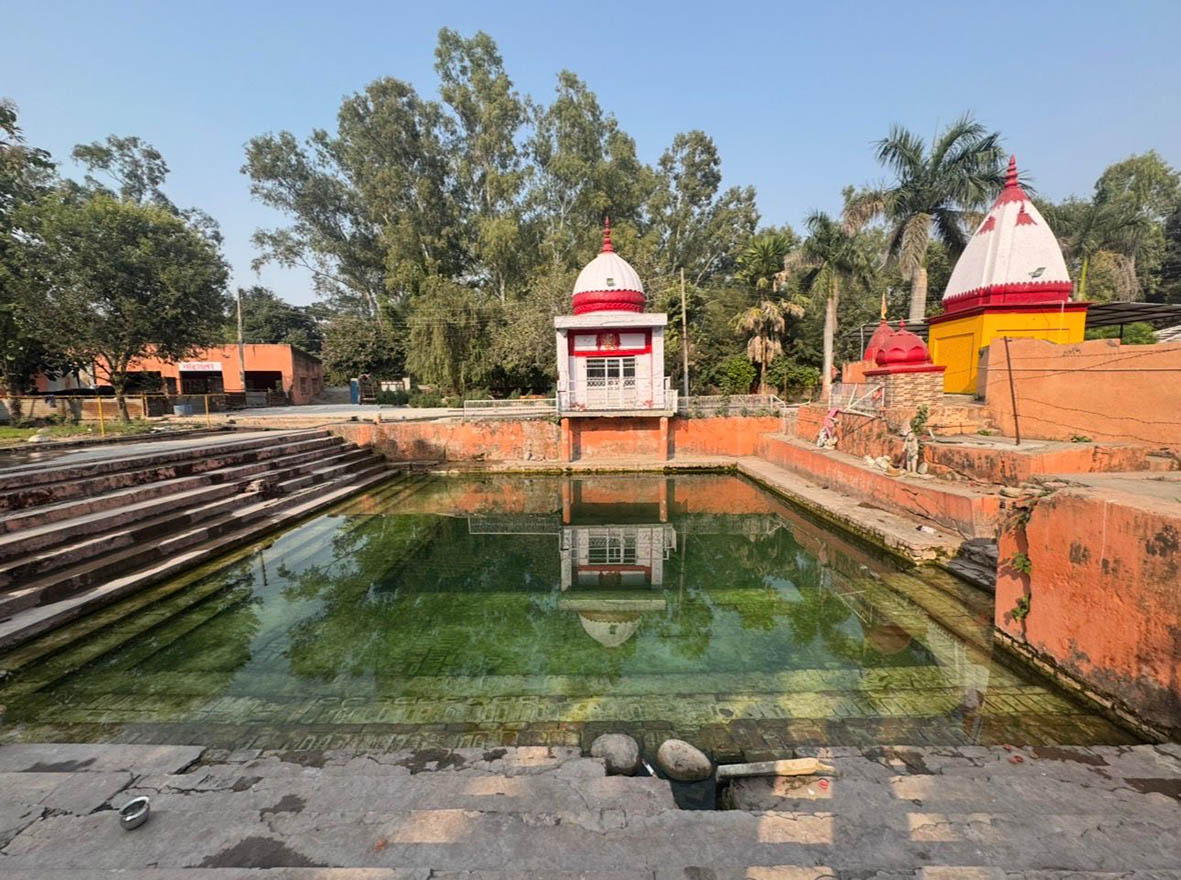
Airawat removed the mountain but in pride, underestimated the force of the river. He was swept away by the mighty current into Pataal Lok. Later, by Lord Shiva’s blessing and Indra’s prayer, Airawat was resurrected from one of the baolis (sacred water reservoirs) that still exists within the temple premises. In remembrance of this divine event, the place came to be known as Airwan, a tribute to Airawat.
The Devotee’s Dream and the Self-Manifested Shivling
Another cherished local legend speaks of a devoted villager from the region present day Nagri Parole, who regularly visited the Shiva temple at Jasrota across the River Ujh to worship Lord Shiva. One day, heavy rains caused the river to flood. From dawn to dusk he waited for the waters to recede, but the current remained strong. Driven by unwavering faith, he finally jumped into the river, braved the currents and reached the temple.
After offering prayers, he stayed overnight at the temple due to the floods. That night, Lord Shiva appeared in his dream and commanded:”Seek the place near your village where a cow is seen pouring milk upon pebbles. Dig there, and you will find me.”
Following the divine instruction, he searched the forests near Nagri Parole and discovered a cow releasing milk over some pebbles. With the help of villagers, he began digging. To everyone’s astonishment, a Shivling emerged from the earth. As they dug further, blood stains appeared on the sacred stone, which was taken as a divine sign to stop. This self-manifested Shivling, known as Aap Shambhu, has remained enshrined as the sacred heart of Airwan Temple for over 1,600 years now.
Ancient Reference, Baolis and Gupt Ganga
The sanctity of Airwan Temple is supported not only by legends but also by ancient Sanskrit texts. The Nilamata Purana, one of the most authoritative Kashmiri scriptures, explicitly affirms Airwan as a sacred site blessed with holy waters and divine presence, establishing its legitimacy as a pilgrimage centre and to its antiquity. Traditionally, the temple complex was said to contain 101 Baolis. Pilgrims begin every ritual with ablution in these waters, believed to be a reflection of the Ganga herself, hence known as “Gupt Ganga.”
Even today many devotees from Jammu, Punjab, and Haryana immerse the ashes of their loved ones here, considering it as sacred as Haridwar and believing that it grants moksha to departed souls, often calling it Mini-Haridwar.
A Living Centre of Faith and Community
The temple complex also houses a shrine of Dharamraj, regarded as the deity who keeps records of human deeds, both good and bad. A temple dedicated to Ram Darbar also stands within the premises. Recently, an annual Shobha Yatra on the foundation day of the Ayodhya Temple inauguration was added to the list of yearly celebrations. With improved road connectivity and communication, the temple has become a vibrant centre for social gatherings and religious festivities.
On every Amavasya, devotees take a holy bath before offering prayers. Somvati Amavasya is considered especially auspicious. A grand fair is held on the fourteenth day of the month of Chaitra. Large fairs are also organised on Shivratri and Baisakhi, drawing thousands of devotees. The complex also includes a well maintained Gaushala, managed by the temple committee.
Celebration of Mahashivratri: Faith in Full Bloom
Mahashivratri is celebrated here with immense enthusiasm and active participation of the administration. A two-day Kisan Mela is organised, with various government departments exhibiting their products and schemes for the benefit of farmers. A Dogra cultural programme showcases local, folk, and indigenous art forms. Rural sports such as Kabaddi, Kho-Kho, races, and tug-of-war form an integral part of the festivities.
The Maha Ganga Aarti has now become the central attraction. Thousands of diyas are lit, creating a divine and mesmerizing aura. Devotees take holy dips in the Baoli after each aarti and perform four poojas throughout the night, bathing after every ritual. Community meals, free langar, and devotional songs further enhance the spiritual atmosphere. It becomes a thrilling, divine, and blissful journey for every pilgrim.
(The authors are Advisor, and the Tehsildar Nagri (Chairperson) of the Managing Committee of Airwan Tirthsthan.)
 Follow our WhatsApp channel
