

Delivers deeply reflective, inspiring address to law students
Excelsior Correspondent
JAMMU, Apr 3: Delivering a deeply reflective and inspiring address to young law students, Justice Wasim Sadiq Nargal, Judge High Court of Jammu & Kashmir and Ladakh today emphasized that the practice of law is not merely a profession but a journey that requires unwavering discipline, integrity and perseverance.
Justice Nargal, who was chief guest of the grand finale at the 7th Gavelled Moot Court Competition organized by the Moot Court Society, School of Law, Lovely Professional University, Punjab, recalled the struggles of early years in legal practice and painted a vivid picture of long hours, quiet hardwork and little recognition, noting that the journey of a lawyer is often marked by silent growth rather than immediate rewards.
“The practice of law is not for the faint-hearted. It demands discipline, endurance and above all, faith-faith in hard work, justice and oneself”, the Judge remarked, urging young entrants to embrace the rigours of the profession with commitment rather than seeking comfort.
Stressing the foundational role of early years in shaping a lawyer’s character, he highlighted that success in litigation is not measured merely by victories in court but by the respect one earns through calmness, precision and courtesy. “Judges remember lawyers who are prepared and dignified, even when the odds are against them,” he said, adding that preparation remains the cornerstone of excellence in the legal profession.
In a powerful reminder of the human dimension of legal work, law students were urged to recognise the weight of responsibility that accompanies every case. Behind every file, Justice Nargal noted, lies a human story that may hinge on the lawyer’s effort and integrity. “Intelligence without humility becomes arrogance, and success without integrity is something none of us should aspire to”, the Judge cautioned.
Addressing ethical challenges within the profession, he candidly acknowledged that lawyers often face moments where honesty may come at a cost. However, it underscored that those who uphold integrity, even quietly and without recognition, carry a deeper sense of fulflilment and self-respect. “The beauty of this profession lies not in its rewards but in the certainty of having stood for something true,” he added.
Turning to the role of the judiciary, Justice Nargal underlined that judicial authority rests not in power but in public trust, which must be sustained through fairness, transparency and reasoned decisions. Each judgment, it was said, extends beyond the courtroom, influencing governance and reinforcing citizens’ faith in the justice delivery system.
Encouraging students to consider litigation as a first choice rather than a fallback option, he described courtroom practice as a unique avenue to contribute to the evolution of law. Unlike corporate practice, litigation offers the opportunity to shape legal precedent and directly engage with the cause of justice. “A small case today may become a guiding precedent tomorrow,” he noted.
Emphasising the importance of Alternative Dispute Resolution (ADR), honest pleadings and avoidance of unnecessary delays, he urged the next generation to treat judicial time as a “sacred public resource”. He also acknowledged the transformative potential of artificial intelligence in research and efficiency. However, a clear caution was sounded against over-reliance on machines.
“Justice remains a human act. Technology can assist, but it cannot replace judgment, empathy and moral reasoning,” he added.
He urged students to hold on to three enduring principles-integrity, preparation and compassion. These, it was stressed, not only build professional excellence but also sustain the deeper purpose of law as a service to society.
Out of 32 prestigious teams from across the nation, the competition witnessed rigorous preliminary, quarter-final, and semi-final rounds. The Grand Finale saw an intense intellectual battle between Symbiosis Law School, Pune and Jai Narain Vyas University, Jodhpur. After a compelling display of legal research and oral advocacy, Symbiosis Law School, Pune emerged as the National Winners, with Jai Narain Vyas University securing the Runners-up trophy.
The final round was adjudicated by a distinguished bench comprising Justice Wasim Sadiq Nargal and Major Gen (Retd.) Vijay Kumar, JAG who tested the finalists on their grasp of complex legal nuances and judicial temperament.
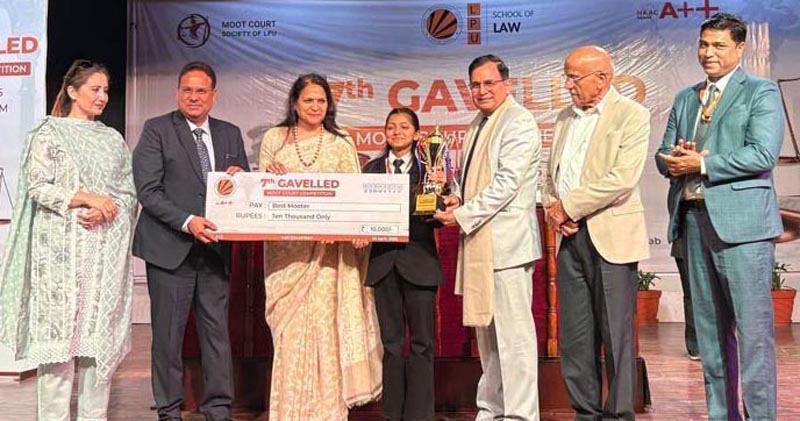
The ceremony was graced by the Chancellor of LPU, Dr. Ashok K. Mittal, and Pro-Vice Chancellor, Col. Dr. Rashmi Mittal.
The winners and runners-up were felicitated with trophies and cash prizes Rs 51000 and Rs 31000 respectively by the dignitaries. The event concluded with a formal Vote of Thanks delivered by Prof. (Dr.) Anand Pawar, Head and Dean of the School of Law.
 Follow our WhatsApp channel
