

‘Agencies working to dismantle radicalization networks’
Fayaz Bukhari
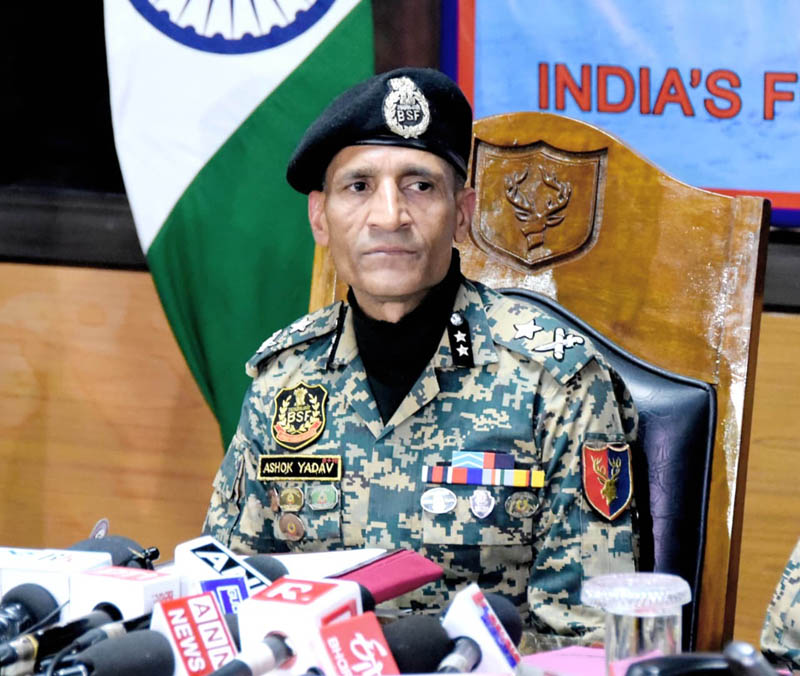
Srinagar, Dec 1: Inspector General of the Border Security Force (BSF) Kashmir Frontier, Ashok Yadav, today said that terrorist launch pads that were moved away from the forward areas by Pakistan after “Operation Sindoor” remain under the radar of Indian troops.
The IG BSF Yadav while addressing a press conference here at the 61st Raising Day celebrations of the BSF at the Humhama campus in Srinagar, said that they have “inputs of launching pads being shifted deeper” following the damage inflicted on them during Operation Sindoor but they remain under Indian troop radar.
Follow the Daily Excelsior channel on WhatsApp
“Some launching pads have been moved away from the forward areas so that they remain outside the firing range of Indian Army and BSF. Even then they remain under our radar,” he said.
The IG said that the BSF intelligence is monitoring 69 active launching pads along the LoC where 100-120 terrorists are waiting to infiltrate.
The BSF chief said that while there has been no major change in the infiltration modus operandi, “some new routes are being explored” by infiltrators.
“We get regular intelligence inputs about these routes and cover them along with the Army. Our intelligence setup has strong resources, generating a high volume of inputs that help in neutralizing terrorists or recovering warlike stores from LoC areas,” he said.
Yadav said that every intelligence input is followed “properly and aggressively” to prevent infiltration. “The operations at the LoC have many success stories: some conducted independently by the Army and some jointly with the BSF,” he said. In the hinterland, 13 BSF companies remain deployed “in support of the Jammu and Kashmir Police (JKP).”
The BSF chief said that the Kashmir frontier recorded only four infiltration attempts this year and attributed the drop to “effective domination of the LoC in close coordination with the Army.” He said a total of 13 terrorists attempted to cross the border, eight of whom were “neutralized by the Army,” while “five were pushed back.”
Yadav said the BSF has conducted 22 joint operations with the Army, Rashtriya Rifles, JKP, and CRPF in the hinterland and along the LoC, leading to the neutralization of militants and recovery of weapons, including AK-47 and MP5 rifles, pistols, grenades, and UBGL rounds.
He said that the BSF has played a key role in security during the Amarnath Yatra and other major events in Kashmir. “Our personnel have operated under harsh weather, hostile terrain, and constant threats, including sniping and fidayeen attacks, yet they continue their duties with full zeal,” he said.
The BSF chief said that “Operation Sindoor” remains ongoing and the force is fully prepared to give a befitting reply to Pakistan in case of any misadventure.
He called the first phase of Operation Sindoor the “most remarkable achievement,” praising the force’s “strong, accurate, and professional fire assaults on Pakistan posts and terrorist launching pads.” He said the response was widely appreciated by the Prime Minister, Home Minister, Defence Minister, and heads of other security agencies.
On narco-terrorism, Yadav said the threat is “growing and serious.” He said the objective behind pushing narcotics into Kashmir is “to turn youth into addicts and to finance terrorism.” According to him, the BSF has been focusing especially on Tangdhar sector to detect and neutralize such smuggling attempts.
He added that Mahila Praharis (women BSF personnel) have been stationed at forward areas and checkpoints to detect female couriers supporting terror and drug networks. “They have won the confidence of women in border villages,” he said.
Addressing drone-related concerns, Yadav confirmed that drone activity “is being observed” across the LoC but said it is currently “restricted to the other side.” “These are largely reconnaissance drones and have not crossed the LoC. Drones are under constant observation,” he said.
Calling the challenge of recruitment of local youth into militancy “definitely big,” Yadav said all security and intelligence agencies are working jointly to dismantle radicalization networks. “Our intelligence wing has been identifying institutions and places being used as radicalization centers, and we immediately pass on the information to the concerned agencies. We must collaborate effectively to disrupt these modules, he stated.
The BSF chief emphasised BSF’s work with civilians through civic action programmes and humanitarian response. The force, he said, has rescued civilians stranded due to landslides and snow and often serves as first responders in border areas. “Making border population partners in national security is a key priority,” he added.
The IG said the BSF is pushing modernisation and technological upgrades in response to changing global warfare. These include training troops in drone warfare, enhancing surveillance and night-operation capability, and preparing personnel for cyber threats.
“New drone forensics labs, the BHUMI start-up innovation initiative, and the BSF Drone Warfare School in Gwalior are part of future battlefield preparedness,” he said.
On the occasion of the BSF’s Diamond Jubilee, Yadav said the force is committed to modernisation including drone warfare training, new surveillance systems, and cyber readiness. “Ensuring the well-being, safety, and security of the local people and tourists is the first and foremost priority of the force,” he said.
 Follow our WhatsApp channel
