

Uchit Singhal
The effect of the heinous act of terrorism that happened on 22nd April in Pahalgam, in which unarmed civilians were targeted by a group of armed militants, will resonate in the annals of history of modern day India. Apart from the effect on the directly affected families, the socio-economic impact of the efflux that it triggered is beyond measure. The nation got together in the support for the affected families and a strong anti-terror voice echoed across nation. Indian Government took a decisive step in wake of Operation Sindoor to destroy the terrorist camps located in Pakistan which was welcomed and appreciated by all. Pakistan resorted to multiple ceasefire violations across LOC by using all sorts of tactics including drone/missile attacks. All this posed a massive, unique and unforeseen challenge before the nascent division of Indian Railways at Jammu.
The challenge was multi-fold. It not only lied in how to manage the train operations in such a scenario but also in how to plan the inward military specials to the maximum efficiency possible and in planning the outward specials to cater to heavy demand of people for outward movement from the region. This required extreme close coordination with Military authorities – right from Udhampur to Pathankot, Milrail Headquarters at Delhi and a very close coordination with the civil administration for timely predicting/assessing the movement of people. The rush management at the station was another challenge which had to be managed effectively in very close coordination with GRP and RPF authorities.
Now once the challenges got identified, the management part comes. A multipronged, holistic approach had to be formulated in such a scenario. For this, one needs to understand a little bit about the train operations. Train operations unlike road transportation include multiple things like arrangement of suitable coaches, locomotives to drive those coaches as single unit, crew to work the train so formed, guard/train manager to ensure safe/smooth train operations and last but not the least, path. Defining and plotting clear path is seemingly not so easy if one goes to plan a special rake in a network which has a defined capacity to handle train operations. To run one special train, all the above units need to be threaded together by the operations team in close coordination with all the other railway departments so involved. The planning part is done from the Control Organization which acts as the brain center of the train operations and works round the clock. Once the planning is framed, execution is done though the stations whose primary objective is to run those trains as planned by the Control, which also keeps a super eye on the execution of train operations by the stations and guides them wherever needed.
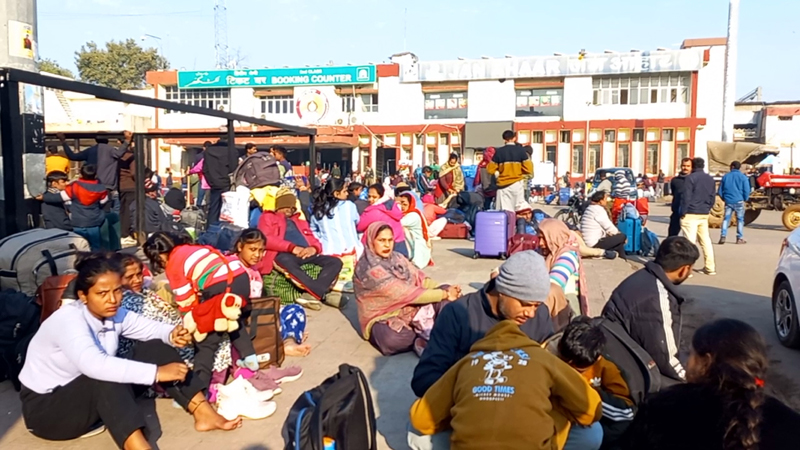
Now comes the crowd/rush management part. This is the most important aspect as any shortcoming here will not only cause passenger inconvenience but can also lead to abnormal rush/crowd situation at stations which in itself is very dangerous. During such a time dissemination of correct and accurate information about train operations becomes very important. First step taken in this direction was the establishment of help desks at the stations. These help desks were enacted immediately at Jammu and Katra stations jointly manned by commercial and RPF staff to give timely and accurate information to the passengers in addition to the Enquiry counters with dedicated helpline numbers. Regular announcements with respect to the upcoming trains come next. A crowd management room was immediately established in the control office which again was jointly manned by the commercial and RPF staff to keep a close watch on the Platforms, Foot over bridges, circulating area, waiting halls, booking/reservation areas among others so as to keep an eagle’s eye over the budding rush like situations and diverting the quick response teams to that hotspot to diffuse the situation timely.
Post-Pahalgam attack, the situation was quite bad as tourists in the valley wanted to leave as early as possible and all their reservations as per the advance planning were of no use. The inward volume of traffic started declining rapidly and the outward demand started rising suddenly.
Given the limited quantum of traffic that airways can carry, Railways was the only mode of the transport available through which such a mass number of people could have been moved safely and securely. Some local civil society organizations and NGOs also came forward and worked actively with the railways in providing food/water to the affected people. The people who came were accommodated in the various different trains by the on ground railway staff. Apart from the already running regular scheduled trains and summer rush specials already notified by the railways, immediately at a very short notice the rakes were moved and multiple specials were planned to accommodate these passengers so that they can reach their homes safely. Railways planned as much coach augmentation as possible in the already available trains so that safety and passenger convenience don’t get compromised. Planning of the specials is one thing and getting them available to the public is another challenge. For this, all forms media – truly the fourth pillar of democracy – came to rescue and the message regarding the special trains was spread far and wide. The sight of the passengers getting boarded safely in the trains so planned so truly heart touching and the staff at railway station whether uniformed or non-uniformed helped these passengers with their belongings/baggage to board the trains.
Similar trend was there post initiation of operation Sindoor on 7th may, when again sudden rise of outward demand and passenger movement was witnessed. Tens of thousands of people were moved during the next 4 days by way of regular trains, already notified specials, coach augmentation and additional reserved and unreserved special trains. Round the clock supervisors were deployed in control office and main areas at stations to keep a close watch on the movement of trains/passengers. Without caring for their own bodily circadian rhythm and sleep cycle, all the staff worked day in and night out to ensure safe movement of passengers back home. The section between Udhampur-Jammu-Pathankot often witnessed the drone/other attacks and close coordination had to be maintained to ensure safe train operations with military authorities and GRP/RPF teams which were deployed for track monitoring on the field. This time the numbers were huge and challenge got further intense. A large number of trains were rescheduled to avoid night time movement between Jammu-Pathankot but with ceasefire declaration coming on evening of 10th may the train movement was again restored back to normalcy. Different teams were formed again to make regular announcements and send information to the passengers through messages which is seemingly easy but given the quantum at hand was a herculean task in itself.
As earlier said, all this indeed posed a massive, unique and unforeseen challenge before the new divisional/control staff and officers of Jammu division but one thing that sailed them through was their high patriotic spirit, their passion towards safe and smooth train operations along with passenger convenience and their enthusiasm to attain excellence. All the railway staff of Jammu division not onlydid great and exemplary work during the past 20 days especially after the pahalgam incident and Operation Sindoor, by braving all odds but left all the comforts of rest and luxury. The tremendous energy by which they worked for planning and executing the special trains and other trains during such adverse conditions deserve a salute and any amount of appreciation will be less. They all showed resolute physical and mental strength to ensure not only safe and smooth train operations but also keeping in mind passenger convenience and comfort. Railway men with all their dedication and hardwork are the warriors working behind the scene as a backbone so that the nation remains indomitable.
(The author is Sr. Divisional Commercial Manager, working in the Jammu Railway division)
 Follow our WhatsApp channel
