

Ashok Ogra
ashokogra@gmail.com
How many “foreign” words do we use daily-without even realising it?
A recent lunch with a Goa-born Konkani relative led to an interesting discovery. The everyday ‘pav’, so central to vada pav and bhaji, actually comes from Portuguese- ‘pão’, meaning bread.
That got me thinking. How many such words do we use every day, assuming they are completely our own?
Take ‘shadi’-it is Persian, while ‘vivah’ is Sanskrit. ‘Algebra’ comes from Arabic (‘al-jabr’). Words like ‘makaan’ (Arabic) and ‘kamra’ (Italian) have quietly settled into everyday speech.
Food offers even better examples. ‘jalebi’ and ‘samosa’-festival favourites-trace their origins to Arabic and Persian. Yet today, they feel entirely Indian.
And that’s really the point. People adopt words that are useful, familiar, and expressive. Over time, these words stop feeling borrowed.
Look around and the pattern becomes even clearer. We wear ‘shalwar (Persian) -kameez'(Arabic), keep valuables in ‘almirah’ and ‘sandook'(both Arabic). Words like ‘topi’ and ‘samaan’ come from Turkish. Even ‘bazaar’, though Persian, feels completely local now. They simply become part of everyday language.
Even transport reflects this long history of exchange. ‘auto’ is Greek, ‘rickshaw’ is Japanese-and together we have ‘auto-rickshaw’, a combination that feels entirely Indian.
We take a bus, use a phone, catch a lift-without pausing to think about their English origins.
Language, clearly, does not stay confined to borders. It travels-with people, trade, governance, and everyday interaction.
The word ‘Peshwa’, from Persian, meaning ‘one who leads’, has become completely embedded in Marathi political vocabulary reflecting how administrative languages have travelled and settled.
Learning: a word arrives, gets used, adapts slightly, and over time becomes part of speech. Generations grow up with it, and its origin fades quietly into the background.
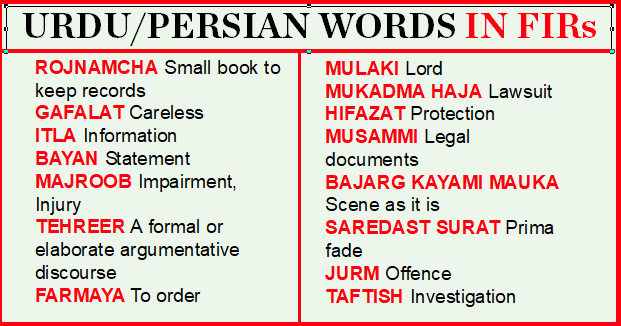
Which is why a circular issued by the Delhi Police caught my attention. Following court directions, they issued directions advising officers to avoid 383 Urdu, Persian, Arabic-origin, and some difficult pronouncing English words in FIRs, diaries, and charge sheets- instead replacing them with supposedly simpler Hindi (or sometimes English) alternatives. The stated aim was to make police documents more accessible.
At first glance, the intention seems reasonable. Legal and administrative language in India can often feel dense and intimidating. Any effort to simplify it deserves consideration.
But the issue is not so straightforward.
What is puzzling is the clubbing of an indigenous language like Urdu with “foreign” imports such as Persian and Arabic. At the same time, the English language-clearly foreign in origin-does not seem to pose a problem.
Perhaps we overlook the irony that even the word ‘police’ comes from Latin (‘politia’), later absorbed into English and normalised over time.
More importantly, what the Delhi Police forgot is that language is not just about substitution-it is about preserving meaning.
Take ‘kanoon’. Replacing it with ‘vidhi’ or ‘niyam’ changes the sense in subtle but important ways. ‘vidhi’ leans towards procedure; ‘niyam’ towards rule. ‘kanoon’ carries a broader, institutional understanding of law that the others do not fully convey.
Then there are cases where no suitable substitute exists, and longer explanations are used by the Delhi Police. ‘Mushteba’ (a suspect) becomes: ‘jis par apradh karne ka shaq ho.’ ‘Jeb tarashi’ (pickpocketing) becomes: ‘jeb se paisa chori karna.’
In other words, theft is limited to money, and one could steal a phone, a wallet, or other belongings as well without inviting a penalty.
It does not end there.’Dastavez’ (a recorded document used as evidence) becomes:’likhit samagri jo pramaan ke roop mein prayog ki jaaye.’ A clear example of what is presented as simplification begins to look confusing.
Some substitutions are technically correct-but unfamiliar in everyday use:
” ‘baar-khilaf’ becomes ‘ke viprit’
” ‘ticket’ becomes ‘pravesh-patra’
” ‘lift’ becomes ‘uhane-wala yantra’
” ‘thana’ becomes ‘prahari kendra’
” ‘daroga’ becomes ‘upnireekshak’
” FIR becomes ‘pratham soochna prativedan’
These expressions may work on paper, but they are not what one hears at a railway station, a police desk, or in an apartment building. They sound constructed rather than lived.
What is being overlooked is that words are not just carriers of meaning-they also carry familiarity, tone, and lived experience. When replacements become longer or unfamiliar, they can reduce clarity instead of improving it.
What also goes unacknowledged in debates around “purifying” language is that linguistic exchange has never been one-way.
India’s linguistic landscape reflects this layered reality. It is shaped by Sanskrit, Persian, Arabic, Turkish, Portuguese, English, and many regional languages-all interacting over centuries.
This mix is not a weakness. It is a sign of continuity and exchange.
Urdu too has immensely benefitted from absorbing words with origin in Sanskrit: Din, Bhai, Aaj, Sunhara, Ghamand, Khulna etc.
Indian languages have also travelled outward. Words like ‘guru’, ‘karma’, ‘mantra’, ‘jungle’, ‘avatar’, ‘bandh’, and ‘loot’ are now part of global English vocabulary.
English itself has also absorbed words from across cultures-Arabic, Persian, Turkish, Latin-and continues to do so even today.
In fact, modern English keeps evolving, constantly adding new expressions shaped by social media, technology, and changing lifestyles. The Cambridge dictionary has added new terms in 2025 like ‘tradwife’, ‘work spouse’, and ‘snackable’ reflect how language keeps adapting to changing contexts.
Language, in that sense, is always in motion. Which is why this discussion is not just about official language or police paperwork. It touches on how language actually functions in everyday life.
Simplifying language is a reasonable goal. But attempting to “purify” it in the manner it has been done may not always serve that purpose.
Our daily speech already offers enough evidence: We take a bus, not a ‘rath’.
We use a passport, not a ‘yatra-patra’.
We click a mouse, not a ‘sanganak chuha’.
When words become too formal or unfamiliar, they can create distance rather than clarity-especially in public-facing systems like policing, where communication needs to be immediate and accessible across diverse groups.
As the Urdu poet Firaq Gorakhpuri observed:
“Har lafz ek taareekh hai.”
“Every word carries a history.” Perhaps that is worth keeping in mind.
So yes, there is a case for making official language clearer and more accessible. But there is also value in recognising which words people already understand and use with ease. Sometimes, the more effective reform lies not in replacing familiar words-but in working with them.
Maybe the better question is not where a word comes from-but whether it works. And if it works-people will use it.
(The author works for reputed Apeejay Education, New Delhi)
 Follow our WhatsApp channel
