

Col Satish Singh Lalotra
slalotra4729@gmail.com
The day of 21 st August 2025 dawned on the national capital, with the date ensuring to etch its name in the artistic endeavours of the sub-continent that was not to be heard or seen earlier.
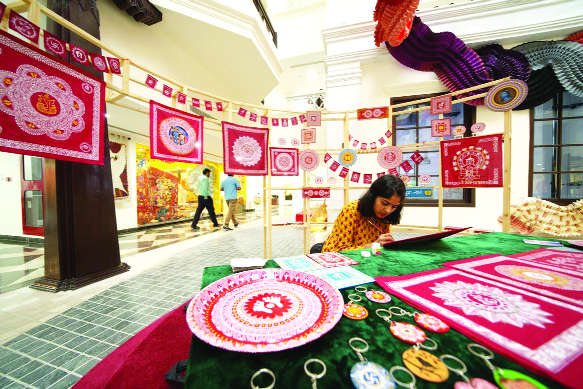
Welcome to ‘The Kunj’ in Vasant Vihar, Delhi -India’s first ever ‘shopping exposition’ dedicated solely to heritage crafts and handlooms that have been exquisitely hand crafted by some of the finest national / State award winning artists from the sub-continent. ‘The Kunj’ is nothing but a one stop institution catering to an intricate mix of hearts and minds which we often forget that it is the hands that bridge the chasm between thoughts and creative expression. These hands weave, spin, write, sculpt, paint and choreograph giving tangible shapes to the beauty of imagination which were never ever brought under one such umbrella, as has been done on 21 st August this year at the national capital. ‘Art appreciation’ seems to be the ‘sine quo non’ and the guiding principle at this new Government run handicrafts complex , where award winners both at the central and state level rub shoulders as well as find the pride of place under the sun in India. ‘The Kunj’ (a grove in Sanskrit) is a name mixing both English and Sanskrit seems deliberate, embodying the re-imagination of the traditional world of arts and crafts in a post truth, post covid, and post internet world.
‘The Kunj’ promises everybody to satiate the palate of artistic flavour drawn from across the grain of the country and holds aloft something for all. Backed by the ministry of textiles and inaugurated by Union Minister Giriraj Singh and MoS Pabitra Marghertia the launch wasn’t just another ribbon cutting in the national capital. It was a loud, unapologetic announcement that India’s artisan heritage finally deserves to stand shoulder to shoulder with luxury fashion houses and brands like Versace, Llardo, Cartier, Bvlgari and others housed at nearby DLF Emporio. This juxtaposition is both ironic and moving-echoing that choosing Indian handmade is to opt for slowness, intention and soul in a market flooded with ultra luxe brands and excess mass products. For decades India has been showcasing its crafts and arts in temporary fairs, ‘Dilli Haat’ style markets or museum corridors.
‘The Kunj’ is the latest offering in a long history of state patronage of traditional craft. Before long Indians had to go to the ‘Central cottage emporium’ in New Delhi for indulgence in matters concerning art & handicrafts. Opened soon after independence in 1947, one could touch and feel a bone-inlay elephant from Jodhpur or marvel at the minutiae in a miniature painting. Though ‘The Kunj’ represents a microcosm of India’s who’s who in arts and handicrafts, the aim of my writing this article was to portray how some areas of India( read Jammu) don’t find at all any mention in the roll of honour or rather blithely passed over. This is a blatant disregard to that area which was once considered as the sword arm of India .Or does New Delhi consider that Jammu region as a whole spanning from the foothills of Shivaliks right till the awe inspiring Pir Panchal mountains don’t have anything worth displaying at ‘The Kunj’ in terms of arts and handicrafts cum paintings? Or is it that only the K-word (Kashmir) will rule the roost even in matters concerning art and handicrafts? Well to put the records straight for the countless countrymen and women visiting this place , I may dare say that Jammu region per se has enough in its recesses to galvanize the people of India by displaying the razzmatazz of art and handicrafts as found from Lakhanpur till Banihal. I have divided this write up of mine in three parts-the first part dealing with some select arts and artifacts as found in the region of Jammu, with the second part dealing the same topic but Pan-india, and lastly what ails the priceless items of Jammu region not finding its pride of place at ‘The Kunj’.
The world renowned painter -‘Nainsukh'( 1710-1778) belongs to that lost genre of Pahari painters of ‘Jasrota’ kingdom of Jammu region whose paintings were a rage all over the world. There have been confirmed reports of his lineage still alive and working in the family workshop based In Guler( HP). An interview/ article explicitly mentions a painter ‘Chandula’ as a descendent of Nainsukh , who was helped with setting up a painting school in Guler ( HP). Films and critical writings also document visits to present day villagers who are treated as descendants/ artistic heirs of Nainsukh. Late BN Goswamy’s return visit and AmitDutta film interviews are a testimony to the living family members of Nainsukh painter the great. What efforts have been made in the past to make sure that his living progeny are given the required heft to paint once again the same magic that found its way at the ‘Victoria & Albert museum’ , London and also at Fogg art museum , Cambridge , Mass . Not only this ,his paintings made all the way to the famed ‘Cleveland museum of art in USA, as well at San Diego museum in the US too. Will ‘The Kunj’ arts and handicrafts at New Delhi not benefit by the paintings of Nainsukh’s progeny if traced and given state patronage and outshine rest of India’s artists by a handsome margin? Similarly, the centuries old rural handicrafts and artifacts like the Peedhas, Binnas( for seating on ground) made in the countless homes of Jammu’s rural landscape not glamorous enough to be displayed at ‘The Kunj’? Unfortunately at the ‘Chinar international’ a space reserved exclusively for Kashmiri art and culture , I happen to speak to MrRaina the caretaker of this space with a straight question– Why Jammu region is not being represented at The Kunj? He was speechless. I happen to see a raft of premium, hand knotted carpets, and rugs showcasing a rich tapestry of Kashmiri craftsmanship. The place had an exclusive space earmarked for Ladakh, Himachal Pradesh, Uttrakahand and even Nagaland all clubbed under one roof . So why not Jammu’s artifacts and world renowned Pahari paintings?
Anyway as mentioned by me above, I shall dwell upon this puzzle later at the end of this write up. Now how ‘The Kunj’ is different from country’s other arts & crafts centers, the likes of which are a passé nowadays? ‘The Kunj’ is not a passé for the under mentioned USPs with which it is identified —
* Over 20 curated crafts-from Mahaeswari, Pashmina, lkat, chanderi, Kalamkari, Madhubani, Tanjore paintings , bamboo crafts and stone inlays -are now positioned as premium cultural assets and not just dusty souvenirs.
* National award winning masterpieces are displayed as collectible art, finally breaking the myth that handloom and handicrafts are for ‘daily wear’
* Immersive installations and live demos allow visitors to see the making process -the sweat, patience, and artistry that too in the heart of Delhi; justifying their exorbitant price tag lines.
* Hands on workshops let customers engage with artisans directly , dismantling the wall between ‘luxury consumer’ and heritage creator.
* The economic & cultural shockwave that it has sent has stymied counterfeit markets peddling fake pashminas, poly khadi etc robbing artisans of their income.
* Declining generational interest among artisan’s children who see weaving and craft wood as low income , low respect professions has been put a stop to a large extent by such centers in the national capital.
* The ‘premiumization of art and culture’ by ‘The Kunj’ has done two vital things-firstly it has raised global perception of Indian art and culture as never seen before, and secondly it has helped raise ‘artisan dignity’.
Coming back to my brief sojourn with this art center in VasantKunj, there is ‘Karigarsangam’ , a hall where objets d’ art are exhibited alongside descriptive cards that bear the name of the artisans, shilpa gurus, and master artisans totaling more than 100 with their phone numbers , making it easier for the customers/ brands to reach them. Now imagine if the descendants of ‘Nainsukh’ the world class painter from Jasrota/ Jammu have their art objects & paintings named and numbered with their phone numbers tagged along, what tectonic effect it will have on the overall spectrum of Jammu’s arts & handicrafts? It is beyond comprehension simple as that. The entire area of ‘Kunj’ is divided into two floors with the ground floor occupying max space , since over here the live artisans undertake their job of crafting their work with their nimble fingers and deft movements. Bearing the tag line-‘Handmade in India, crafted for the world’ Kunj has masterpieces from Gujarat with ‘Sadeli art’ rivaling the most ornate Persian trinket boxes, the ‘Seep Mahalhaar’ from Jaipur crafted from pearls , pure silver, Zarkan, and adorned to perfection and so on. A living anthology of India’s craft legacies, at ‘MeMeraki’ towering scrolls of Madhubani , Pichwai and Pattachitra paintings add a dash of colour to the walls of this center.
Kitchenware brand P-Tal’s glistening brass and copperware utensils revive the ‘Thathera art’ legacy that was once nurtured under the royal patronage of Maharaja Ranjitsingh. For those who want to learn about these time tested crafts, the ‘KalpKoshis the corner to head for. Right from the lexicon to the intricacies of these crafts have been chronicled in a manner that speaks for itself. Though this write up of mine will fall short of words and letters to chronicle all that Indian artisans have put in over there for us to see and experience, the best tribute would be to have a look see about the place for yourself. Coming back to my question of why Jammu & its artifacts have not been showcased at ‘The Kunj’ , when even places as remote as Nagaland have their pride of place reserved at the newly inaugurated arts center. Well, much goes to the lackadaisical / partial attitude of the UT Govt and the ‘J&K Academy of Arts Culture & Languages (JKAACL) the apex body of the erstwhile state to promote only Kashmiri arts and artisans at the cost of Jammu arts & artisans. The Kunj is more than an arts exposition, it’s a monument to memory , skill and survival. If it succeeds, it can become the prototype of familiar hubs across India. But for now, it is clear—‘your heritage is not your craft-its currency’.
(The writer is a retired Army Officer)
 Follow our WhatsApp channel
