

Satbir Singh ‘Kapoor’
ersatbirsinghkapoor@gmail.com
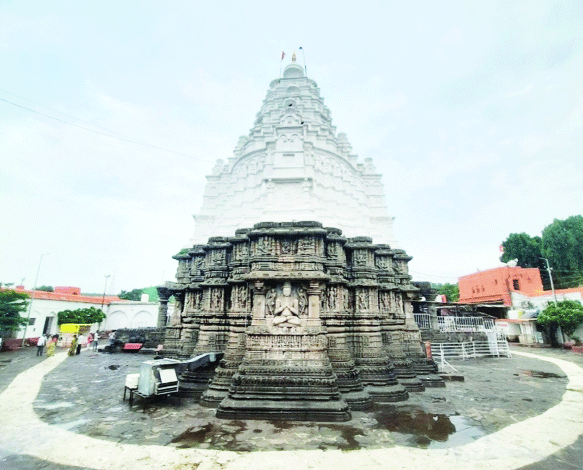
Aundha Nagnath Temple is one of the twelve Jyotirlingas (specifically 8th one) located in Hingoli district of Maharashtra. It is dedicated to Lord Shiva who is worshipped as Lord Nagnath in this region. The name Nagnath Signifies Shiva as ‘Lord of serpents’. This ancient temple is a sacred pilgrimage site where lakhs of devotees both Hindus and Sikhs visit every year to seek blessings of Lord Shiva. The temple is renowned for its rich history, spiritual significance and divine blessings. It is strong belief among devotees that worshipping here provides relief from Kalsarp Dosh and Pitru Dosh.
Legend has it that this temple was originally built by Yudhishthira, the eldest son of the Pandavas during their exile, placing its origin in the epic era of Mahabharata. Over the centuries, the temple has seen periods of grandeur and destruction. This temple has explicit carvings. This temple is a unique blend of Hemadpanti and Maratha style of architecture and is situated in about 60,000 square foot area.
Every year a large number of pilgrims visit this temple on Mahashivaratri and Vijayadashami. The current edifice of the temple is thought to have been built in 13th century under the rule of Yadava dynasty. It is also said that Mughal Emperor Aurangzeb attempted to demolish the temple; however, his efforts were thwarted when a swarm of bees attacked his soldiers, prompting him to abandon the endeavour. Despite this, some damage was inflicted upon some temple part. Subsequently, Rani Ahalyabai Holkar, the Queen of Maratha Malwa Kingdom, undertook the restoration and renovation of the temple. She under took the reconstruction of the upper portion, including the Shikhara (spire), which now exhibits a distinct Maratha Architecture style.
This holy place is special to both the communities Hindus and Sikhs. For Hindus, it is revered as eighth Jyotirlinga, where Lord Shiva is worshipped as Nagnath. For, Sikhs this place is associated with Sant Namdev, a revered saint whose 61 hymns are included in Holy Guru Granth Sahib. It is said once Namdev went to Aundha Nagnath Temple, he sat and started worshipping God but the priests grabbed his arm and drove him out of the temple. The priests said that Namdev should not enter temple to worship God as he was of low caste.
Namdev was deeply hurt, so he went to the back of the temple and started worshipping God. In his prayer, he said “O Lord, I joyfully came but I was driven out of your temple as I was born in family of low social caste, O Lord Why was I born in a family of fabric dyers? What is my fault in this? O Lord Please do not forget me. Because if you forget me, then where should I go? Calling me of low caste and untouchable, temple priests beat me and drove me out. What should I do now? O Lord If you give me salvation after my death, no one will know that I attain salvation. These priests call me of low birth, while they say this, they tarnish your honour as well. You are called kind and compassionate, kindly save my honour my lord” Pleased by his intense devotion. Lord Shiva is said to have miraculously rotated the entire temple to face Namdev, turning its back to the priests. Devotees point out to the temple’s unusual layout as proof of this event. Unlike most Shiva temples, where the Nandi (sacred bull) Statue faces the entrance, at Aundha Nagnath it is located at back of the temple. This architectural anomaly is central feature of temple with Nandi placed in a separate pavilion located behind the main structure. While most Hindu temples face East, Aundha Nagnath is a West facing temple. The founder of Sikhism Guru Nanak Dev ji is said to have visited this temple when He travelled this area.
I was fortunate to visit the temple few years back and was surprised to experience a unique blend of spirituality and history along with serene atmosphere perfect for introspection and connection with the divine.
The temple’s unique West facing orientation and Saint Namdev’s story emphasize inclusivity and devotion over rituals. It is a reminder that true spirituality is about heart and intention, not just external practises. The temple’s architecture and surroundings amplify this message, creating a space for spiritual connection.
In a way, the temple becomes a bridge connecting both faiths in a shared Spiritual quest. The Aunda Nagnath Temple foster a sense of universal community and shared spiritual heritage. It illustrates how devotion resonates across both Hindu and Sikh traditions by transcending geographical social and religious boundaries.
(The author is an Executive Engineer REW Kishtwar)
 Follow our WhatsApp channel
