

Chanakya Charan Dass “Tikri”
Maharaja Hari Singh, the erstwhile sovereign of JandK is under political scrutiny yet again, especially with respect to the events on July 13, 1931.
He ascended to the throne of J&K in 1925 after the death of his uncle, Maharaja Pratap Singh. The Dogra rulers though sovereign were always under the scrutiny of the British. The posting of British Resident in J&K was essentially to keep a tab on the King and exercise control over him in taking major decisions so that they were generally in line with the British policy.
However, these were tumultuous times. The first world war had ended in November 1918 after the defeat of the Axis Powers and victory for the Allies. Ottoman Empire had dissolved and Turkey emerged, creating quite a disquiet amongst the Muslims of India who were psychologically attached to the Ottomans. Russia too had had its own revolution and the monarchy had come to a bloody end paving the way for the communist rule.
A new world order was taking shape!!
India was craving for independence from the British. The idea of Dominion Status was rejected.Mahatma Gandhi had started the Civil Disobedience Movement in the country against the British which was triggered by the imposition ofsalt tax by them. The movement had energized the Indian masses no end. Mohmmad Ali Jinnah had also become a leader of the Muslim League.
During this period quite a few Muslim young men from Kashmir returned to their native place after completing their education at Aligarh Muslim University. They were abreast of the happenings in the world. They also craved for a decent place for their Muslim brethren in Kashmir. To say that they were not impacted by the undercurrents, rather waves, of the Muslim nationalism flowing in the country would be betraying one’s own wisdom. After all the founder of Aligarh Muslim University, Sir Syed Ahmed Khan, had said in no uncertain terms that Hindus and Muslims are two Nationsand those who had ruled India for centuries couldn’t be expected to beruled by the Hindusunder a democratic setup or otherwise. Afterall, how could the rulers of the yore possibly be converted into “subjects” through a ballot box?!
It is during these tumultuous times that Sheikh Mohammad Abdullah returned to Kashmir from Aligarh Muslim University. He had a towering personality and was a mesmerizing orator. He could quote as easily from the Holy Quran as he would quote Dr. Muhammad Iqbal in his public speeches. He was able to sway the audience into frenzy with a little”twist and turn of his tongue” or the brush of his hand during a public speech.
Earlier Maharaja Pratap Singh and now Maharaja Hari Singh had already initiated some important steps towards reforms in the governance, but they were slow while the young Kashmiri, the Sheikh, was in a hurry buoyed by the happenings in the world and in the rest of the country. Politics, always a game – dirty if you like, was also playing out very swiftly and seamlessly. Sheikh Abdullah had already started a Fateh Kadal Reading Room (Party), after permission from the Maharaja’s government, where the young, educated Muslim youth of Kashmir would gather and exchange notes on the current politics and also delve on methods to improve the lot of the Kashmiri Muslims. Muslim Conference/National Conference were yet to be born.
It must also be mentioned here that the Maharaja’s government was not anti-Muslim. Even his detractors have never accused him of being anti-Muslim.But being a Hindu King in a Muslim majority state had its own pitfalls and these pitfalls were galore. The Sheikh exploited them for furthering his own interests. He exploited them later too, after the subcontinent was divided and JL Nehru, the PM,always failed to understand his game of chess.
At the 1st Round Table Conference in London in 1930, Maharaja Hari Singh as the leading light of the Chamber of Indian princes had earned the ire of the British as he spoke as a Nationalist Indian to the gathering at the meeting. He declared himself “Indian first and Indian last” and demanded equality, honour, and freedom for India and its people. He said that as Indians and loyal to the land whence we derive our birth and infant nurture, we stand as solidly as the rest of our countrymen for our land’s enjoyment of a position of honour and equality in the British Commonwealth of Nation.
And there he was!This was to the utter dislike of the British!
The British brought to Kashmir a person named Abdul Qadir who was working as a cook for a British Army officer who was visiting Kashmir, probably on aholiday. Whether he was a cook or not, but he was a rabble rouser and “instigator in chief.” It is believed that either he was from Swat or Peshawar, but the fact remains that he was not a Kashmiri.
He mysteriously appeared in front of Khanqah-e-Maula and addressed a huge gathering of Muslims a few weeks short of 13th July. His address is recorded briefly by Rashid Taseer in his book “Tarikh-e-Hurriyat” as under:
“Muslim brothers: the time has now come when we should meet force by great force to put an end to the tyrannies and brutalities to which you are subjected, nor will they solve the issue of disrespect to Holy Quran to your satisfaction. You must rely up on your own strength and wage a relentless war against oppression, “pointing his finger towards the palace (in all likelihood the fort atop Hari Parbat as the Kings palace wouldn’t have been visible from the Khanqah), he thundered: Raze it to the ground”. He said, “We have no machine guns. But we have plenty of stones and brickbats”. He also expressed annoyance on ban on cow slaughter and exhorted the crowd to revolt against the King. Obviously, he was arrested.
On 13th of July 1931 Ghulam Qadir was to be tried in the court established in the Central Jail Srinagar, a safer place, as Srinagar continued to be disturbed after his arrest. In the unfortunate incidents that followed, the gates of the jail were broken by the massive crowds and firing had to be ordered by the magistrate to bring things under control. This unfortunate incident resulted in killings of 22 people.
As if this was not grisly enough the enraged crowds ran amuck and took their revenge on the hapless Hindus.
A report in the Tribune News Paper of July 18, 1931, reads as under:
“The mischief- mongers, realising that all the forces were centered around the Central Jail, a place 3 miles away from the city, decided upon raiding the houses and shops of the Hindus in the city. There seemed to be well organised conspiracy behind all this….About 6000 Mohammedans raided Maharaj Gunj, looting and plundering the Hindus of that vicinity. Then followed harrowing scenes of incendiarism. No military or police aid reached those quarters for full 2 hours during which hundreds of Hindus were looted and hundreds were injured with lathis and stones and incalculable damage was caused to Hindu’s property. Visitors were also not spared; they were severely belaboured and everything even their shoes and turbans were removed from their person….Children, while returning from their schools, are reported to have been picked up and hurled in the river Jehlum. Hindu women were insulted and maltreated.” Looting & mayhem was also reported from Vicharnag.
Maharaj Ganj was the main commercial hub of that time where several Kashmiri Hindus and also Khatri Hindus from Punjab owned their shops and business establishments.
Surprisingly, Abdul Qadir vanished from Srinagar as superstitiously as he had arrived. Was he sent to Kashmir to create disturbances under a plan?
What happened after 1931 up to the signing of the Instrument of Accession by Maharaja Hari Singh on 26th Oct 1947 is well known. India got divided, the State of J&K of Maharaja Gulab Singh got dismantled; first when some of the territories were snatched by Pakistan in the war of 1947/48 & later by China up to 1962. The story of occupation of Gilgit Baltistan, that was part of the territory ruled by the Dogra rulers, by Pakistan is a different tale of deceit and tragedy.
The fact remains that the happenings of 13th July 1931 brought Sheikh Mohammad Abdullah to the fore & he eventually consolidated his position firmly in the politics of J&K. Overtime,he virtuallybecame the Maharaja of J&K, in power and even out of it. Whether you liked him or not he could not be wished away till his death on 8th September 1982. However, did he lap up a nondescript,non-Kashmiri “rabble-rouser” to create mayhem on the streets of Srinagar?
This question remains unanswered!!
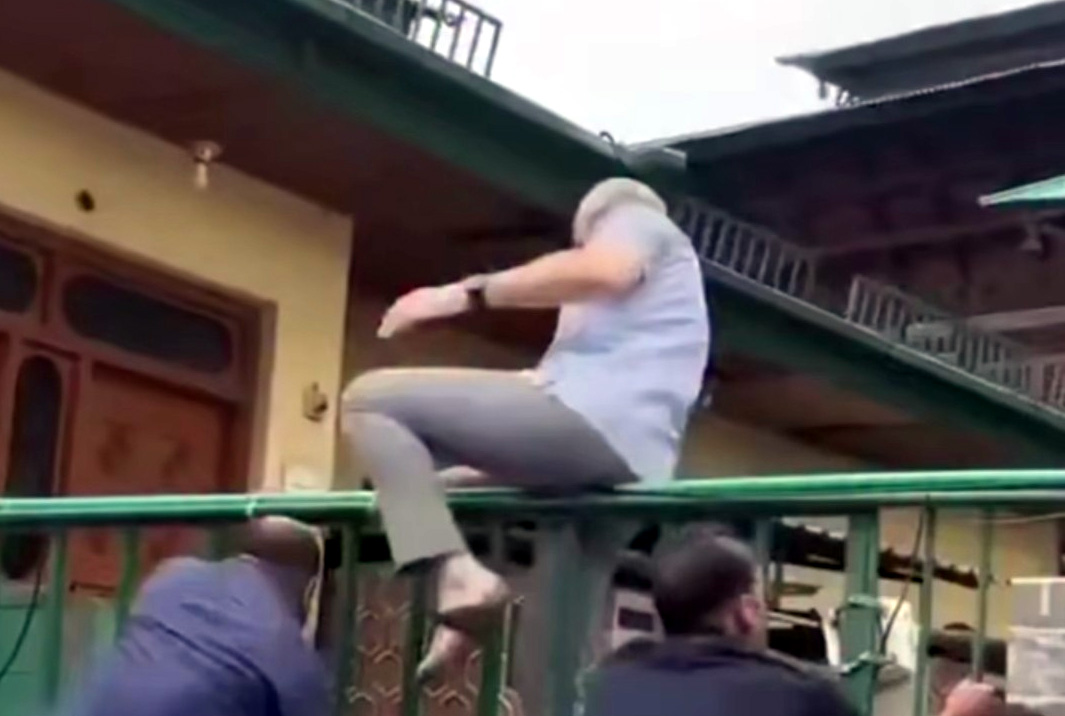
Omar Abdullah climbed over the fencing to reach Mazar-e-Shuda in Srinagar on 14th July 2025. The Dy Chief Minister, Surinder Choudhary could be seen awestruckby this act of the CM. Other National Conference leaders including Dr. Farooq Abdullah also reached there in time for the Fateh Khani.
That is good enough. The dead should be respected and prayed for, without any doubt; but what about the Hindus in Kashmir who lost their lives on that unfortunate day?
Why is it that Hindus in Kashmir must face and have always faced the brunt of the annoyance of the Kashmiri Muslims with the ruling dispensation? In 1989/90 the Hindus were expelled from Kashmir because the Muslim majority had its differences with the Central Government. When there was no fig leaf left to hide their complicity the Kashmiri political parties and politicians promptly tried to blame it on Pakistan and the Late Governor Jagmohan!! True, Pakistan was the flame of terror, but what about the wick?! If there was no wick there would have been no flame!!
In 1931 there was no “Central Government” like we have today nor was there anyone like “Late Jagmohan”. What is it that compelled the local population to vent their annoyance with the rule of the Maharaja on the hapless Hindu minority? Were the shopkeepers in Maharaj Ganj representatives of Maharaja Hari Singh or did they have any say in the decision-making process of the then Government? Did the tortured and disrespected Hindu women and their children have any say in the governance of the J&K state? What had Vichar Nag and the nearby temple to do with the Maharaja’s governance?
This is a question that not only Omar Abdullah needs to ponder over, but also Surinder Choudhary? They should also ponder over the question as to when shall they build a memorial for all those Hindus killed during the riots of 1931? When will they ensure that there are no “Abdul Qadirs” and protectors of people like him in J&K?
Recently the LG of the UT of J&K, Manoj Sinha, took responsibility for the unfortunate terror killings in Pahalgam. He was as candid as an administrator could be. It is probably for the first time that any administrator/politician has taken responsibility publicly for such a gruesome happening. Omar Abdullah was quick to appreciate it. However, who will take responsibility for the happenings in J&K since 1947 generally and between 1989/90 and the present, particularly?
Jumping over the fence of Mazar-e-Shuda is just not enough!!
 Follow our WhatsApp channel
