

Excelsior Correspondent
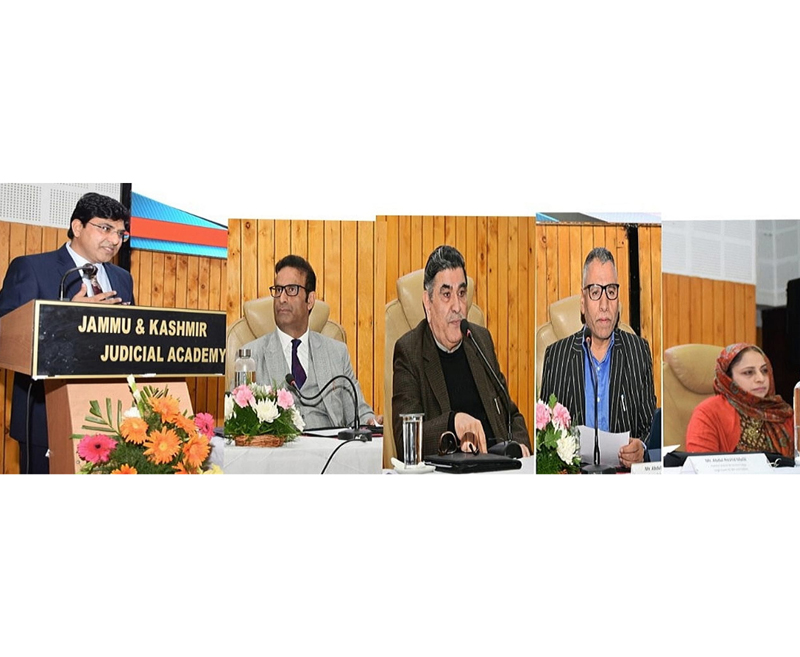
SRINAGAR, Apr 4: Under the patronage of Justice Arun Palli, Chief Justice, High Court of Jammu & Kashmir and Ladakh (Patron-in-Chief, J&K Judicial Academy) and under the guidance of the Chairperson and Members of the Governing Committee of the J&K Judicial Academy, a one-day training programme on “Role and Responsibilities of Trial Judges in Ensuring Just, Fair and Speedy Trial (as guaranteed under Article 21 of the Constitution of India)” was successfully conducted for Judicial Officers of the Kashmir province.
Justice Shahzad Azeem, in his inaugural address, highlighted the pivotal role of trial courts in the justice delivery system, observing that they serve as the first point of interaction between citizens and the judiciary, where facts are established, evidence is tested, and rights are ultimately adjudicated.
He emphasized that while the maxim “justice delayed is justice denied” remains significant, equal caution must be exercised to ensure that “justice hurried is justice buried.” He stressed that the real challenge before trial judges lies in maintaining a delicate balance between expedition and fairness.
Describing the role of Judicial Officers as a “sacred trusteeship,” he called upon them to act as reformers by embracing technology, minimizing delays, and upholding the principles of fairness, efficiency, and human dignity in the administration of justice.
Naseer Ahmad Dar, Director, J&K Judicial Academy, in his welcome and introductory address, underscored that the theme of the programme lies at the very core of the constitutional guarantee under Article 21 of the Constitution of India. He highlighted that trial courts form the foundation of the justice delivery system and that trial judges play a crucial role in ensuring that the promise of a just, fair, and speedy trial is meaningfully realized in every courtroom.
He further informed that the programme had been specifically designed in light of the guidance of Justice Rahul Bharti, with particular focus on Judicial Officers who have joined service without prior practice at the Bar.
The first technical session on “Constitutional Mandate and Foundations (Fair Trial under Article 21 of the Constitution of India)” was delivered by Dr Syed AsimaRefai, Faculty Member, Department of Law, University of Kashmir.
The second session, conducted by Abdul Rashid Malik, Former District & Sessions Judge, High Court of J&K and Ladakh, focused on “Practical Challenges before Trial Courts.”
The third and concluding session was delivered by Justice B A Kirmani, Former Judge, High Court of J&K and Ladakh, on “Judicial Conduct, Ethics and Best Practices.” He emphasized that constitutional principles serve as a unifying framework ensuring consistency, objectivity, and integrity in the administration of justice.
The programme concluded with an interactive session and feedback, wherein participants actively engaged with the resource persons, sharing practical experiences and discussing challenges faced in trial courts.
 Follow our WhatsApp channel
