

Jagmohan Sharma
J&K’s tryst with electricity started in 1905 when Mohura hydro powerhouse was constructed on River Jhelum during the reign of Maharaja Pratap Singh with a capacity of around4 MW. A smaller power house with a capacity of 1 MW was also built near the present-day Bhagwati Nagar on the Ranbir Canal in 1910.
Today we have several hydro power generating stations in the UT along with a complex network of transmission and distribution along with associated grid stations, receiving stations and distribution sub-stations. The transmission network is inter-state/UT as well as intra-UT.
Today power transmission and distribution network has come a long way in J&K. As believed generally this network is not limited to towers, poles, conductor, transformers and transformer oil, but has turned very complex with the advent of automation (SCADA),Unified Load Dispatch and Communications (ULDC) systems, data centres etc. J&K’s grid is also integrated with the national grid. In one sense our system is “hardwired and softwired” to the National Grid. In J&K automation and ULDC have presently been “superficially leveraged” for operation of the networks.
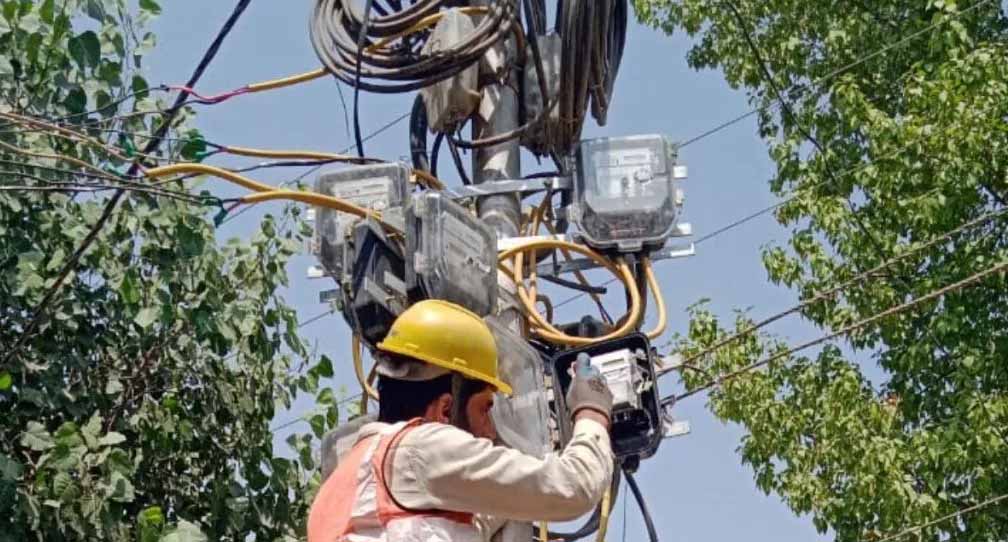
Smart metering at various levels such as 11 KV feeder, distribution transformer and consumer end is a new and completely specialised domain. Data from lakhs of smart meters is being monitored and analysed regularly for achieving optimal results and reducing AT and C losses. This is still a work in progress.
Metering for industries, commercial electricity consumers and agriculture is a different ball game. Provision of subsidies to the needy is another critical area for the power utilities. Even for extending subsidies to the BPL consumers their premises needs to be metered to know the quantum of energy consumed by the individuals.
Indian Railways, which is expected to start train service to Baramulla in the Valley from Delhi very soon shall also be looking for a reliable and quality power supply from J&K power utilities.
Complexity of the J&K power sector, as also of the rest of the country, is increasing exponentially with the advent of renewable energy. PM’s Surya Ghar Muft Bijli Yojna and the KUSUM schemes have the potential of being a game changer for the power sector in J&K.
Renewable energy also brings in its own complexities for operation of the grid. More the complexity in the system, more is the need for real time data for grid management. Same is true for J&K.
Greater the integration of various elements of the grid through communication and allied systems, the more is the necessity of keeping these networks secure from the cyber-attacks and vulnerabilities.
Power system engineers, additionally, face the humongous task of keeping the legacy equipment functional on the one hand and also managing the sophisticated microprocessor-based equipment and many more complex systems on the other. Therefore, there is a need for engineers and technicians who can handle equipment of diverse kinds and yet ensure quality 24×7 power supply to the consumers of electricity.
Additionally, the protection system(relays, digital fault recorders, sequence of event loggers, fault analysing equipment) deployed for protection of the network from faults and analysis have to be configured and tested periodically, as per norms, for their fidelity. Same is true for the electrical equipment installed in various grid and substations which need to be tested as part of predictive and preventive maintenance as per a specified schedule.
As can be seen from above the power sector has dimensions and nuances that generally escape the eyes of the administrators and consumers. These dimensions and nuances are very complex. Handling such a complex system also calls for engineers and technicians with specialised skill sets. The personnel used to erect poles and towers and working on conventional systems will not be able to operate the newly introduced state-of-the-art technology.
These systems can’t be handled by “mistries” but should be handled by trained/skilled engineers, who are ready to work “hands-on” on the new systems.
Let’s now try to understand where the power utilities of J&K stand today in context of the above:
In J&K the Power Development Department (PDD) was reorganised in 1988/89 and several Divisions and Sub-Divisions were created/reorganized to operate and maintain the existing assets and infrastructure. Consequent to the reorganisation, manpower requirement at several levels was redefined. Therein came the concept of “sanctioned posts” that various stakeholders in J&K speak about. So, the posts for PDD were “sanctioned” in 1988/89 to operate and maintain the existing network and build new infrastructure.
In 2019 the PDD was “unbundled” and two distribution and one transmission companies were created and assets transferred to these utilities. As the name suggests Jammu Power Distribution Corporation(JPDCL)and Kashmir Power Distribution Corporation (KPDCL) were mandated to distribute/supply electricity to the consumers in the two respective provinces and also upgrade, strengthen and augment the system as per the requirement/policy. JKPCL (Jammu Kashmir Power Corporation) was also created with the mandate to purchase power for J&K and Ladakh. This was designated as the holding company for all the power utilities under PDD. JKSPDC (Jammu and Kashmir State Power Development Corporation – the generation utility) was already a functional company under the umbrella of PDD.
The manpower existing with PDD was posted on deputation to these utilities maintaining their lien with PDD. This was done to ensure that their service conditions remained unaltered.
A look at the capacity addition of various components in the power sector in J&K since 1988/89 will reveal that the number of distribution substations has increased by around 2500%, receiving stations by around 1500%, 33 KV and 66 KV lines by around 1100%, 11 KV lines by 1500%and LT lines by 950%.
In the transmission network the number of grid stations has increased by 650% and transmission lines by around 300%.
In fact, even after 2019 several of the components of the power sector have increased by 80 to 90%because of massive investment by the GoI in power sector in J&K.
But what about the human resource? To be more precise – what about the manpower that would be able to take up the challenges posed by the expansion in power sector and handle the new technologies?
There has been no recruitment in PDD for quite some decades now. In fact, manpower has dwindled because of retirements of several employees progressively over the years. Thus, on one hand while the assets and complexities in power sector have exponentially increased, the manpower managing it has dwindled. The result is that engineers at several levels are handling volume of work that is sometimes 3 to 5 times more than the work they normally do. This is having an all-round negative impact on the services being provided by the utilities.
The state-of-the-art technology inducted into the system to bring in responsibility, transparency and efficiency has largely remained unutilized because the skilled manpower for handling the technology is not available. Candidly speaking the funds being spent upon new technology are simply being wasted.
In 2019 the Govt. of J&K constituted two committees under the Chairmanship of Er. Avinash Dubey and Er. Javed Yousuf Dar, then DCP and CE, PDD respectively. These reports were comprehensive and detailed the requirement of not only reorganisation within the newly formed power utilities, but also reorganisation of territories of Circles, Divisions and Sub-Divisions to make them geo-economically viable/efficient.
A few ofthe examples of “geographical abundance” in jurisdiction from Jammu region areas under:
* One of the Sub Transmission Divisions has an unimaginable territorial jurisdiction from Nagrota to Jourian.
* A newly commissioned220/66 KV grid stations in Kathua has its maintenance stores in Jammu.
* The transmission lines in JKPTCL are haphazardly distributed amongst the Divisions without any consideration for geographical contiguity of the Divisions and the assets. No attention has been paid to reorganize the jurisdiction of the Divisions so that the lines could be operated/maintained more efficiently.
Er. Avinash Dubey and Er. Javed Yousuf Dar committee reports try to address this as well as other such anomalies. The committees also specify in detail the manpower required for managing the new power utilities.
These reports also try to project a trajectory of reduction of AT and C loss. They also try to address the issues related to daily wagers in power utilities. The reports also mention the need of outsourcing some of the activities in the power utilities. It must have been envisaged by the committee members that at some stage there will be requirement of bringing in expertise from outside the department, especially in areas where the power utilities are not adequately equipped.
Today, with the induction of smart meters the concept of AT and C losses has taken a different dimension and similarly with the induction of SCADA at the grid station and receiving station level and induction of GIS stations in distribution the playing field in power sector is continuously changing.
It is high time that the Er. Avinash Dubey and Er. Javed Yousuf Dar reports are revisited. The reports will have to be reviewed so that the additional assets and the new technologies that have been adapted after 2019 at grid and receiving station level are taken care of and manpower model for the utilities accordingly worked out. With substantial changes that have taken place in the power sector in J&K the old template is just not adequate.
It would be in fitness of things that the core electrical sector functionalities in the utilities are defined by PDD. These areas may be assigned to the regular employees of the power utilities. While as all the other activities, that are of repetitive nature viz testing commissioning of relays and other such equipment (switch yard equipment included), maintenance of SCADA, SLDC and associated systems,(even pruning of trees for maintaining electrical clearances)may be outsourced through a well-defined tendering process with reasonably stringent qualifying requirement and well laid out norms. The contractors of the outsourced activities must have their own manpower and tools/plant including safety equipment, based in well-defined locations under various Divisions/Sub-Divisions. The testing and maintenance protocol should be well defined with proper oversite and responsibility of the engineers from the power utilities. The present system of rate contract should be done away with as it is neither adequate for the present nor does it hold any hope for the future.
Since Distribution, Transmission and Generation are specializations in their own right as such the inter-utility transfer of staff should be stopped so that the staff acquires expertise in the specific field.
And finally, the power utilities should be truly corporatized with well-defined structure and financial powers. The revenue earned by them should be used by the distribution companies for purchases of power, maintenance of their assets, paying transmission charges (including to JKPTCL), operation and maintenance of their assets. The government, obviously, will need to handhold them by bridging the deficit till the time they became financially independent. The financial transactions should get truly and religiously reflected in the quarterly, six monthly and yearly financial statements of the utilities.
In short, the way ahead for the power utilities lies in having adequate and skilled manpower (employees + outsourced) manning various operational areas and restructuring of the power companies to meet the challenges ahead. It may be understood that the high at and c losses in power utilities are as bad as having inadequte and unskilled manpower.
And finally, the distribution companies should invest in enforcement to curb AT and C losses and if none of above works then privatisation of distribution companies is the only way out with the staff being posted to transmission and generation companies where there is dearth of staff anyway.
 Follow our WhatsApp channel
