

Dr Dharam C. Attri
dharam@iust.ac.in
The Union Territory of Jammu and Kashmir (J&K) possesses a silent, yet immensely powerful, competitive edge in the global bio-economy, its unique status as a biodiversity hotspot for Medicinal and Aromatic Plants (MAPs). The region is home to over 1100 known species of significant therapeutic and commercial value, placing it at a critical juncture to capitalise on a robust global market that exceeds Rs 2 lakh Crore, with India’s national market alone estimated at Rs10,000 Crore. Global demand for raw botanical materials is increasing rapidly, projected to grow at a rate of 15% to 25% annually, assuring sustained market security for high-quality produce.
Yet, this ecological wealth presents a profound economic paradox. Administrative assessments revealed that the MAP sector currently generates a minimal annual revenue of just Rs 12 Crore. This startling figure underscores a systemic failure to capture the intrinsic value of its resources, suggesting that value addition such as extraction, refining, and processing is predominantly occurring outside the Union Territory. Recently by recognising the urgent need for reform, under HADP, the Government of J&K is adopting a science-driven MAP cultivation strategy to generate Rs 74.76 crore by 2027, by establishing 28 clusters, training over 5,300 farmers, and strengthening market linkages.
The National Medicinal Plants Board (NMPB), Ministry of AYUSH, is spearheading a comprehensive transformation of India’s Medicinal and Aromatic Plants (MAPs) sector through its flagship Central Sector Scheme. Aimed at positioning India as a global leader in herbal resources, the board provides dedicated financial support for the conservation of endangered species, the establishment of high quality nurseries, and the development of post-harvest infrastructure like drying and storage units. To empower farmers and entrepreneurs, the NMPB facilitates direct market linkages via the e-CHARAK digital portal and offers substantial cultivation subsidies ranging from 30% to 75% under the National Ayush Mission. By integrating cutting-edge research with traditional wisdom and promoting herbal gardens in schools and homes, the NMPB is ensuring a sustainable, quality-driven supply chain that benefits both local growers and the global AYUSH industry.
Recently, the high-level interventions of Chief Secretary indicate that the Government has begun to recognise the urgency of this situation. The chief secretary has clearly issued the instructions to the Forest, Agriculture Production and allied departments to pursue a coordinated, science-driven and commercially viable strategy for scaling up of MAP sector in the Union Territory. Emphasising convergence rather than fragmented schemes, he has called for area-specific cultivation plans based on agro-climatic suitability, the use of forest land for demonstration and training, the development of district-level model herbal gardens, and the creation of clusters that integrate cultivation, processing and market access. Importantly, he has underscored the need for decentralised value-addition facilities so that economic value is retained locally rather than leaking out through raw material trade.
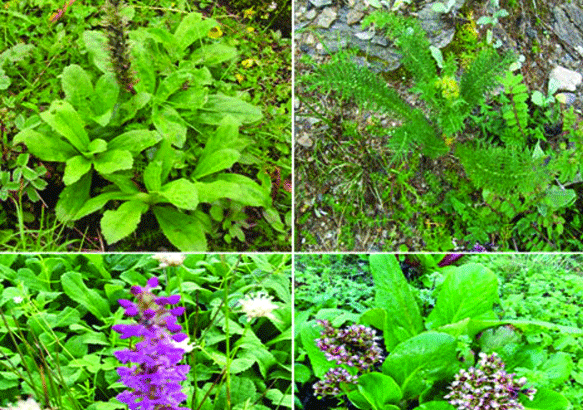
The true complexity of scaling the MAP sector lies in the high-altitude, difficult to access regions that yield some of the high value endemic species, such as Dactylorhiza hatazirea, Picrorhiza kurroa, Aconitum spp., Saussurea costus, and Podophyllum hexandrum, etc. These areas face a confluence of environmental and structural constraints. The short, often unpredictable growing seasons, coupled with harsh winters, severely limit agricultural viability. Climate change exacerbates this unpredictability, forcing forest dwellers to rely increasingly on the picking of medicinal plants during the narrow farming window as their income source. This concentrated, often unregulated pressure is driving biodiversity loss, threatening critically endangered endemic plants, including Arnebia benthamii, Saussurea costus, Gentiana kurroo, Lilium polyphyllum, Aconitum spps., Picrorhiza kurroa and Trillium govanium, etc. The shift to cultivation is urgent, as it provides a controlled source of raw material, thereby reducing the massive anthropogenic pressure on wild populations.
Several high-altitude regions of Jammu and Kashmir are well suited for the cultivation of high-value medicinal plants, including Gulmarg, Pahalgam, Sonamarg, Gurez Valley, Bangus Valley, Doodhpathri, Yusmarg, Machil Valley, Lolab Valley, Bhaderwah, Padder, Patnitop-Sanasar, Saojhdar, the upper reaches of Dudu-Basantgarh, Banni, Basholi, and the Poonch-Rajouri region, provides the favourable agro-climatic conditions.
The logistics of moving bulky raw produce across the region’s rough, high-altitude terrain are exceptionally challenging. This barrier leads to significant post-harvest losses and high transport costs. This forces farmers to sell unprocessed, low-value material to local collectors. The medicinal plant marketing system in J&K is highly unregulated and unfair, lacking authoritative control. This structural weakness is exploited by middlemen and brokers who create information asymmetry and engage in price discrimination, preventing small-scale farmers from receiving a fair price and discouraging them from investing in high-quality cultivation.
The roadmap for J&K must incorporate successful policy models from neighbouring Himalayan states (viz., Himachal Pradesh and Uttarakhand) and integrate modern technology to overcome physical constraints.
Both of these states offer a crucial lesson through its implementation of Access and Benefit Sharing (ABS) mechanisms. By enforcing the Biological Diversity Act, they ensure that industries accessing bio-resources contribute revenue to the State Biodiversity Fund. This revenue, generated by regulating previously unrecorded trade, is then channelled into conservation and supporting the cultivation of endangered, high-value species like Picrorhiza kurroa (Kutki). J&K must swiftly adopt a similar rigorous ABS framework to create a self-funding mechanism for its own conservation and cultivation efforts.
The most potent strategy against high-altitude logistics is transforming the raw material into concentrated, high-value extracts immediately after harvest. The immediate post-harvest distillation of aromatic crops drastically reduces the bulk and perishability of the material, mitigating reliance on expensive transport and cold chains. This decentralized network of processing facilities, managed by farmer groups, is vital for retaining maximum economic value within the Union Territory.
The success of J&K’s pivot rests entirely on resolving the contradiction between high potential and institutional friction. To fully unlock the Rs 10,000 Crore opportunity, the following steps, derived from best practices and identified needs, are suggested:
The State Biodiversity Council/Board should prioritize the rapid, mandatory implementation of the Access and Benefit Sharing (ABS) framework, modelled on the successful strategy of neighbouring states. This revenue must be strictly earmarked for the State Biodiversity Fund, specifically funding Ex-situ cultivation programs that provide scientifically validated Quality Planting Material (QPM) for critically endangered species. This action provides both conservation finance and a sustainable supply chain solution. Farmer Producer Organizations (FPOs) and Digital Markets must be institutionalised, promote aggressively and empower monetarily. These organizations are essential for consolidating inputs, managing decentralized processing and securing collective bargaining power. Furthermore, incentivize FPOs to integrate fully into digital trading platforms like e-NAM (National Agriculture Market) to eliminate information asymmetry and ensure price transparency, thereby directly challenging the monopoly of unregulated middlemen.
Capital investment must be channelled toward establishing Common Facility Centres (CFCs) within the newly formed MAP clusters. These CFCs must be equipped with essential post-harvest infrastructure drying, grading, and small-scale distillation units close to the point of harvest. This ensures that bulky, low-value raw material is immediately converted into high-value, stable extracts, mitigating logistical risks and retaining maximum value within the territory.
Specific development programs must be established to provide alternative, sustainable livelihood training focusing on MAP cultivation and processing skills to high-altitude communities traditionally engaged in nomadic pastoralism and wild collection. This economic diversification will reduce grazing pressure on fragile rangelands, which is critical for the survival of local biodiversity.
By prioritizing this scientifically grounded, commercially focused, and ecologically sensitive roadmap, J&K can transform its natural heritage into sustained prosperity, positioning itself not just as a biodiversity haven, but as India’s leading hub for a high-value MAP-driven bio-economy.
(The author is Assistant Professor Dept. of Environment, Sustainability and Climate Change (ESCC) Islamic University of Science and Technology (IUST), Kashmir)
 Follow our WhatsApp channel
