

Sourav Singh Manhas, Shivanshu Singh Bhalwal
souravskuast@gmail.com
Jammu & Kashmir’s identity has long been rooted in its breathtaking landscapes, lush forests and world-famous orchards. Today, as the region navigates economic transition and seeks sustainable avenues for growth, horticulture and forestry stand out as two of its most promising and transformative sectors. These “green pillars” are no longer just traditional occupations; they are engines of employment, revenue generation, ecological security, and rural empowerment. Horticulture already contributes substantially to Union Territory of J&K’s economy, with more than seven lakh families directly or indirectly dependent on it.
The UT’s apple, walnut, cherry, almond and saffron industries enjoy national and global recognition. Yet the real potential remains untapped. With the adoption of high-density plantation systems, modern irrigation, cold-storage chains and market linkages, J&K has the capacity to double its horticultural productivity. Regions like Shopian, Pulwama, Kupwara, Doda, Ramban and temperate region of district Kathua, are witnessing a visible shift as youth return to orchards equipped with technology, advisory services and better financial support.
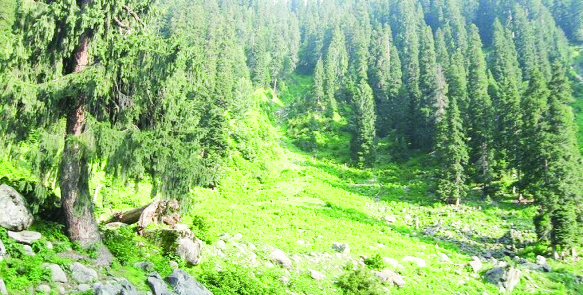
At the same time, J&K’s forests represent some of India’s richest biodiversity. Forestry is emerging as a crucial sector not only for ecological balance but also for livelihood generation. Around 20,000 square kilometres of J&K is under forest cover, making it one of India’s most biodiverse regions. This natural wealth presents enormous scope for eco-tourism, medicinal plant cultivation, bamboo-based livelihoods, carbon credit markets and community-based forest enterprises that can diversify income sources for local communities while promoting conservation.
In an era of climate uncertainty, healthy forests act as nature’s defense system, protecting slopes, rivers and agricultural land while supporting wildlife. In a world increasingly threatened by climate change, strong forests are J&K’s most reliable shield. To fully unlock the potential of its forests and orchards, the J&K government must adopt a forward-looking strategy centered on modernization, sustainability, and community participation. First, establishing climate-resilient horticulture zones, equipped with advanced nurseries, weather-based advisory systems, and scientific pest management, will protect orchardists from unpredictable weather. Second, expanding cold-chain networks, fruit processing units, and export hubs can reduce losses and boost global competitiveness.
In forestry, the Government should promote community-led forest management, large-scale afforestation, and regulated harvesting of medicinal plants. Introducing eco-tourism circuits and carbon credit programs can create new income streams. Most importantly, dedicated skill training for youth in horticulture technology, forest conservation, and value-addition will ensure long-term sustainability. These steps can secure a greener and more prosperous future for Jammu & Kashmir.
However, tapping these potential demands policy consistency and scientific management. Climate change, erratic snowfall, invasive species and human encroachment threaten both orchards and forests. J&K needs stronger research-extension linkages, resilient crop varieties, transparent timber policies and community involvement in forest conservation and can significantly boost local incomes. Horticulture and forestry are not merely sectors they are J&K’s pathway to a sustainable, self-reliant and green economy. If nurtured with vision and science, the region’s natural wealth can drive prosperity for generations. The time to invest in these green assets is now.
(The authors are Ph.D Research Scholar Silviculture & Agroforestry, SKUAST-Jammu and Scholar, Horticulture, SKUAST-Kashmir)
 Follow our WhatsApp channel
