

Nawshaba Iqbal
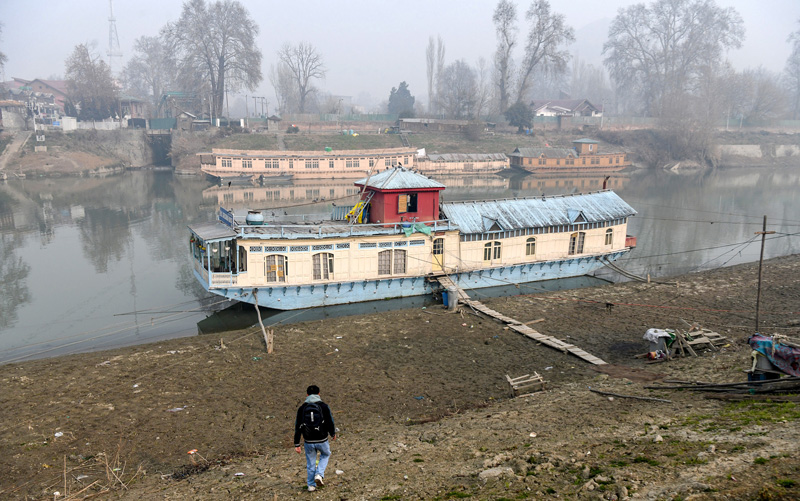
Srinagar, Dec 11: The prolonged dry spell has brought down the level of Kashmir’s main river Jhelum to its lowest point in recent years, leaving residents worried about a possible water shortage.
Follow the Daily Excelsior channel on WhatsApp
In Sangam, the important gauge point in South Kashmir, river levels have been reduced to 0.56 feet, laying bare a substantial portion of the riverbed, which remains bare and arid.
Chief Engineer of Irrigation and Flood Control, Showkat Hussain, told Excelsior that owing to dry conditions there has been a marked dip in the water level of river Jhelum. “The river’s level at Sangam has been recorded at 0.56 feet, whereas Munshi Bagh has been recorded at 3.59 feet,” he said. Click here to watch video
Hussain said the dry spell started in October, and it has affected the intake of water at various points, which, in turn, is putting pressure on irrigation and drinking water supply schemes that are dependent upon this river.
Presently, Jammu and Kashmir is grappling with a deficit of 85.8% in rainfall, which has been continuing for weeks now. Since November 5, the area has been in a dry spell, with most of its districts receiving little to no rain. The Meteorological Department has noted that this area ought to register 43.1 mm of rainfall but has received almost nothing.
Authorities said that the minimum water level of the Jhelum has been falling, but there are no concerns regarding drinking water in the Valley.
“Areas in Sopore and Baramulla where water is supplied from the Wular lake have not received any report of disruption,” he said.
He added that the lake functions as a natural holding reservoir that releases water in a controlled manner to satisfy demands of areas that are connected to it.
MeT Director Dr Mukhtar Ahmad said that no major weather activity has been foreseen until December 19, and no change in this situation is expected unless new western disturbances enter.
 Follow our WhatsApp channel
