

‘Gair Mumkin Khad a matter of survival for poor’
Excelsior Correspondent
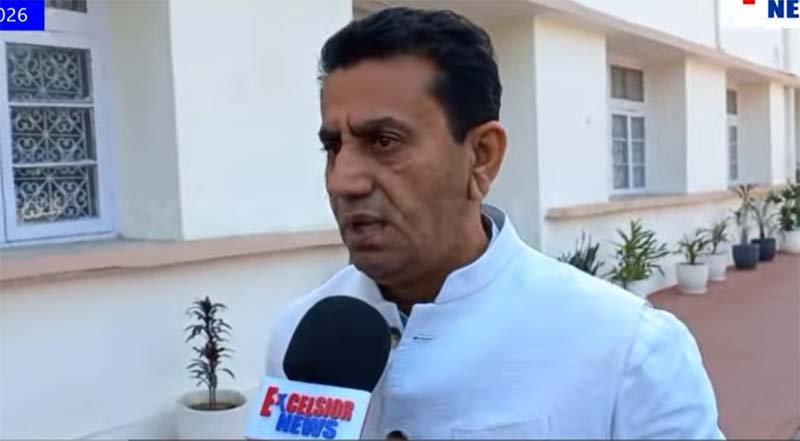
JAMMU, Feb 19: Showing his concern that discrimination with Jammu region still continues, BJP MLA from Kathua and former Minister, Rajiv Jasrotia today said that in allocation of SASCI (Special Assistance to States for Capital Investment) funds for year 2025-26 many Departments of the region have not been allocated even a single rupee while preference has been given to Kashmir Valley only.
Follow the Daily Excelsior channel on WhatsApp
He said despite Chief Minister’s claims of equitable distribution of funds the ground reality is totally different. “When one goes through figures there is a huge difference in allotment of funds between Kashmir and Jammu region in various departments indicating that the discrimination still continues,” Jasrotia added.
Click here to watch video
He said Jammu tourism has been ignored. While Kashmir was allocated Rs 22.85 crore, Jammu got a meager amount of Rs 6.50 crore. He said Government needs to see the condition of Patnitop and Sanasar tourist resorts of Jammu.
He said likewise in Agriculture Production Department, Kashmir was allocated Rs 60.40crore while Jammu region was ignored. For Cooperatives Kashmir was allocated Rs 10.63 crore while Jammu was totally ignored. Same is case with Culture where Kashmir has been allocated Rs 8.90 crore and Jammu ignored.
Jasrotia said for School Education Department, Kashmir has been allocated Rs 21.06 crore while Jammu again ignored. For GAD Kashmir has been provided Rs 13.42 crore and Jammu ignored. In Horticulture Department Kashmir got Rs 41.17 crore and Jammu only five crore while for Industry and Commerce Kashmir got Rs 111.83 crore and Jammu got a paltry Rs 27.69 crore. For Law Department Kashmir given Rs 908 .22 crore while Jammu totally was ignored. For Social Welfare Kashmir got 9.90 crore and Jammu ignored, he added.
Stressing on development of tourism infrastructure in Jammu he said presently Government stresses on three main things for tourism promotion one is Mata Vaishno Devi , second Swami Amaranth and third is Kashmir Valley but apart from that there are many more places for attraction of tourists in the UT and there is utter need of creating infrastructure facilities for these spots to attract tourists and boost local economy.
While highlighting the proposed Kathua -Basohli, Bani Bhadarwah Rs 30,400 crore rail link Project which is in pipeline, he demanded that the same be got sanctioned by pursuing the Central Government. The Project is to be completed in six phases and it will boost tourism in the region besides help in employment generation.
Besides, Jammu -Poonch Railway Project of Rs 22000 crore is also in pipeline. The survey of the project has already been conducted and that should also got approved to built the tourism infrastructure in the region. He said this project has been put into cold storage now.
Jasrotia said Kathua district has lot of power potential as Shapur Kandi and Ujh falling in his constituency but he regretted that there was no mention of Ujh Multipurpose Project in Lt Governor’s address. He asserted that both Ujh Multipurpose Project and Shahpur Kandi will prove game changer projects for Kandi belt of Kathua and Samba. Besides, solving irrigation problem they will also boost electricity generation, he added.
Jasrotia said earlier J&K was getting 150 cusecs of water from Shahpur Kandi and now we get 1150 cusecs of water but questioned that how it will be utilized when there is no infrastructure. Besides, for 100MW Solar plant worth Rs 900 crore 300 acres of land was identified in Chan Arrorian in Kathua district but later the same was shelved. He demanded that the Government should look into it.
Jasrotia raised a wide spectrum of critical public issues, placing special emphasis on the long-pending Gair Mumkin Khad land matter, welfare of daily wage workers, balanced regional development, and equitable allocation of resources.
Jasrotia revisited the issue of daily wage workers, recalling that during the previous budget session, a High-Power Committee was discussed to examine their grievances. However, he pointed out that despite repeated assurances, thousands of workers continue to await tangible relief. He highlighted the challenges faced by Anganwadi workers, SPOs, NHM staff, Rehbar-e-Zirat, Rehbar-e-Khel employees, and teachers working under academic arrangements, many of whom continue to serve on meager wages without job security, social protection, or clear regularization policies. While acknowledging fiscal and administrative constraints, he asserted that decisive intent and time-bound action are essential. He urged the Government to frame a transparent and structured roadmap to address regularization, wage enhancement, and welfare mechanisms for these workers, who form the backbone of essential public services.
Emphasizing that Agriculture & Allied Sectors along with Tourism are the economic pillars of Jammu & Kashmir, Jasrotia called for balanced investment across regions. He pointed out that recent infrastructure allocations amounting to over Rs 10,000 crore have largely benefitted Kashmir, and urged the Government to reduce this developmental gap. He stressed the need to upgrade tourist infrastructure in the Jammu division, particularly in Patnitop, Sanasar, Mansar, Sarthal, and other potential destinations. Enhanced connectivity, improved facilities, and professional management of tourist authorities, he said, can significantly expand tourism potential and generate employment.
Giving special emphasis to the Gair Mumkin Khad issue arising after the Border Act of 2010, Jasrotia termed it one of the most sensitive and long-pending land matters affecting thousands of families in Jammu, Kathua, and Samba districts. He informed the House that approximately 2,46,000 kanals of land were identified for delineation. However, since 2017, only about 14,520 kanals have been processed, of which the majority has been categorized as Government land, leaving private landholders in uncertainty. Jasrotia stressed that the issue is not merely administrative-it is directly linked to the livelihood and survival of small and marginal farmers who own just two to six kanals of land. Many families are facing legal ambiguity, cultivation restrictions, and economic distress due to delays in demarcation and clear policy decisions, he added.
He called for the expedited and transparent delineation of the remaining land to bring clarity and certainty to affected families. He further stressed the need to protect genuine small and marginal landholders from undue harassment and administrative complications arising from prolonged delays. Jasrotia urged the Government to formulate a clear and comprehensive policy framework to resolve disputes in a fair, humane, and legally sound manner. He also emphasized the importance of implementing court directions and Standard Operating Procedures (SOPs) in a time-bound and effective manner to ensure that the issue does not linger indefinitely.
He underscored that resolving the Gair Mumkin Khad issue is not merely a procedural necessity but a matter of justice and dignity, essential for restoring confidence and trust among border communities. In addition, he reiterated the need for equitable allocation of development and disaster management funds, ensuring balanced distribution of resources so that all regions receive fair and proportionate support.
Referring to fund allocations under power, infrastructure, agriculture, culture, and cooperative sectors, Jasrotia highlighted disparities in regional distribution. While appreciating sanctioned projects, he underscored that development funds and disaster management resources must be allocated in a balanced and transparent manner. He urged the Government to ensure that both Jammu and Kashmir divisions receive fair representation in development planning so that no region feels neglected.
Jasrotia reiterated that inclusive development, transparency, and regional harmony must guide governance in Jammu & Kashmir. He stressed that fulfilling promises to daily wage workers, resolving the Gair Mumkin Khad issue, strengthening tourism and agriculture infrastructure, and ensuring equitable resource allocation are critical to sustainable progress. He appealed to the Government to translate assurances into action through time-bound decisions and balanced policymaking, reaffirming that equitable growth is the cornerstone of a stable and prosperous Jammu & Kashmir.
 Follow our WhatsApp channel
