

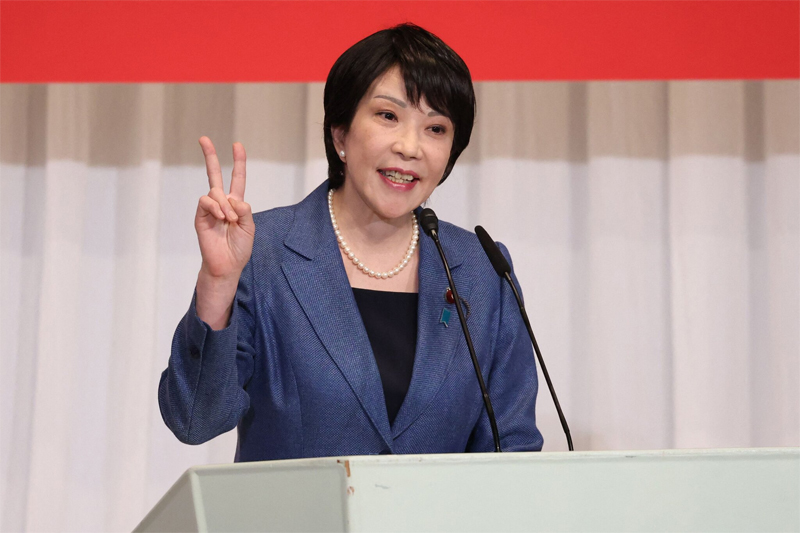
TOKYO, Sep 20: Japan could soon see its first female prime minister, with Liberal Democratic Party (LDP) heavyweight Sanae Takaichi emerging as a leading contender in the party’s leadership race, scheduled for 4 October.
Her candidacy in the highest echelon of political power is rare development, as women have rarely risen to the strongest positions of power.
Takaichi, 64, is a hard-line conservative and a long-time ally of the late former prime minister Shinzo Abe, whose policies she has pledged to continue.
A strong public favourite alongside agriculture minister Shinjiro Koizumi, she narrowly lost to outgoing Prime Minister Shigeru Ishiba in last year’s runoff for the LDP leadership, reports Japan Times.
If victorious this time, she would become Japan’s first female premier – a potential historical milestone in the country’s political history – showcasing Tokyo’s gradual progress on the issue of gender equality in politics.
Since the country’s post-war constitution was adopted in 1947, no woman has ever served as prime minister. Only a handful have held senior cabinet posts, and female candidates have historically faced institutional barriers within the male-dominated LDP, which has governed almost continuously since its founding in 1955.
Notably, former Foreign Minister Yuriko Koike came close to breaking the glass ceiling when she became Tokyo’s first female governor in 2016, but she never secured strong enough support within the LDP to contend for national leadership.
Similarly, past female contenders in LDP leadership races, including Takaichi herself, often struggled to win backing from powerful party factions despite polling well with the public.
Her policy positions lean heavily towards national security and conservative social values. Takaichi has been outspoken on countering Beijing’s growing military presence in the Asia-Pacific, advocating for a shift from Japan’s strictly defensive military posture towards a more active armed force.
She has also supported major government spending and ultra-low interest rates, echoing Abe’s economic legacy.
On social and cultural issues, Takaichi has courted controversy through her repeated visits to the Yasukuni Shrine, which honours the soldiers who died in WWII, as many of these soldiers were also convicted war criminals.
The former Imperial Japan is noted to have committed many atrocities and brutalities, and as such visits to the shrine have long provoked strong criticism from neighbouring countries like China and South Korea, which endured the worst brunt of Japanese military occupation.
Takaichi has contested several previous LDP leadership races and has steadily built a stronger base within the party.
In this election, she will face competition from three declared male candidates, including Chief Cabinet Secretary Yoshimasa Hayashi, a political moderate known for his policy expertise, as well as other senior figures within the ruling party.
(UNI)
 Follow our WhatsApp channel
