

Prof. Beata Bochorodycz
The Japanese people went to the polls on February 8 to elect their representatives to the Lower House of Parliament, although the last elections were held only in October 2025. Prime Minister Takaichi Sanae unexpectedly dissolved Parliament January-end 2026, after just three months in office, to obtain a clear answer as to whether the Japanese people wanted her in office. She secured a decisive victory and a majority in Parliament. This signified stability and the continuation of the current government’s political course.
In the previous elections, the then ruling Liberal Democratic Party (PLD) under the leadership of Ishiba Shigeru lost her majority. Takaichi Sanae, elected leader of the PLD in October 2025, formed a minority government in coalition with the Kōmeitō, and later with the Ishin no Kai (Renewal Party, or Ishin for short). The goal of the early elections was for the new prime minister to win a simple majority of 233 of 465 seats to implement her announced policies.
In the February elections, the PLD received 316 seats, setting a record in the party’s over 70-year history. Its coalition partner secured 36 seats. In fact, the PLD even gained 15 more seats under the proportional representation system, but it didn’t have enough candidates. Nobody expected such a victory. Both coalition partners control 352 seats, meaning the lower house of parliament can pass legislation even if it is rejected by the upper house, where the Ishida government lost its majority in July 2025.
Sources of success
How did Prime Minister Takaichi achieve such a resounding victory after only three months in office? Above all, the strategy of dissolving parliament during a political boom, fueled by high public support, proved effective. This is an ace in the hands of prime ministers, based on Article 7 of the Japanese Constitution. Although over 50% of Japanese people reacted lukewarmly to the news of the dissolution of parliament, nearly 70% of respondents expressed support for the Takaichi cabinet. Among young voters (aged 19-29), support even exceeded 80%. So where did this popularity come from?
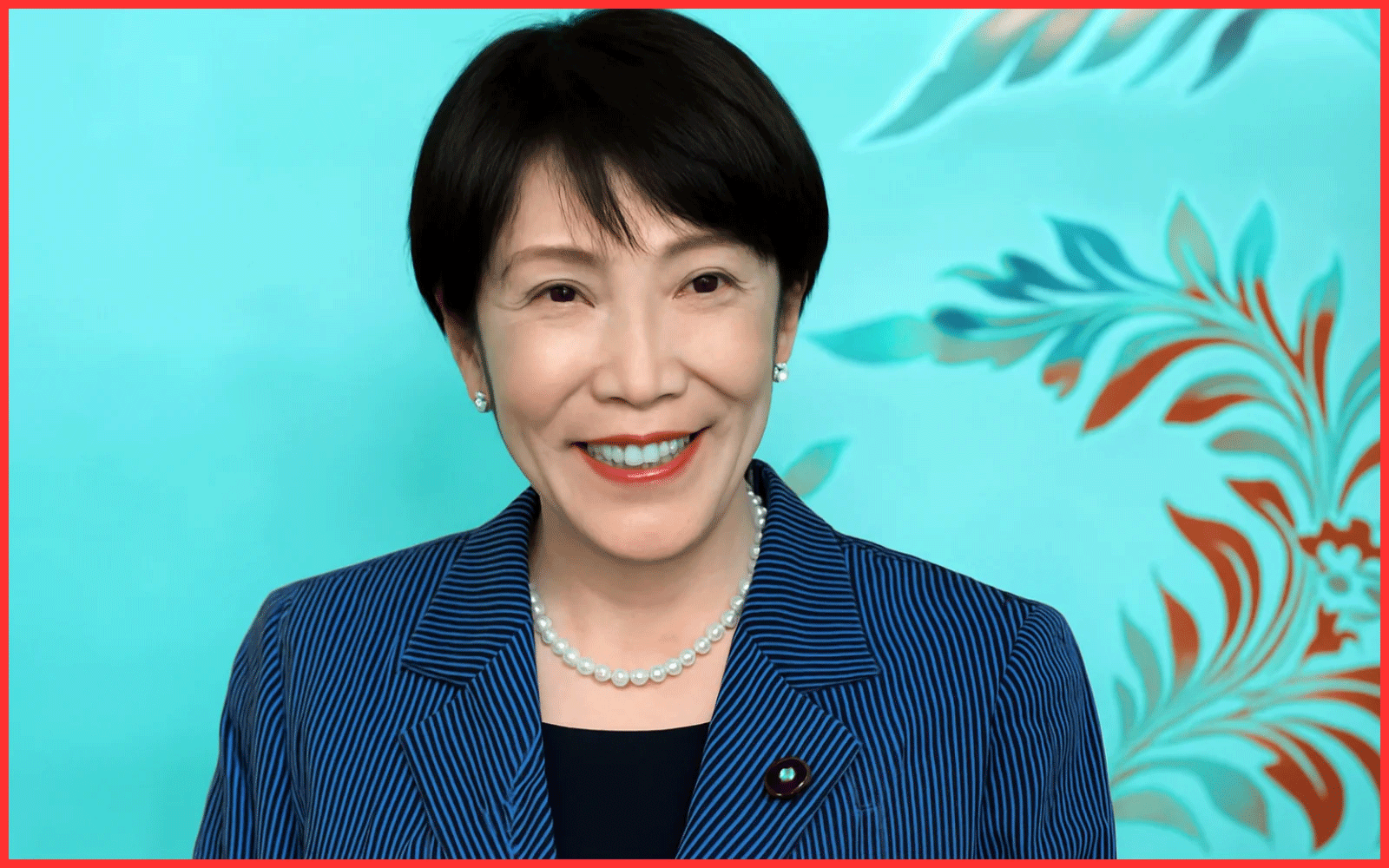
Firstly, Takaichi’s charismatic personality plays a significant role. She is energetic, intelligent, smiling, enthusiastic, and direct. Unlike many of her party colleagues, she answers questions directly. She has some rather endearing quirks for a politician: she listens to heavy metal music, plays the drums, and likes motorcycles. Her dedication to serving Japan is evident.
Moreover, she is a woman. Critical voices that Takaichi displays conservative and nationalist values and therefore will not bring a feminist turn to politics are currently irrelevant. Many young people are impressed that a woman has become the head of government in Japan. Crowds gathered at election rallies announcing her presence. Some carried placards: Sana-chan, ganbare, or “Hang in there, Sana-chan” (a diminutive of the prime minister’s name, Sanae, + the suffix “chan,” denoting sympathy and close relationships).
Secondly, Takaichi demonstrated her expertise in the difficult art of political negotiation. Immediately after her victory as PLD leader, the party’s longtime coalition partner, Kōmeitō, unexpectedly announced the end of their 26-year partnership. He disliked Takaichi’s views on the constitution and military buildup. The prime minister’s position seemed to be slipping away. Takaichi refused to give up. She initiated talks with opposition parties and, after a few days, found a new partner, the conservative Ishin, with whom the PLD ran the elections.
Third, Takaichi has proven herself adept at international socializing. She speaks English, which usually arouses admiration among the Japanese, who often have a complex about it. Immediately after her appointment, she was thrown into the deep end of diplomatic negotiations. First, the ASEAN Summit in Kuala Lumpur, then APEC Summit in South Korea, President Trump’s three-day visit to Tokyo, South Korean President Lee Jae-myung’s visit to her hometown of Nara, and a meeting with Prime Minister Georgia Meloni in Tokyo.
Fourth, Takaichi has defied China and refuses to apologize for it. All indications are that this was not a planned action. She has said that a possible Chinese attack on Taiwan could constitute a “situation threatening Japan’s survival,” which, according to Japanese law, could justify the use of the Self-Defense Forces. This was a scenario where the US, Japan’s ally, would join the conflict on Taiwan’s side, not direct aid to Taiwan, but the information spread. Beijing clamped down sharply, restricting the export of rare earth metals to Japan, and strongly discouraged tourism and study trips to Japan. The impasse continues. Takaichi assures that she has no intention of retracting her statement, although she adds that her government is open to talks with Beijing.
Implications for domestic policy
Takaichi’s decisive victory means, above all, a continuation of the current course. This time, however, without the need to negotiate every decision not only with the government coalition partner but also with the opposition. While She has announced that she will engage in discussions with opposition parties, as this is required by political culture, she will ultimately be able to make decisions independently on fundamental issues. Furthermore, Takaichi confirmed she has no intention of changing the composition of the Council of Ministers for now, as it constitutes a committed team, and only three months have passed since its inauguration. The absence of changes in these key positions means an acceleration of the work already underway.
Economic and national security issues are on the agenda, topics from the PLD leadership campaign last October. These are close to voters’ hearts and include: lowering the consumption tax, subsidizing electricity and gas bills, raising the basic tax-free threshold, and reforming the pension and healthcare systems. After winning, She declared a shift away from “excessive budget discipline” in favor of “responsible but aggressive fiscal policy.” Markets reacted positively.
Foreign policy
Continuation is expected in foreign policy. The goal is to strengthen relations with Japan’s main ally, the US, and maintain American security guarantees against threats directly emanating from China and North Korea. This relationship was built on the special relationship between Trump and assassinated Prime Minister Abe Shinzō. The President’s relationship with the Prime Minister seems to be flourishing. Trump even openly supported her candidacy in the election.
While maintaining its relations with the United States, Japan will expand its cooperation with other partners in the region, particularly Australia, the Philippines, Vietnam, and South Korea, and countries outside the Indo-Pacific, primarily NATO. Since taking office, Prime Minister Takaichi has declared continued support for Ukraine. Japan has announced a further $6 billion in funding for this purpose.
Defence policy
In defence policy, Takaichi intends to further increase military spending. She has accelerated spending to 2% of GDP by the end of the current fiscal year (March 30th) and likely won’t stop there. Other key demands include the development of the domestic defence industry and the easing of restrictions on arms exports; the expansion of intelligence and counterintelligence capabilities, which have been severely lacking until now; and a revision of the country’s key strategic documents (National Security Strategy, National Defense Strategy, and Defense Expansion Program) by the end of this year.
Finally, it’s worth mentioning constitutional revision, which is a top priority for her as it was for her mentor, Abe. She announced the convening of a Constitutional Revision Commission tasked with preparing a draft, which will then be submitted to public consultation. The final version of the constitution will be announced at March-end.
Prime Minister Takaichi begins the year with very good cards in her hand. The length of her reign, as well as her assessment by posterity, will depend on how she addresses economic challenges and delivers tangible results to voters, as well as how she handles controversial political issues. The pressure and expectations on the country’s first female prime minister are incredibly high.—INFA
 Follow our WhatsApp channel
