

Ashok Sharma
ashoksharma23may@gmail.com
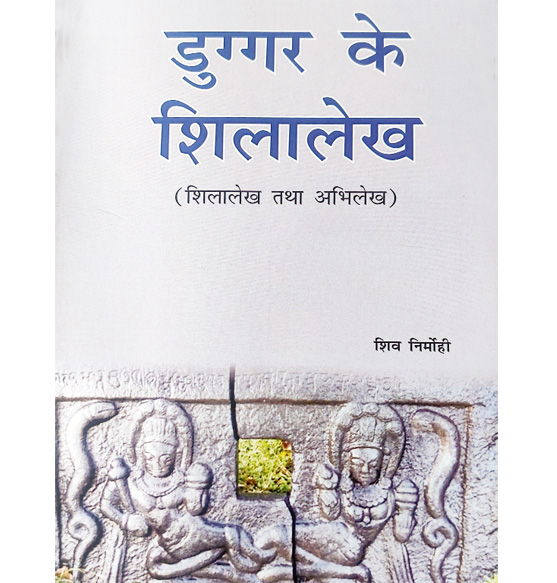
Book Review: Duggar ke Shilalekh
Author:Prof. Shiv Nirmohi
Publisher:Sahitya Sangam Publications, Jammu
Year of Publication:2025
Price: Rs 200.00
Prof. Shiv Nirmohi, a noted scholar and chronicler of Dogra culture and heritage, has once again enriched the literary and historical landscape of Duggar with his latest work, Duggar ke Shilalekh. Known for his meticulous research and commitment to preserving the cultural ethos of the region, Prof. Nirmohi in this volume takes his readers on an illuminating journey through the world of ancient stone inscriptions – the silent yet enduring voices of Duggar’s glorious past.
This book is the outcome of the author’s painstaking research, fieldwork and exploration across temples, baolis (water springs), caves and other historical sites scattered across Jammu’s hilly terrain. The author has studied and documented inscriptions in diverse scripts – Shankh script, Ancient Brahmi and later Brahmi – totalling eight in number. Among these, the oldest inscription has been discovered on the roof of a large cave at Badhsthal, first brought to notice by R. C. Kak. Another notable find is an inscription at Sudh Mahadev dating back to the 4th century, bearing the name of Ganpati Nag. His name also appears in the ancient records of Gupteshwar and Barahat in Uttarakhand, establishing valuable historical linkages. Inscriptions from Allahabad reveal that Ganpati Nag was defeated by Skandagupta, after which he is believed to have migrated to the Shivalik range of Duggar. The presence of a shrine at a place named Karlah near Patnitop, dedicated to his son Grihanag, supports this assumption.
The author has also recorded stone inscriptions found near Guptganga (Bhaderwah), Bhandarkot (Gangasar), Poonch and Mandi, each contributing to a better understanding of the region’s dynastic and cultural evolution. Moving beyond the early medieval period, the book notes that most inscriptions discovered after the 10th century are written in Sharda script. These have been unearthed from places such as Thalora, Nagsaki, Marwa Dacchhan, Sassinai, Kundgram, Brindavan (Kishtwar), Nagri Parole and Rainkikot – many of which hold significant historical value.
Of particular scholarly interest are the inscriptions written in undeciphered scripts, found at Dhanas, Sukrala and Ambar. These mysterious engravings offer fertile ground for further linguistic and archaeological research. After the 15th century, stone inscriptions in Takri script began to appear. The most prominent among them is at Mahanpur, bearing the date Samvat 1583. Other Dogri Takri inscriptions have been found at Veni Sangam, Sudh Mahadev, Krimachi, Chenani, the Maheshwar Temple (Udhampur) and Jib. Many of these are engraved on baolis, temples, lakes, wells and samadhis. Interestingly, a few sites even display bilingual inscriptions in Takri and Persian scripts, reflecting the region’s cultural intermingling through successive ages. The stone inscriptions found at Kameshwar Temple Akhnoor,bear Dravidian names such as Sagamma,Sukhang etc.
Adding further scholarly value, Prof. Nirmohi has appended the alphabets of the Takri, Brahmi and Kishtwari scripts, enabling readers and researchers to understand the structural evolution of these ancient writing systems.
Overall, Duggar ke Shilalekh stands as a monumental contribution to the fields of Archaeology, Anthropology, Epigraphy and History. It not only sheds light on the forgotten inscriptions of the Duggar region but also revives the cultural consciousness of a civilization etched in stone. The book is an indispensable resource for students, scholars and anyone interested in exploring the rich and layered past of Jammu’s Duggar land.
 Follow our WhatsApp channel
