

Somewhere between incomplete narratives, parochialism and quiet dignity of a patriot
Nidhi Soni
Jammu – a land where the sheep and the tiger once drank from the same stream – has long stood as a sublime confluence of valour and art, steel and soul. But in an age when identities are shaped by hashtags, headlines, and history textbooks, Jammu’s voice echoes in silos rather than in unison.
So we must ask: What is Jammu’s narrative? What is our story? And more importantly, who is telling it?
The Land of Padma Awardees- and Forgotten Pillars
Jammu boasts 19 Padma Shri awardees in art, literature and education, and one Padma Bhushan. It is home to Natrang, India’s acclaimed theatre group led by Padma Shri Balwant Thakur, an institution itself, in giving Dogra folk theater and folklore a world stage while taking Performing art into every home through children theater. Shaping the young to own their culture, stories and to take Dogra art,values and confidence into the world. Then there is the venerable Dogri Sanstha, now helmed by Padma Shri Dr. Lalit Magotra, a man of science with poetic soul and activism for Dogri. Yet these institutions – instead of becoming the next NSD or Sahitya Akademi, struggle on shoestring budgets and borrowed attention. Why? Because Jammu has never been allowed to write its story – only footnotes to someone else’s.
We gave India General Zorawar Singh, the “Napoleon of India,” who annexed Ladakh, Baltistan, and parts of Tibet. And Brigadier Rajinder Singh, MVC, who with just 100 Dogra soldiers, fought the first battle for Kashmir in 1947 to save Kashmir. Their valour stitched India’s borders. But ask our children – how many know these names or stories of their valour and their supreme sacrifice? Perhaps a handful!
The Greats Who Lit the Way
Jammu’s story has never lacked greatness. Only amplification. Kunwar Viyogi, the Sahitya Akademi Award-winning Dogri poet, stands as a beacon in our literary sky – a man of both pen and uniform, man of science, sonnet and service, who infused the soul of Shakespeare’s sonnet into the rhythms of Dogri. His literary oeuvre is as vast as it’s deep. His poetry was not just art – it was resistance. A resistance to obscurity. A refusal to let the language of his people fade into silence. His legacy reminds us that regional literature is not lesser – it is just less amplified.
Equally determined to rewrite obscured truths is General Goverdhan Singh Jamwal, a decorated soldier turned chronicler of Dogra history. Through his books, lectures, and relentless pursuit of facts, he’s told the stories no one else would – of General Zorawar Singh and Brigadier Rajinder Singh. These men didn’t just fight wars – they preserved India’s map. Yet, how many children in Jammu, let alone India, know their names?
Jammu’s literary tradition runs deep, shaped not only by Viyogi but also by stalwarts like Padma Shri Ved Rahi, a masterful storyteller and filmmaker who brought Dogra identity to the screen, and Padma Shri Jitendra Udhampuri, whose poetic and literary brilliance brought Dogri and Pahari languages into national focus. From prose to poetry, from radio to print – these voices shaped identity in ink and emotion.
In the realm of theatre and performance, Padma Shri Mohan Singh gave Dogri culture a stage. His contributions to traditional theatre are not just performances but living, breathing repositories of memory, folklore, and pride. He turned Dogri into drama, into movement,’. To Col. Ajay Raina, whose pen wages a daily war for military truth and historical justice. From Prof. Ram Nath Shastri, the “father of Dogri,” who led the language’s revival, to Dr. Karan Singh, scholar-prince, who donated land for Dogri Sanstha and championed Dogra divinity and literature; to Padma Sachdev, who gave Dogri a national voice – immortalised when Lata Mangeshkar sang her iconic “Bhala Sipahiya Dogariya.” Even today, Dr. Jitendra Singh, Minister of Science and Technology and Minister of Earth Sciences, for Prime Minister’s Office, embodies that Dogra fusion of intellect and cultural pride.
Our Musical Legacy
Jammu has also shaped India’s musical soul. From KL Saigal, Indian cinema’s first superstar, to Ustad Alla Rakha, tabla maestro who conquered global stages, to Malika Phukraj, whose ghazals whispered Dogri sophistication, to Radhika Chopra, in whose classical soulful ghazals, hums a Dogra soul . And now, new artists on stage, reality shows and streaming platforms are earning space. Be it Kathak dancer Sanchita Abrol, former RJ Shwetima Jamwal, very talentd singe Vanshika Jaral, noted actor Kusum Tikoo, each reminding us that the stage is still ours to claim. But brilliance scattered is not legacy. It needs a platform. A policy. A plan.
The Disconnect: Power Without Narrative
We have it all – the martyrs, the musicians, the poets, the scholars. But we do not have a unified narrative. There is no textbook chapter on General Zorawar Singh or Brigadier Rajinder Singh. No Dogri web series on OTT or Dogra story in Hindi. No dedicated Dogra wing in national museums. Even the most passionate voices – Zorawar Singh Jamwal of Team Jammu and author-activist Manu Khajuria – often fight alone in a fragmented cultural front.
When Powers Converged: A Stirring Attempt
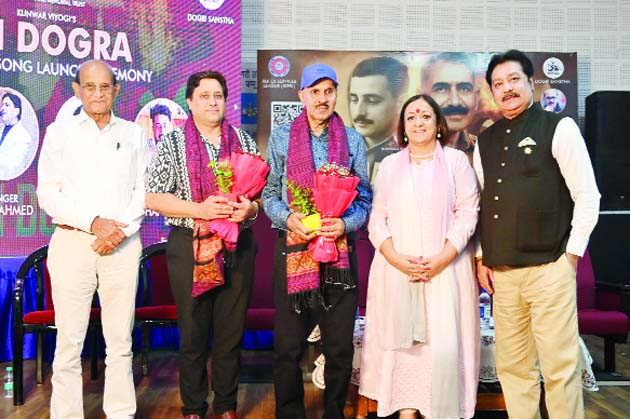
In 2023, Kunwar Viyogi Memorial Trust, a not-for-profit committed to Dogri revival, launched a stirring campaign. From Paris to New York, Sydney to Delhi – Dogri went global. This month, the Trust then released “Jai Dogra”, a soul-stirring tribute to Brig. Rajinder Singh and his 100 warriors – composed by Brij Mohan, sung by BSF soldier Riaz Malik. A tribute from the soil, for the soil. This was followed by the panel “Operation Gulmarg to Sindoor: How Valour Forged Naya Bharat”, featuring Lt. Gen. Goverdhan Singh Jamwal, Lt. Gen. Rakesh Sharma, Col. Ajay Raina, Brig. Anil Sharma, and Col. K.S. Jamwal – moderated by journalist Ayushman Singh Jamwal.
While Lt. Gen. Jamwal (Retd) spoke about the need to bring out Brig Rajinder Singh’s story to each household of Jammu, highlighting at length “what is not taught to us,” Col Raina (Retd.) asked people to recognise their strength in unison and spearhead the war of narrative on every given platform. Lt. Gen. Sharma (Retd.), who is also the president of J&K Ex-Services League, with which Kunwar Viyogi Trust collaborated brought to light the many initiatives the organization has championed to serve the widows of our nation’s brave. Brig Sharma (Retd.) spoke of the importance of civil-government partnership in weaving together a collective narrative for Jammu. Col. KS Jamwal (Retd.), who is also the general secretary of J&K Ex-Services League said that when language disintegrates, the social fabric disintegrates with it. He stressed on the urgent need to reclaim Duggar roots and spread it like wildfire across schools, colleges, universities and beyond. Ayushman Jamwal concluded with Just a thought-‘let’s together tell our story- let’s question, seek, repair, create and become one voice of poise, poetry, patriotism and pride.’
What Must Come Next?
Jammu needs more than passion. It needs a movement. One that’s not just artistic but institutional, collective and not individualistic.
We need: to tell our story through inspiring lives of Dogra Greats and verse and words of Dogra literary geniuses. More specifically, we need a collective push to include Dogri in school curricula across J&K and NCERT; introduce Zorawar Singh & Brig. Rajinder Singh in national history books, construct museums and academies named after Dogra icons, introduce a National Dogri Fellowship for young school and college level students.
While we debate and deliberate upon how to bring Dogri at centerstage, let’s revisit the fundamental question – So, What Is Our Story? Will it be of greatness ignored, valor unsung, language sidelined or that of celebration, pride and great storytelling?
Let Dogri rise from nostalgia to aspiration. Let our children grow up speaking Dogri with pride, not apology. Let Jammu be known not for what it endured – but for what it created. Let the war cry shift – from defending borders to defending identity.
As Kunwar Viyogi wrote:
Jai Duggar. Jai Dogri. Jai Dogra. Be Dogra. Be Proud.
Because if we don’t tell our story, someone else will. And we’ve seen how that ends.
 Follow our WhatsApp channel
