

Massive rain disrupts normal life in region
*Day temp drops by 7 degrees in winter capital
Gopal Sharma
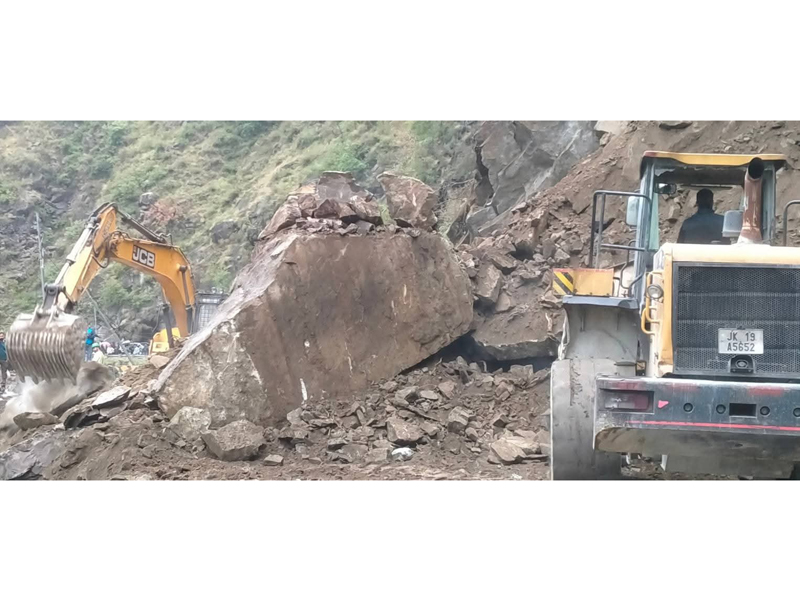
JAMMU, Apr 7: The Jammu-Srinagar National Highway was closed for traffic on Tuesday due to multiple landslides in Ramban sector a few hours after its restoration, while heavy rain disrupted normal life in Jammu and several other areas of the region today.
Official sources said that more than 1200 vehicles have been stranded at different points along the 270-km highway, including Nagrota, Udhampur, Dhar Road, Banihal, Qazigund and Anantnag.
Follow the Daily Excelsior channel on WhatsApp
The highway was restored during the day for stranded vehicles but again after a few hours around 2.30 pm the fresh landslides at Gujjar Morh in Digdole area, Khooni Nallah and also near Nashri Tunnel caused extensive landslides. It was raining heavily in the area and at two- three more points between Nashri and Banihal boulders blocked the highway.
The traffic movement was restored along single tube late this evening at around 8.45 pm at Digdole, and two other points but only stranded vehicles at the isolated placed between Banihal and Ramban were allowed to move. No fresh movement of vehicles was allowed from Udhampur, Nagrota, Qazigund/ Kashmur side.
“Traffic movement was stopped in both directions – from Jammu towards Srinagar and vice versa – on the highway due to a heavy landslide between Digdol and Khooni Nallah. The road was completely blocked but partially restored late in the evening. It was continuously raining in the area and only some of the stranded vehicles in the sector were allowed to cross and reach safer locations,” a Traffic official said.
He said that people are advised not to travel on the highway until the road is fully restored.
In Jammu City and its adjoining areas, it was raining heavily since 5 pm. Till 10 the rain continued in the winter capital. Many roads and the low lying areas of the City were waterlogged. The rain disrupted normal life in the City.
Fresh snowfall was reported from the higher reaches of the region, while Pir Ki Gali/ Pass on Mughal Road, Sinthon Top in Kishtwar and Chhatergalla in Bhaderwah area were closed. Several other link roads were also blocked in hilly districts of Ramban, Doda, Udhampur and Reasi. The Nallahs and streams in the region were swollen with the flash flood during this evening.
Meanwhile, heavy rain and fresh snowfall on higher reaches in the region triggered cold wave-like conditions. The day temperature dropped 7.2 degrees Celsius below normal.
The Meteorological Department said that an active western disturbance has impacted the region for 36 hours, bringing widespread rainfall, a sharp fall in temperatures and disruption to normal life.
Jammu city recorded a maximum temperature of 23.2 degrees Celsius, which is 7.2 degrees below normal, marking a significant dip under persistent cloudy and rainy conditions, the Met office said.
Similar temperature trends were recorded across the region, including Katra at 20.5 degrees Celsius (6.7 degrees below normal), Batote 14.2 degrees Celsius (5.8 degrees below normal), Bhaderwah 16.6 degrees Celsius (5.2 degrees below normal) and Banihal at 17.1 degrees Celsius (3.2 degrees below normal), it said.
Heavy rains continued intermittently in most districts, leading to water-logging in some areas and a chill in the air, a Met office added.
The rainfall activity remained pronounced across the Jammu division, with Katra recording the highest precipitation of 7.8 mm between 0830 and 1730 hours, followed by Jammu at 5.8 mm, Bhaderwah at 3.0 mm and Batote at 2.4 mm. Banihal also received 0.9 mm of rainfall during the same period.
Despite inclement weather, the pilgrimage to the revered Mata Vaishno Devi Shrine continued without major disruption, the officials said.
The IMD has warned that two back-to-back western disturbances will affect northwest India, with peak intensity expected on April 7 and 8 over Jammu and Kashmir and Himachal Pradesh. It also predicted brief spell of light rain/ thunder shower at scattered places towards afternoon on April 9 and 10. From April 11 to 16 the weather will generally remain dry across the region.
It has issued a heavy rain alert and cautioned about moderate to high risk of flash floods in parts of Jammu and Kashmir, Ladakh and Uttarakhand over the next 24 hours.
Rising humidity levels also reflected the prevailing moist conditions, with Jammu recording an increase from 53 per cent in the morning to 88 per cent in the evening.
In contrast, the Kashmir Valley witnessed comparatively lesser rainfall activity, with most stations recording either dry weather or light precipitation. Srinagar recorded a maximum temperature of 17.3 degrees Celsius, 1.5 notches below normal, while Qazigund and Kukernag registered minor rainfall over the past 24 hours.
The weather department advised people to remain cautious, particularly in landslide-prone and hilly areas, as intermittent rainfall, gusty winds and thunderstorms may continue over the next couple of days.
Authorities have also issued advisories in several districts, including Ramban, Doda, Kishtwar and Poonch, warning of possible landslides, flash floods and shooting stones, and urging residents and travellers to follow official guidelines.
 Follow our WhatsApp channel
