

Mohammad Hanief
m.hanief@gmail.com
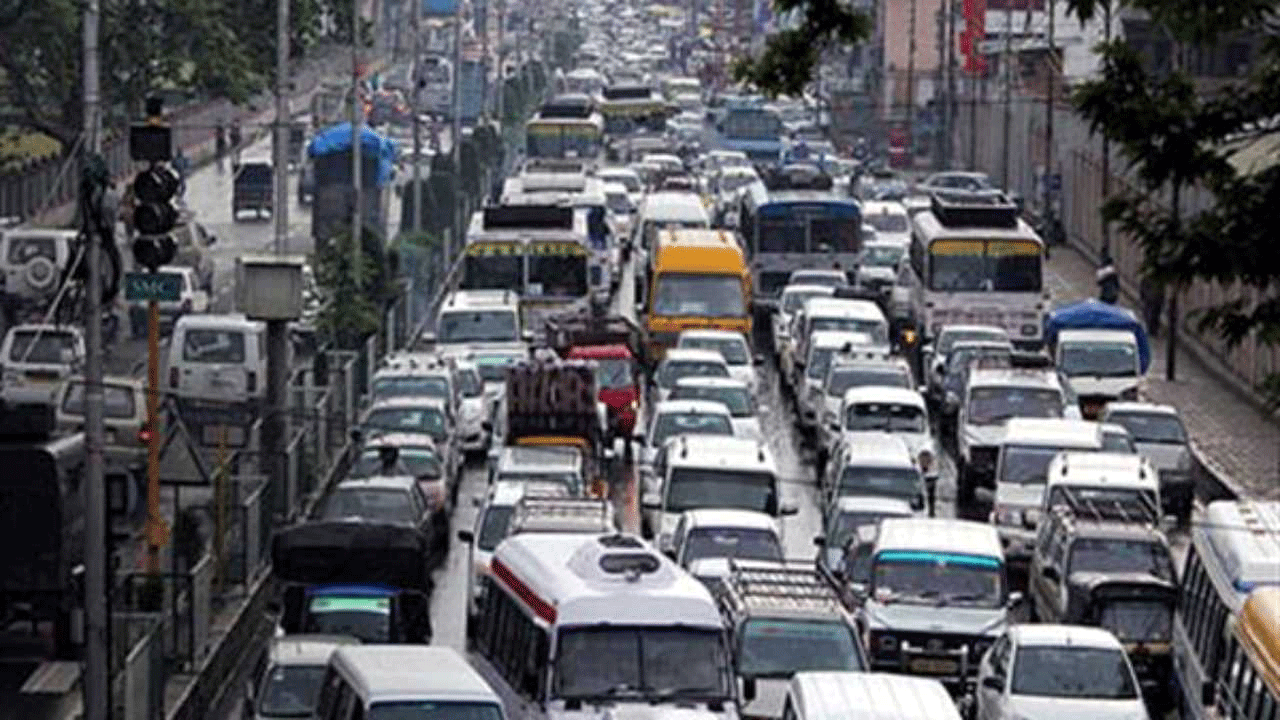
Jammu and Kashmir today stands at a critical juncture in its development journey, where rising aspirations, economic revival, and unprecedented mobility are placing immense pressure on a road infrastructure that is struggling to keep pace. What was once perceived as a seasonal inconvenience has now evolved into a persistent and region-wide mobility crisis, cutting across the Kashmir Valley, Srinagar, and Jammu with varying intensity but shared consequences.
The present scenario reflects a convergence of multiple factors. A sharp rise in tourism, steady urban expansion, increasing private vehicle ownership, and the reopening of educational institutions have collectively intensified traffic density across the Union Territory. The surge in visitor numbers, particularly over the past two years, has transformed mobility patterns in a way that existing systems were never designed to accommodate. Roads that once handled predictable local movement are now burdened with a mix of tourist vehicles, commercial transport, school traffic, and daily commuters, often leading to prolonged congestion and rising safety risks.
In the Kashmir Valley’s district towns, the change is both visible and significant. Places such as Anantnag, Baramulla, Pulwama, Kupwara, and Budgam have evolved into active commercial and educational centres, drawing people from surrounding rural areas. Improved connectivity and higher disposable incomes have contributed to a rapid increase in vehicle ownership, but infrastructure expansion has not kept pace. Narrow roads, unregulated parking, and encroachments have reduced effective road space, turning even routine traffic movement into a challenge. Congestion, once limited to peak hours, now frequently extends throughout the day, particularly during school hours and tourist seasons.
Urban expansion in Srinagar has largely been unaccompanied by proportional upgrades in road capacity. Residential colonies have spread rapidly, while commercial activity has intensified in traditional hubs, creating a mismatch between demand and infrastructure. Public transport initiatives, including the introduction of electric buses, signal progress, yet they remain insufficient to offset the overwhelming dependence on private vehicles. The growing trend of multiple vehicle ownership within households has further accelerated the strain, leaving little room for the system to absorb additional pressure.
Jammu presents a different but equally challenging scenario. As the gateway to the Union Territory, it carries the dual burden of urban traffic and long-distance transit movement. Interstate buses, freight carriers, pilgrimage traffic, and military convoys regularly pass through the city, creating a dynamic and often unpredictable traffic environment. Ongoing infrastructure projects, while essential for long-term improvement, have temporarily compounded congestion in several key areas. The result is a city that is constantly negotiating between development and disruption.
The rise in pilgrimage tourism has added another layer of complexity to Jammu’s mobility landscape. Seasonal spikes in traffic bring not only increased congestion but also logistical challenges that require careful management. The coexistence of heavy vehicles, local commuters, and pedestrian movement in densely populated areas increases the likelihood of accidents and delays. Despite its relatively favourable terrain compared to the Valley, Jammu’s traffic challenges underscore the limitations of existing planning frameworks in the face of rapid motorization.
Beyond congestion, road safety remains an equally pressing concern across Jammu and Kashmir. The region’s diverse topography introduces risks that vary from one area to another. In the Kashmir Valley, mountainous terrain, sharp curves, and unpredictable weather conditions such as snowfall, rainfall, and fog significantly heighten accident vulnerability. Landslides and poor visibility further compound these risks, particularly on rural and peripheral roads that often lack adequate safety features.
In Jammu, while terrain-related hazards are less severe, the nature of traffic itself creates its own set of dangers. High-speed driving on arterial roads, combined with mixed traffic conditions and increasing pedestrian movement, contributes to a steady rise in accident risks. Fatigue among long-distance drivers and inadequate adherence to safety norms further aggravate the situation.
What unites these diverse challenges is the persistence of behavioural issues that continue to undermine road safety efforts. Overspeeding, disregard for lane discipline, use of mobile phones while driving, and non-compliance with basic safety measures such as seatbelts and helmets remain widespread. The problem is particularly acute around educational institutions, where unregulated school transport and chaotic parking practices expose children to unnecessary risk. Enforcement mechanisms have improved in recent years, but their impact is often diluted by inconsistency and limited coverage.
The economic implications of this mobility crisis are substantial and far-reaching. Delays in tourist movement affect not only visitor experience but also the broader hospitality sector, which plays a crucial role in the region’s economy. In urban centres, prolonged congestion results in lost productive hours, increased fuel consumption, and rising operational costs for businesses. For a region striving to strengthen its economic base, the inefficiencies caused by traffic congestion represent a significant and often overlooked setback.
Government initiatives aimed at addressing these challenges indicate a growing recognition of the problem. Infrastructure projects, including road widening, flyovers, bypasses, and the introduction of intelligent traffic management systems, reflect a commitment to improving mobility. However, the pace of change on the ground suggests that infrastructure development alone cannot provide a comprehensive solution. The scale and complexity of the current scenario demand a more integrated and forward-looking approach.
The need of the hour is a shift from reactive measures to strategic planning that anticipates future growth rather than merely responding to present pressures. Urban planning must align more closely with mobility needs, ensuring that expansion in residential and commercial spaces is matched by corresponding improvements in road networks and transport systems. Public transport must be strengthened not only in capacity but also in convenience and reliability, making it a viable alternative to private vehicles.
Equally important is the role of governance and civic responsibility. Effective traffic management requires not just infrastructure and enforcement but also active public participation. A culture of disciplined driving, respect for traffic norms, and consideration for pedestrians can significantly reduce both congestion and accidents. Educational institutions, civil society, and media platforms have an important role to play in fostering awareness and encouraging behavioural change.
Jammu and Kashmir’s mobility challenges are, in many ways, a reflection of its progress. Increased movement of people and goods signifies economic activity and social dynamism. However, without timely and effective intervention, this very progress risks being undermined by inefficiencies and safety concerns. The current situation serves as a clear reminder that infrastructure must evolve in tandem with development, not lag behind it.
The region now faces a defining moment in its approach to mobility. The choices made today will determine whether its roads become conduits of growth or corridors of congestion. With thoughtful planning, technological integration, and a shared sense of responsibility, Jammu and Kashmir has the opportunity to transform its mobility landscape into one that is safe, efficient, and sustainable. The urgency of the situation leaves little room for delay, making it imperative for all stakeholders to act with clarity, coordination, and commitment.
(The author is a senior analyst)
 Follow our WhatsApp channel
