

it’s people’s money, not mine, yaar!
poonam i kaushish
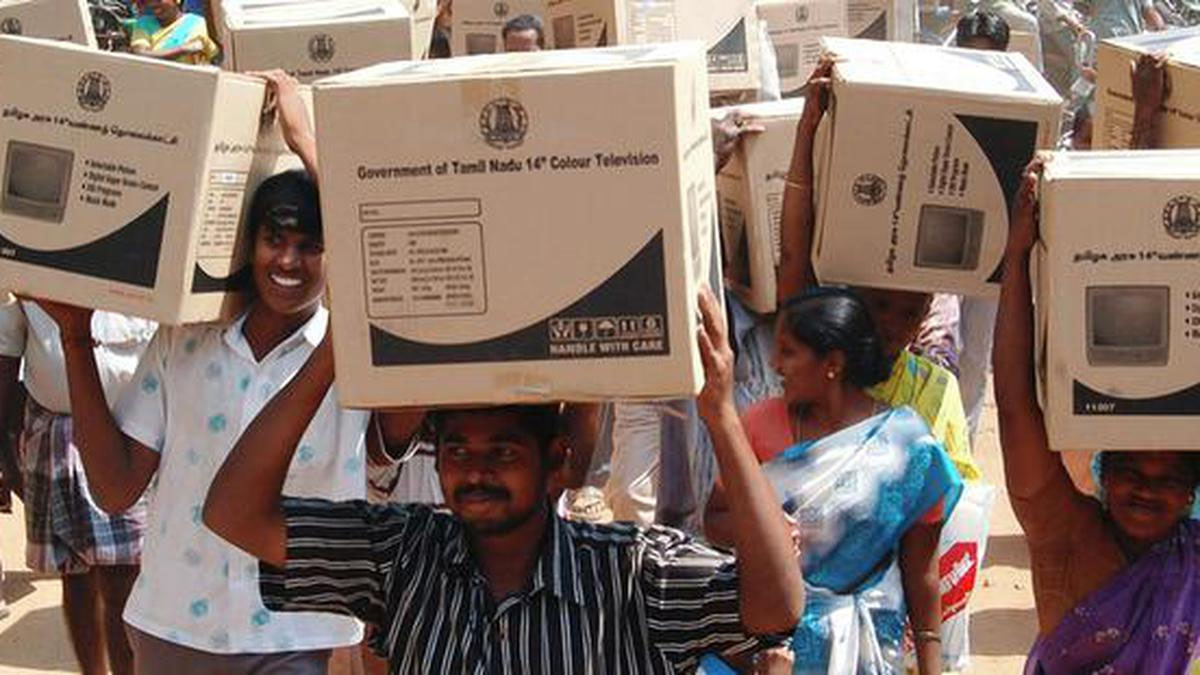
Beware Voters: With less than two weeks left for Bihar’s high-octane poll tamasha be ready to open your purse strings as Parties and netas roll out a perfect electoral cake iced with populist schemes, luscious lip-smacking freebies galore for one and all. Merrily converting political sops into vote percentages wherein social and economic upliftment is weighed on vote-bank political scales. On the assumption populist hand-outs yield better electoral rewards than reasoned policies and sustainable programmes. Whereby, sound economic sense is surrendered to political gamesmanship. After all, our money is neta’s money!
NDA’s JD(U) Chief Minister Nitish Kumar promises to provide 10 million job opportunities to State’s youth over next 5 years. Over 12 million women granted Rs 10,000 each to start businesses, remaining women who want to run businesses will be paid Rs2 lakh. Old age pension will increase from Rs 400 to Rs 1100.
BJP assures one crore jobs in next five years after disbursing Rs 10,000 each to 75 lakh women beneficiaries under Mukhyamantri Mahila Rojgar Yojana. Clearly, forgotten is Prime Minister Modi crying halt to free “revadi” culture.
INDIA Mahagathbandhan RJD leader Tejashwi Yadav announced: One Government job to each household, permanent job to jeevika didis with monthly salary of Rs 30,000, waiving interest on existing loans, double allowances of Panchayati Raj representatives, hikes margin of those working in public distribution network, pension and insurance coverage of Rs 50 lakh.
Raising a moot point: Where do netas get monies to fund doles? Obviously, taxing people. Should our hard-earned tax money be used to boost Parties electoral vote-banks? Shouldn’t leaders, Parties pay from their pockets or funds? Are freebies different from subsidies? Are they good and bad hand-outs? Who decides?
True, Parties are obliged to be seen as populist in the no-holds-barred free-for-all electoral race, as it would be stupid to wish away political lollipops to entice voters. Correct, cheap rice, wheat or free electricity assurances can be justified. Aren’t such concessions imperative in a country where 70% people live below poverty line, hungry stomachs feed on enticing neon lights of fast food, rummage in garbage bins for rat-infested left-overs’ and 600 million earn less than Rs 50 a day. Is it not our leaders’ duty to take care of citizens?
Certainly, but one should never mistake political rhetoric for reality. Politicians of all hues cry hoarse for “better deal for poor.” Those who want water have been given watershed management programmes. Those who want naukri have been handed NREGA. Debt-laden farmers have got loan waivers. More trees, not coveted mangoes!
However, given the level of dishonesty, populism and irresponsibility which increasingly governs our political system along-with a leech-infested environment of the uundata takes it all and the economic logic there is no such thing as a free lunch, the measures announced are invitation to disaster as a populist scheme is invariably paid for either in the form of higher taxes or increasing inflation.
Underscoring, what ails India and its burgeoning poor is not poverty, which can be corrected, but the ruthless heartlessness of our netagan who not only lack humility and empathy for the garib. Worse, it exposes their sheer ennui and paucity of ideas along-with accentuating their moral bankruptcy. And a perspective completely divorced from reality.
Bluntly, political promises in the economic sphere should not cross prudence limits, where it starts hurting the economy. None sees the danger of economic derailment as the biggest losers are the poor in whose name freebies are justified. Sadly, there is no agency which can stop public funds from being wasted, despite views expressed by committees.
Plainly, we pay taxes for growth and development, better educational institutions, health care, hospitals, infrastructure etc. By providing voters free candies citizens have become dependent on netas resulting in no empowerment. Consequently, people are unable to critically evaluate leaders.
Ironically, vote-pressure has given birth to bigger irony for Parties whereby scarce fiscal resources are diverted from investments that could be beneficial to poor in long-term to boost short-term consumption which does nothing to solve the larger systemic problem of inequality.
See how BJP-Shiv Sena-NCP’s Maharashtra’s public finances are in a mess due to Ladki Bahin Scheme burden which provides Rs 1,500 per month to women who earn less than Rs 2.5 lakhs per year.
Congress Himachal Government is struggling to fulfil its poll promises amid significant debt burden. In BJP’s Madhya Pradesh Ladli Behna Scheme was a game-changer but Government is groaning under severe financial burden. Punjab’s AAP Sarkar whose outstanding liabilities stand at Rs 3,51,130 crore is unable to abide by its poll promises.
Consequently, with cash handouts hardwired into manifestoes Parties expose their hypocrisy —everybody uses such schemes — but accuse each other of doling revadi underscoring India’s systemic and symptomatic broken political economy than bad political intent. True, growth has created wealth and upward mobility for a section of Indians. But a large majority is living a life of extreme poverty and precarity. Unless they reap rewards of growth, they will continue expecting fiscal palliatives in return for political support.
Alas, successive Governments in their quest to garner votes have taken on spending commitments in areas they shouldn’t have entered if division of spending areas for Centre-States were followed. Resulting, in squeeze on resources for strategic sectors like defence. BJP has mastered this model by using centrally-funded schemes to generate political tailwinds. Hence, increasing insecurity of Opposition Parties which add fuel to fire by seeking political insurance from populism.
What next? One, make it obligatory for Parties to inform EC where they will get monies to implement free giveaway once elected. Will they raise taxes or reduce allocation for programmes? Two, Parties should offer permanent solutions instead of seemingly advantageous, but temporary stop-gap measures. Three, EC should penalize Parties who use quick exploitative mechanism to win votes.
The Supreme Court which voiced apprehension vis-a-vis necessity for increased accountability recently, cautioned against unchecked welfare programmes that could potentially compromise a State’s financial well-being and mooted a committee of Government, Niti Aayog, Finance Commission, RBI and Opposition to brainstorm “dispassionately and make recommendations two years ago, but mum is the word from Government.
Unless the economy boosts and tweaks its dynamics to create remunerative opportunities for the underclass, demand for more and more welfare schemes is unlikely to dissipate soon. It’s only a matter of time before this political survival manoeuvre ends up overwhelming the fiscal capabilities of Government.
Clearly, leaders must draw a distinction between welfarism and populism. Welfarism takes needs of different sections of society as part of a large development framework. Populism is purely guided by vote-banks, granting concessions which have no economic rationale or are part of larger Governmental economic planning. It provides immediate succour at the future’s expense. It is no remedy for education and health neglect, faulty industrialization and under-investment in rural areas.
Time our leaders concentrate on the big picture. The real significance of any electoral battle is that unless the problem of poverty is substantially resolved and efforts made to reduce number of people in need of handouts, fake promise will continue to entice voters which could endanger our democracy. Time to draw a ‘lakshman rekha’ on vote-bank politics as democracy cannot allow exercise of public funds as private spending. What says you? —- INFA
 Follow our WhatsApp channel
