

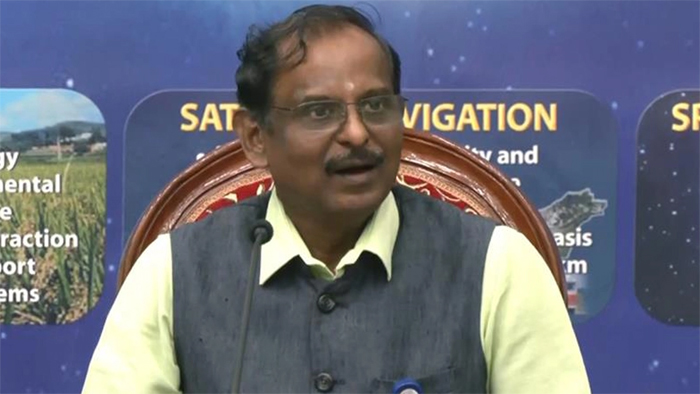
HYDERABAD, Nov 24: India’s space programme has travelled an extraordinary distance – from transporting rocket parts on bicycles to launching advanced satellites for global customers – ISRO Chairman and Secretary, Department of Space, Dr V Narayanan, said.
In his keynote address at the 68th Annual Day celebrations of the Indian Railways Institute of Signal Engineering and Telecommunications (IRISET) in Secunderabad, Dr Narayanan drew parallels between the evolution of Indian Railways and India’s space capabilities, noting that both sectors, despite starting modestly, have grown into critical national assets delivering safety, connectivity and technological excellence.
He recalled how India’s first small rocket was launched on November 21, 1963, from Thumba – a US-supplied vehicle at a time when the country lagged six decades behind advanced spacefaring nations.
“From carrying payloads on old bicycles and rockets on bullock carts to launching cutting-edge satellites built entirely in India, the transformation has been phenomenal,” he said.
Dr Narayanan spoke at length about major milestones that have shaped the country’s space journey.
He mentioned the landmark SITE experiment in 1975, when educational programmes were beamed to 2,400 villages across six states, marking India’s entry into mass communication. From that stage, India has gone on to develop and launch 133 satellites, including high-throughput communication systems such as GSAT-11 and the recently launched CMS-03 for strategic purposes.
He underlined India’s growing stature in planetary missions, from discovering water molecules on the Moon through Chandrayaan-1 to making history with the Mars Orbiter Mission, which succeeded on its very first attempt – a feat no other nation has achieved.
He also traced the evolution of launch vehicle technology, recalling the partial success of the first SLV-3 launch in 1979, a project led by Dr A P J Abdul Kalam, and the long road that followed.
India today has six generations of launch vehicles, capped by the country’s 100th successful launch earlier this year, which Dr Narayanan described as a moment written in “golden letters” in India’s history.
He noted India’s recent success in docking technology, where the country became the fourth in the world to demonstrate satellite-to-satellite docking – a capability that will be vital for future manned and orbital missions.
The ISRO chairman pointed to the rapid strides in Earth observation as well. This year witnessed the launch of a sophisticated Earth observation satellite in collaboration with NASA, where the Indian-built satellite bus and instrumentation were developed at a fraction of international costs.
He added that next month India will launch a 6,000-kg US communication satellite on a commercial basis using an Indian rocket, signalling how the country has become a trusted and competitive global launch services provider.
Dr Narayanan emphasised that space applications today touch almost every sphere of life – from weather forecasting and real-time fishing advisories to crop monitoring, disaster warning and national security.
Recalling the devastation caused by the 2004 tsunami near his hometown, he said satellite-based early warning systems have since helped reduce casualties significantly during cyclones and other natural disasters.
He shared that ISRO has mapped flood-prone regions across the country and flagged areas where railway lines and roads should be avoided because of long-term risks. ISRO, he said, is also ready to support Indian Railways with satellite-based communication by offering its spare transponder capacity.
Looking ahead, he outlined ISRO’s ambitious roadmap for the coming decade.
India is preparing for the Gaganyaan human spaceflight mission scheduled for 2027, followed by the launch of its own space station by 2035 and a lunar landing mission using an Indian rocket by 2028.
He noted that the recent suborbital mission involving Indian astronauts trained in the United States demonstrated the strength of India’s training ecosystem, which he said is “second to none.” ISRO also plans to triple its current satellite fleet within the next three years as part of its enhanced national service mandate.
The event was attended by South Central Railway General Manager Sanjay Kumar Srivastava, Additional Member (Signal) Railway Board Rajesh Kumar Pandey, Additional Member (Telecom) Railway Board Shailesh Gupta, IRISET Director General Sharad Kumar Srivastava and several senior officials.
(UNI )
 Follow our WhatsApp channel
