

jerzy wójcik
Contrary to optimistic vision of stabilisation and economic development in the Middle East contained in Trump administration’s US strategic documents, Israeli political elites appear to perceive the coming years as a period of systemic uncertainty. From their perspective, Israel is at a historic turning point that justifies pursuing policies that maximize strategic goals, even at high international cost. The goal is to gain acceptance for the vision of a single state in the Palestinian territory.
Regardless of whether the Palestinians will have a broader or more limited scope of presence and self-government in West Bank, it should be assumed that by 2028 the strategy of the government of Benjamin Netanyahu will be focused on three aims.
One, the annexation process of parts of West Bank, while maintaining limited Palestinian representation in selected areas, could be seen as a strategic goal. A permanent change in the status of this territory could be seen as a strategic goal, assuming the most densely populated Palestinian areas would remain under the control of their inhabitants and function under a formula of limited self-rule. Such a solution would also have a political and image-building dimension, allowing, on the one hand, to limit pressure from the international community and, on the other, to present the existence of Palestinian enclaves as an alternative to a full two-state solution.
Two, the voluntary or forced relocation of a portion of the Palestinian population from the West Bank. In conditions of international instability, this process could be staggered and hybrid, combining elements of forced migration with formally voluntary migration, implemented through both direct and indirect actions. Strategically, this would mean striving to reduce the Palestinian population in Judea and Samaria.
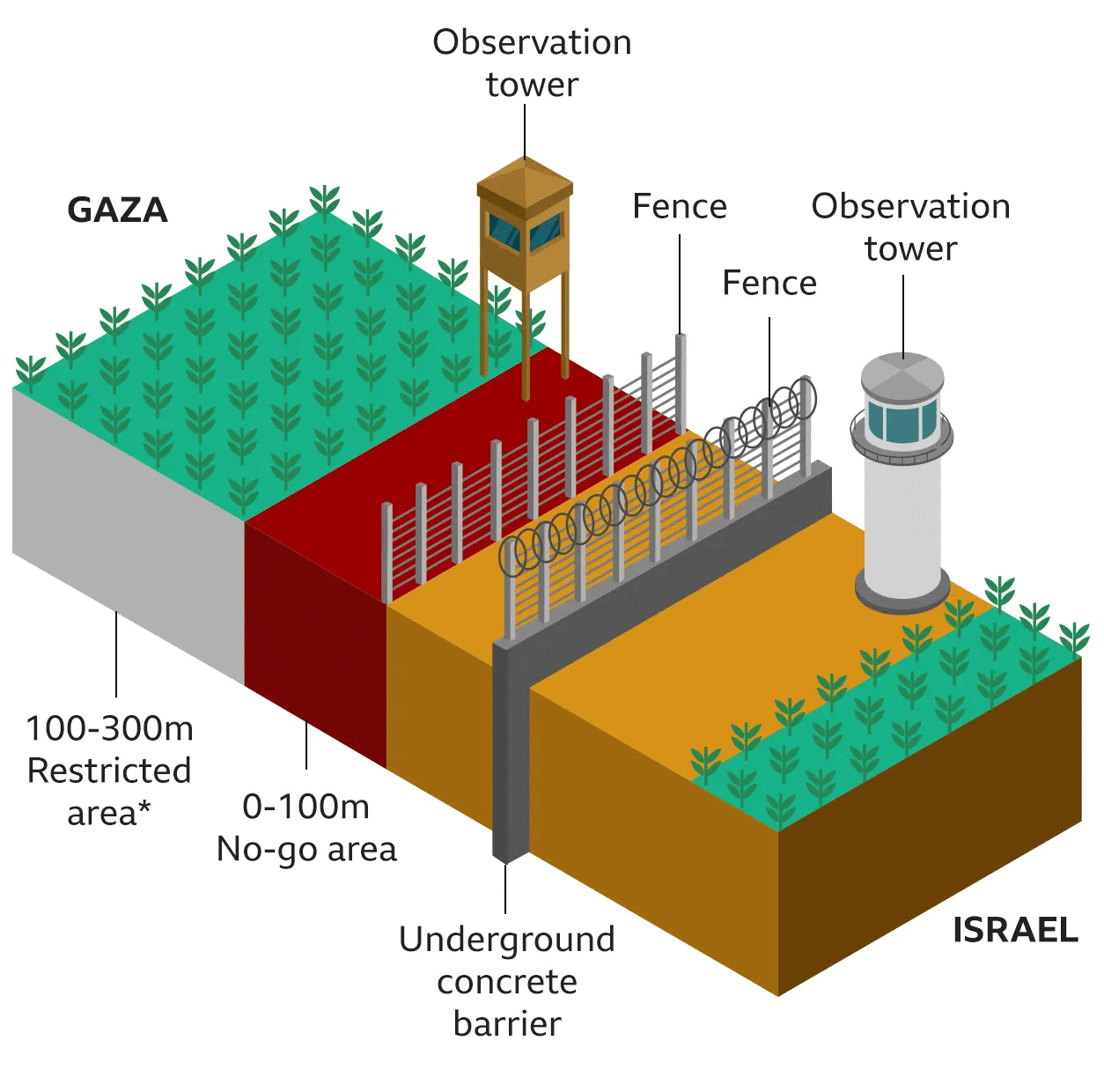
Three, pursuing an offensive-defensive policy towards the Gaza Strip, the nature and intensity of which will depend on the evolving security situation in the area. It can be assumed that the Israeli government’s policy will largely depend on development of the situation in the area. If the presence of international military forces reduces the terrorist threat, stabilises the situation, and creates conditions for infrastructure investments, Israel may allow implementation of the so-called Trump Plan. However, if the developments are deemed unfavourable from a national security perspective, the possibility of renewed, controlled military escalation should be considered, which will effectively block the reconstruction process in this territory.
The pursuit of a lasting resolution of the status of the territories of historic Palestine should be viewed as a central element of Israel’s strategic calculation. West Bank is crucial for Israel, both from a security perspective and in terms of historical and identity considerations, and its formal or de facto integration into the Israeli political and spatial system remains a fundamental goal of the current policy of Netanyahu’s government.
The Gaza Strip occupies a more ambivalent position within this strategy. On one hand, its permanent integration into Israeli security system cannot be ruled out, but on the other, under favourable conditions, it could become part of a broader regional and international agreement. Maintaining it in a state of controlled uncertainty, however, seems more likely, limiting political and strategic costs while simultaneously maintaining full freedom of action. The long-term prospects for Gaza’s potential reconstruction must also be borne in mind. Repairing the infrastructure damage alone is estimated to take 10–15 years, meaning that the implementation of more extensive economic and spatial projects would have to be spread over at least a dozen years.
Consequently, Israeli strategic planning assumes a functional separation of two theaters: the Gaza Strip and West Bank. While the former remains a space for conflict management and an instrument in regional relations, the latter represents a fundamental priority in geopolitical, cultural, and religious dimensions, as well as a key area for long-term transformation of the territorial reality.
Many indications suggest that Israeli strategic planning is currently being conducted within the timeframe set by Trump’s second term. This period can be viewed in Jerusalem as a window of opportunity, enabling fundamental territorial and structural changes with relatively limited political costs in relations with US.
At the same time, Israeli security elites must assume a scenario in which, after 2028, Washington will no longer play the role of guarantor of regional security to the same extent as before. This stems from both the evolution of American strategic doctrine and changes in public opinion in US. Support for Israel’s policy in Gaza Strip remains low, which will influence the long-term calculations of subsequent administrations, regardless of their party affiliation.
At the same time, a gradual erosion of Israel’s relations with some European countries is visible. Although it maintains relatively stable relations with selected Central European countries, as well as with Germany and Austria, in the long term, the political directions of Israel and the European Union may increasingly diverge. This necessitates a redefinition of the current security model, which is largely based on the American strategic umbrella and political support from the West. In this context, Israel’s new security architecture must consider a scenario of partial strategic autonomy, understood as the ability to function with limited support from US.
This is not just about increasing military self-sufficiency, but also about building regional security systems that could function independently of the Palestinian component and creating physical buffer zones that would strengthen the state’s strategic depth. In this context, maintaining control over the Golan Heights, the recurring concepts in Israeli debate of re-establishing a security zone in southern Lebanon, activity in unstable Syrian areas, and the strategic role of the Jordan Valley are particularly important.
A key element of Israel’s strategy is relations with India, maintaining channels of communication with Russia, especially in context of Syria and Moscow’s relations with Tehran, and deepening cooperation with Persian Gulf states are gaining importance. In the long term, Saudi Arabia’s position will be crucial, as it remains the main variable determining the durability of a regional security system based on logic of Abraham Accords.
From Israel’s perspective, the most desirable scenario would be the creation of a regional security system focused on containing Iran, functioning independently of a resolution to the Palestinian issue. However, the greatest barrier to implementing such a model remains Riyadh’s current policy, which makes full normalisation of relations contingent on progress on Palestinian issue.
The process of shaping a new security architecture includes actions aimed at eliminating the strategic threat to Israel, which remains the Islamic Republic of Iran and its network of affiliated non-state actors (so-called proxies). Elements of this strategy have been visible over the past two years: in actions against Hamas, in strikes against Hezbollah’s military infrastructure in southern Lebanon, and in attacks on nuclear and military installations in Iranian territory.
.
The escalation at the turn of February and March 2026, however, goes beyond the need for tactical neutralization of the threat. It has strategic and psychological significance. Its goal is, of course, to reduce Iran’s military capabilities, but also to demonstrate to Muslim states of Middle East that Israel aspires to be the dominant military power in the region. The strategic base thus built is intended to act both as a real projection of power towards Arab states and as a tool of deterrence.
The second dimension of this strategy remains the continuation and expansion of the Abrahamic Agreements, albeit within a modified political logic. Until now, the normalization process has been characterized by relations between formally equal partners. In the current geopolitical situation, this dynamic may change. Arab states may find themselves under increasing psychological pressure stemming from the belief that remaining outside the system of regional agreements with Israel will have tangible consequences for their security. From a different perspective, regional states may seek to deepen strategic relations, including in military and defense dimensions, with powers such as China and India.
For Israel, the expansion of the Abrahamic Accords remains a key strategic objective in the process of building a new security architecture. For Saudi Arabia, the Palestinian issue remains an obstacle to normalizing relations. This very area may become the subject of intensified diplomatic activity. From Israeli perspective, the new security structure is based on two parallel processes: changing the status of West Bank and normalizing relations with Riyadh. With its growing military superiority, Israel may seek to exert political pressure on Saudi leadership to marginalize the Palestinian issue or partially exclude it from the normalization process.
The reduction of American security guarantees in Middle East, combined with growth of Israel’s regional military advantage, may induce Saudi Arabia to fundamentally redefine its policy towards the Palestinian issue and to revise its current support for the two-state concept. Solution, and Israel itself may take additional military and diplomatic initiatives to accelerate the process.—INFA
 Follow our WhatsApp channel
