

Dr Vijay Sagar Dheman
motivatedvijay128@gmail.com
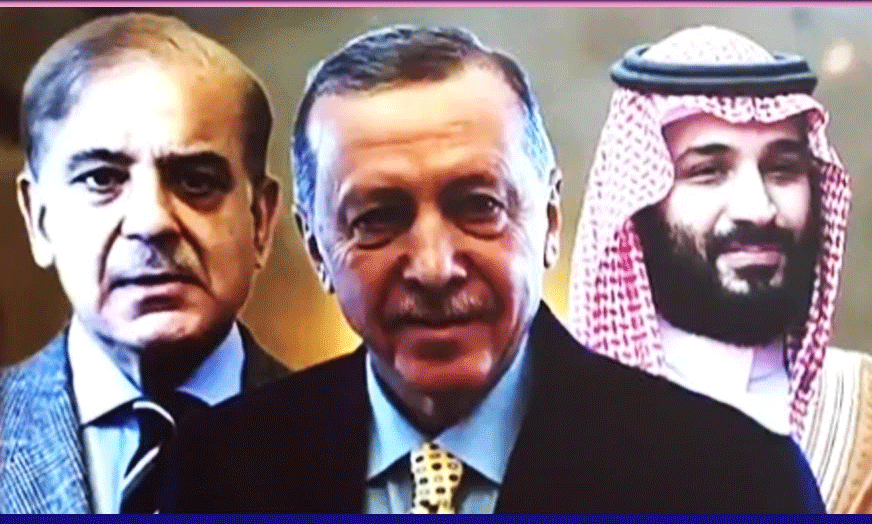
Within the marble corridors of power extending from Ankara to Riyadh and Islamabad, a quiet yet significant transformation is taking place. Three nations, each motivated by unique strategic ambitions, are converging towards a common vision i.e a collective defence framework that adopts its most provocative principle from NATO, the notion that an attack on one is an attack on all. This emerging alignment, often referred to as the “Muslim NATO,” signifies more than mere diplomatic posturing; it potentially signals a redefinition of the regional security landscape that warrants meticulous analysis and a considered response from New Delhi.
Recent reports indicate that Turkey is making significant progress in negotiations to join a strategic mutual defence agreement with Pakistan and Saudi Arabia. This isn’t merely symbolic; the agreement reportedly includes language very similar to NATO’s Article 5, underscoring its significance and commitment. If Turkey joins officially, it would create a strong three-way partnership. Each member contributes unique strengths: Turkey provides valuable combat experience and a developing defence industry, Saudi Arabia adds energy influence and strategic reach within the Islamic world, and Pakistan’s robust nuclear deterrent becomes the cornerstone of this alliance.
India already recognises Turkey’s active role. During the four-day Operation Sindoor in May 2025, a tense military stand-off between India and Pakistan, Ankara was far from merely watching from afar. Turkish operatives were present on the ground, actively supporting Pakistan by supplying hundreds of drones and loitering munitions, including the well-known Bayraktar TB2s. Turkey has become an integral part of Pakistan’s military scene, assisting in building Babur-class corvettes and helping keep the F-16 fleet operational. For Pakistan, this partnership provides a much-anticipated benefit: political support and military collaborations that could reduce India’s usual diplomatic edge.
Riyadh’s involvement truly signals a meaningful shift away from its historically balanced relationship with New Delhi. The main catalyst seems to be a growing waning trust in American security guarantees. As Washington’s interest in Middle Eastern commitments lessens, regional powers are increasingly creating their own security arrangements to feel more independent from the West. For Saudi Arabia, Pakistan presents a convenient military partner with nuclear capabilities, making the partnership even more significant.
Despite the strong appearance of this new bloc, India is actually quite connected. New Delhi has been building strong, meaningful partnerships. For example, its relationship with Israel has grown beyond simple transactions; Israel is now an important partner in developing advanced technologies like the Barak-8 missile system.Moreover, India is actively building stronger bonds with Greece and Cyprus, countries that see Turkey’s regional actions as a concern. By boosting its naval activities in the Mediterranean and engaging with the I2U2 group (which includes India, Israel, UAE, and the US), India is clearly demonstrating its growing strategic presence.
This alignment shows a positive shift away from old assumptions. Regional powers are increasingly trusting one another locally and creating flexible, overlapping partnerships. For India, the approach is neither alarmed nor complacent but clear and focused. Turkey has stepped out of neutrality; Pakistan is exploring new alliances; and Saudi Arabia is expanding its options. India’s real strength is in its ability to adapt quietly and wisely-through careful partnerships and locally made defence systems. In today’s world, where alliances are constantly changing, flexibility truly becomes the most powerful tool.
(The author is a Geopolitical Affairs Expert)
 Follow our WhatsApp channel
