

TEHRAN, Mar 9: In the latest developments in the ongoing Israel-Iran war, Tehran on Monday accused the United States and Israel of attempting to fragment the country and seize its oil wealth, even as fighting intensified across the region and Iran launched fresh strikes against US and Israeli targets.
Iran’s armed forces carried out the 30th round of strikes against US and Israeli targets in the Middle East, deploying drones along with hypersonic and ballistic missiles, according to the Islamic Revolutionary Guard Corps (IRGC).
The IRGC said the strikes were part of “Operation True Promise 4,” which it claimed achieved “complete success” by hitting US bases in the region and locations in what it described as the “northern occupied territories.”
The operation reportedly involved Khorramshahr, Fattah and Kheibar missiles along with strategic drones.
The strikes came as Mojtaba Khamenei, son of Iran’s late supreme leader Ayatollah Ali Khamenei, was named the country’s new supreme leader amid the intensifying conflict.
US President Donald Trump had earlier described Mojtaba as an “unacceptable” choice, while Israel warned it would target any successor.
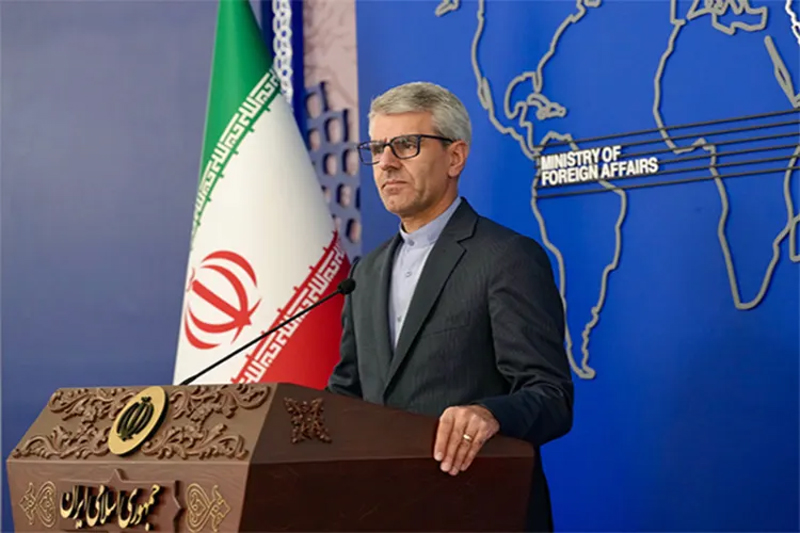
Speaking at a press briefing in Tehran, Iranian Foreign Ministry spokesperson Esmaeil Baghaei alleged that Washington and Tel Aviv were pursuing a broader geopolitical agenda.
“The US and Israel want to fragment the country and take over its ‘oil riches,'” Baghaei said, condemning ongoing military strikes on Iranian territory.
He ruled out talks or mediation at the current stage of the conflict.
“As we speak, military confrontations are still under way. At this particular point, speaking of any matter other than ‘defending our homeland’ is irrelevant,” he said.
Baghaei asserted that Iran did not initiate the conflict, describing it as “not a war of choice” but “a war of necessity that was imposed on us.”
He also accused Washington of having “torpedoed” diplomatic talks that were under way before the latest attacks on Iran.
At the same time, he said Tehran remained “adamant to maintain good and friendly relations” with neighbouring countries, while retaining the “right to defend” itself if other states allowed their territory to be used for attacks against Iran.
Meanwhile, the war has triggered economic shockwaves globally. Oil prices surged past $100 per barrel, prompting G7 finance ministers to consider a joint release of strategic reserves as energy markets reacted to escalating attacks on regional infrastructure.
European stock markets and US futures also fell sharply, reflecting growing concerns over the global economic fallout from the expanding Middle East conflict.
Saudi Arabia strongly condemned what it described as Iranian attacks targeting the Kingdom, Gulf Cooperation Council (GCC) states and other regional partners.
In a statement, the Saudi Ministry of Foreign Affairs said the attacks on civilian infrastructure, airports and oil facilities were unacceptable and violated international law.
The Kingdom said it “reserves its full right to take all necessary measures to protect its security, sovereignty, and the safety of its citizens and residents.”
Saudi Arabia also rejected Iranian claims that its fighter jets and refuelling aircraft were preparing to participate in the war, saying the aircraft were deployed only for air patrols to monitor and protect the airspace of the Kingdom and GCC states from Iranian missiles and drones.
The escalating confrontation has raised fears of a wider regional war as military exchanges continue and diplomatic efforts remain stalled. (UNI)
 Follow our WhatsApp channel
