

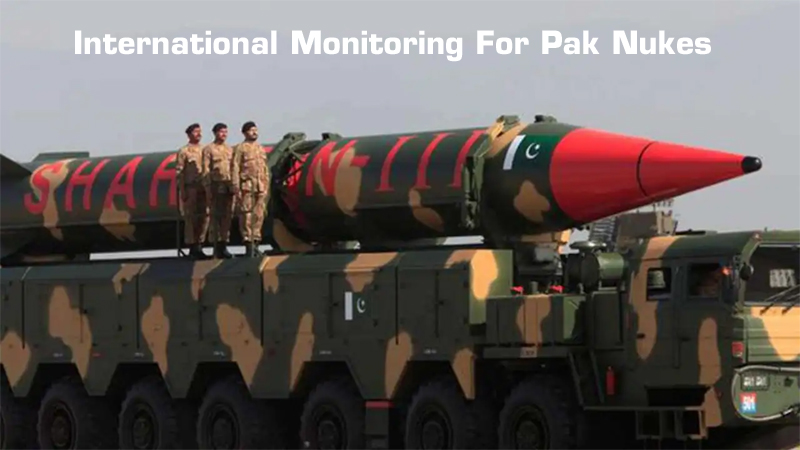
Defence Minister Rajnath Singh’s remarks in Srinagar, calling for Pakistan’s nuclear weapons to be placed under the supervision of the International Atomic Energy Agency, are both timely and rooted in compelling geopolitical and security realities. While such a statement inevitably invites diplomatic ripples, it must be viewed through the prism of regional stability, global nuclear norms, and the increasing volatility in Pakistan’s internal and external affairs. Pakistan’s nuclear capabilities have long been a matter of global attention. Although both nations claim responsible stewardship over their arsenals, the global community must acknowledge a stark difference in reputational, procedural, and institutional control mechanisms between the two countries.
India has consistently demonstrated restraint, maintaining a “No First Use” doctrine and a transparent command-and-control structure. In contrast, Pakistan’s nuclear posture remains ambiguous and doctrinally aggressive, with an emphasis on first use in a conventional conflict scenario. The repeated veiled and overt nuclear threats issued by Pakistani political and military leadership against India only compound concerns about its nuclear maturity and intent.
Pakistan has repeatedly demonstrated rogue behaviour through irrational actions and chronic political instability. No democratically elected Government has completed a full term since its independence; former Prime Ministers have been hanged or imprisoned, exposing deep-rooted anarchy. Uniquely, Pakistan is the only nuclear-armed state that openly uses terrorism as a tool of state policy, with top global terror groups operating from its soil. Its inaction against terrorists and repeated nuclear threats to India amount to blatant nuclear blackmail and pose a grave danger to global security.
DM’s concerns underscore a persistent threat: What happens if nuclear weapons fall into the wrong hands in a politically fragile state? Pakistan’s internal landscape has deteriorated significantly in recent years. Political instability, military overreach into civilian affairs, economic collapse, and the resurgence of radical militant outfits such as Tehrik-i-Taliban Pakistan present a complex security threat. In such an environment, the risk of nuclear proliferation-either through state-sanctioned channels or rogue elements-is not hypothetical but real. The world has not forgotten the legacy of A.Q. Khan, the Pakistani nuclear scientist who masterminded a vast proliferation network that supplied nuclear technology to countries such as North Korea, Iran, and Libya. The lack of accountability and transparency since then raises legitimate concerns about the integrity of Pakistan’s nuclear command. Additionally, with Pakistan’s increasing strategic alignment with China and continued covert patronage of terrorist proxies, there are worries that its nuclear program could be used as leverage in regional or ideological power plays. This is not merely an Indian concern but one that reverberates through every capital that seeks to ensure non-proliferation and regional peace.
The IAEA, a United Nations body responsible for promoting peaceful nuclear energy use and preventing its weaponisation, serves as a neutral and credible mechanism for oversight. Several non-NPT states, including India, have permitted IAEA inspections at civilian facilities, affirming their commitment to transparency. However, Pakistan’s nuclear weapons program, being outside the NPT framework, has largely avoided this scrutiny. Bringing Pakistan’s nuclear arsenal under IAEA supervision means subjecting its command, storage, and transport protocols to international norms and periodic verification.
Such oversight could serve multiple purposes: it could deter proliferation, reduce the risks of unauthorised use, and provide the international community with a measure of assurance. India’s call for IAEA supervision is not a unilateral demand but a proposal for collective responsibility. The world cannot afford to be reactive when it comes to nuclear security. The tragic consequences of miscalculation, unauthorised use, or nuclear terrorism would be global, not regional. It is a wake-up call for the world. The UNSC, the NSG, and key global powers must take this proposal seriously and initiate a dialogue with Islamabad under the umbrella of multilateral diplomacy. Security assurances, technical cooperation, and phased transparency could be negotiated in exchange for Pakistan’s agreement to bring its arsenal under international observation. DM’s statement should not be dismissed as rhetoric. It is a genuine call for peace through accountability and security through transparency.
 Follow our WhatsApp channel
