

Prof. D. Mukherjee
Industrial revolutions mark pivotal moments in human history, bringing not only technological breakthroughs but also profound social, economic, and political transformations. The 19th-century Industrial Revolution in Britain and Europe shifted societies from agrarian economies to mechanized industrial centres, unleashing unprecedented productivity and wealth, reshaping urban landscapes, and redefining global trade. Yet, alongside these gains came severe social disruptions, labour exploitation, and environmental degradation. These contradictions prompted intellectual and ideological critiques, most notably by Karl Marx and Friedrich Engels, who exposed the human costs of industrialization and called for structural reforms to address inequality and worker alienation.
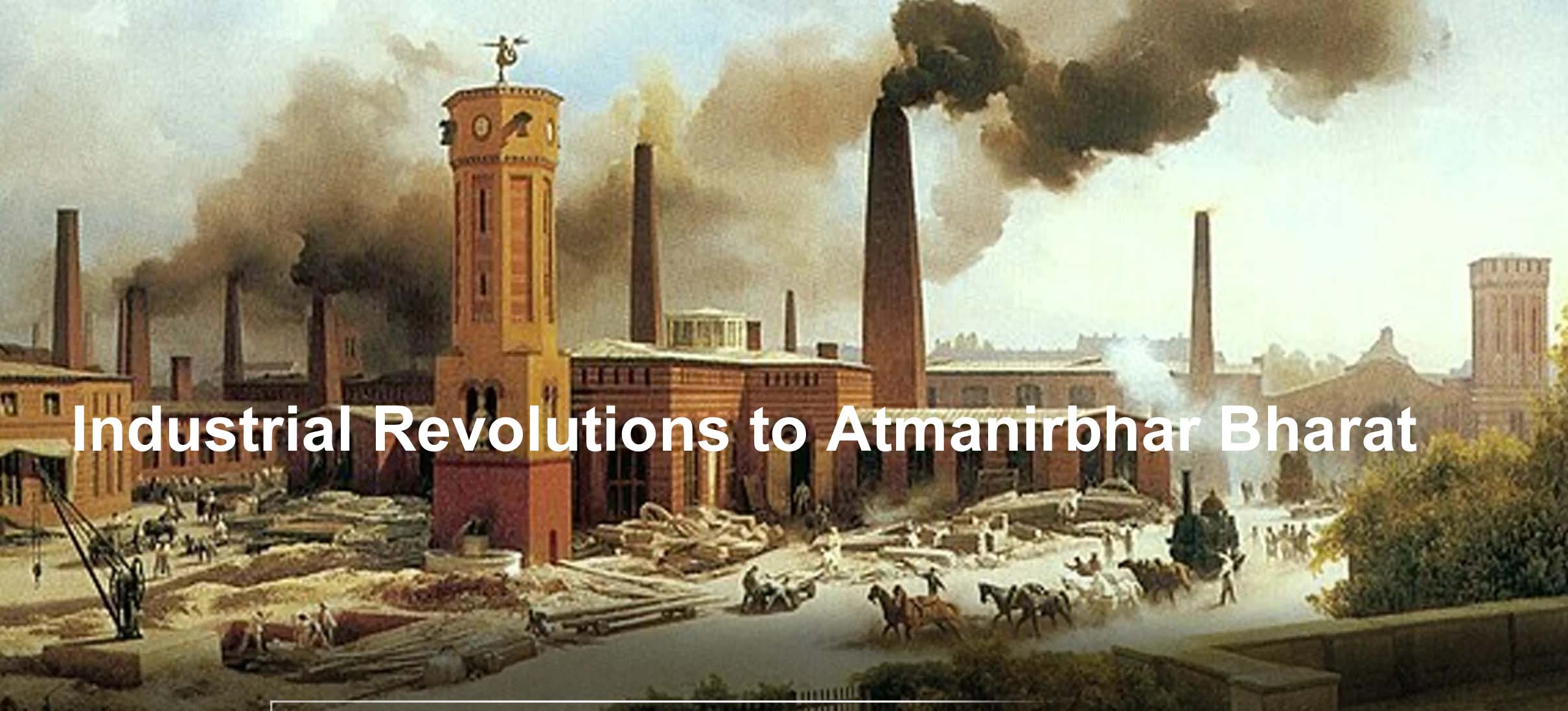
Over a century later, Deng Xiaoping’s pragmatic reforms transformed China into the world’s industrial hub, illustrating the value of gradual economic liberalization, technological adoption, and global integration. India today faces a comparable challenge under the Atmanirbhar Bharat Mission, seeking to build a self-reliant and globally competitive industrial base. However, weaknesses in skills, technology adoption, firm dynamics, supply chains, and research and development constrain progress, demanding a strategic and holistic approach.Britain’s industrial transformation was fuelled by innovations such as the steam engine, mechanized textile production, and the spinning jenny, supported by railways, canals, and improved communication. These changes made goods more affordable, expanded literacy and education, and turned urban centres into economic and cultural hubs. Industrial capitalism also influenced political modernization, shaping labour laws, social welfare, and education policies that continue to inform contemporary industrial development.
However, these gains came at a significant human cost. Labourers, including women and children, endured long hours in unsafe and poorly paid work environments. Urbanization often outpaced infrastructure, resulting in overcrowding, poor sanitation, and disease. Industrialization also accelerated environmental degradation, with coal smoke and factory waste polluting air and water. Colonial exploitation further amplified these inequalities, as European powers extracted raw materials and imposed trade structures favouring metropolitan centres. The Industrial Revolution, therefore, was both a boon and a bane, generating progress while exposing profound social and ethical contradictions.
The harsh realities of early industrial society provided the context for Karl Marx and Friedrich Engels’ critical analysis of capitalism. In Das Kapital, Marx argued that the wealth of industrialists was derived from the systematic exploitation of labour, producing “surplus value” at the expense of workers’ dignity and well-being. Engels, in The Condition of the Working Class in England, documented the physical and social suffering endured by factory workers, highlighting urban poverty, child labour, and widespread insecurity.Marx and Engels’ critique went beyond economic analysis; it identified an intellectual and moral bankruptcy in the industrial capitalist system. Workers were alienated from both the product and process of labour, and society increasingly valued profit over human welfare. Their proposed remedy-a classless society in which workers controlled the means of production-remains a reference point for labour rights, social justice, and industrial ethics. Though never fully realized, their insights informed labour legislation, social welfare reforms, and the broader discourse on equitable industrial development, which continues to resonate in modern industrial societies.
The dilemmas highlighted by Marx remain relevant today. Modern industrialization, driven by automation, artificial intelligence, and globalized supply chains, has greatly increased efficiency but also produced social dislocations. Job displacement, precarious employment, and weakened labour protections echo the alienation and exploitation of the 19th century. Environmental degradation, once largely local, now poses global threats through climate change. Industrial societies must therefore balance productivity with social equity and ecological sustainability. Nations that successfully integrate technological advancement, workforce skilling, environmental stewardship, and labour rights demonstrate that industrialization can be both efficient and humane.
China’s experience under Deng Xiaoping illustrates the transformative potential of pragmatic industrial reform. After decades of stagnation under Mao, Deng gradually opened the economy to markets and global trade while maintaining strategic state control. Agricultural de-collectivization, Special Economic Zones (SEZs), and incentives for foreign investment spurred industrial growth. The Beijing Economic Forum of 1987-88showcased China’s methodical approach, bringing together policymakers, intellectuals, and industry leaders to design policies that maximized productivity and socio-economic upliftment. Deng’s gradualist, experimental strategy enabled China to avoid economic shocks while building the world’s largest manufacturing base. Today, China’s industrial dominance highlights the value of combining policy innovation, skill development, technological adoption, and global integration-a model offering lessons for India’s industrial ambitions.
India aspires to follow a similar trajectory under the Atmanirbhar Bharat Mission, seeking industrial self-reliance and global competitiveness. Yet, structural weaknesses have slowed progress. The National Manufacturing Policy of 2011 aimed to increase the manufacturing sector’s contribution to GDP from 16% to 25% by 2022, but by 2025 it remains at 17%, highlighting persistent challenges.A central constraint is the skill deficit: only about four percent of India’s workforce has received formal vocational training, compared to over 70% in Germany and South Korea. This limits the capacity to adopt advanced manufacturing techniques, operate modern machinery, and participate in high-value industrial activities.Technological adoption is equally limited. India’s robot density is less than 10% of China’s, reflecting low investment in automation and digital manufacturing. Consequently, productivity remains constrained, and India risks remaining a labour-intensive assembly hub rather than a creator of high-value products.
The industrial landscape is fragmented. Most firms are small “dwarf” establishments, employing fewer than 100 workers, which rarely upgrade or expand. Larger firms, capable of anchoring supply chains, are too few to create resilient networks. The MSME sector, often described as India’s industrial backbone, is financially and technologically fragile, lacking CNC machines, ISO-certified labs, and internationally recognized quality standards. This structural weakness inhibits India’s participation in high-value global supply chains.Infrastructure and logistics present additional hurdles. Logistics costs account for 14% of GDP-nearly double the levels in Germany and South Korea. While initiatives like the Gati Shakti Mission aim to reduce these costs, implementation remains uneven. Moreover, inconsistent power supply and dependence on imported machinery further constrain industrial efficiency.
Finally, India’s research and development (R&D) culture is underdeveloped. Total R&D expenditure is only 0.7% of GDP, with industry contributing just 36%, far below the >70% industrial share seen in Germany, Japan, and South Korea. Without robust R&D, Indian firms struggle to innovate, develop new processes, and compete in global markets, reinforcing dependence on imported technology.These combined weaknesses leave India on the periphery of global value chains, often confined to low-value manufacturing. Without strategic interventions, the country risks missing the industrial and geopolitical objectives of Atmanirbhar Bharat.
Addressing India’s industrial challenges requires a holistic and integrated strategy. Expanding vocational training is the first priority. Programs should aim to cover at least a quarter of the workforce within a decade, aligned with Industry 4.0 needs, including robotics, AI, and precision engineering. Automation and technology adoption are equally critical. MSMEs, which employ a large share of the workforce, need incentives to integrate robotics, CNC machines, and digital manufacturing tools, thereby enhancing productivity and global competitiveness.Strengthening supply chains is essential. Developing a robust middle layer of tier-2 and tier-3 suppliers, supported through credit access, technology transfer, and cluster-based industrial policies, will stabilize production networks and improve integration into global value chains. Reducing logistics costs through full operationalization of the Gati Shakti mission is also crucial; achieving single-digit logistics costs, comparable to Germany or South Korea, will significantly boost efficiency.Investment in research and development (R&D) must rise to at least 2% of GDP, with industry contributing over half, fostering innovation and moving India from imitation to original technological capability. Cultivating a culture of quality through widespread adoption of Kaizen and Six Sigma will improve processes, reduce defects, and enable Indian manufacturing to meet global standards. Collectively, these measures form a roadmap to transform India’s industrial base and realize the objectives of Atmanirbhar Bharat.
Bridging the industry-academia divide is essential for India’s industrial transformation. Universities and research institutions must align with industry needs, ensuring that research outputs are actionable, commercially viable, and capable of driving innovation. A workforce equipped with relevant skills, supported by dynamic innovation ecosystems, is crucial for sustaining long-term industrial growth.By integrating measures such as skills development, automation, supply chain resilience, logistics efficiency, quality management, and R&D investment, India can move from a peripheral assembly hub to a global originator in manufacturing, fulfilling the vision of Atmanirbhar Bharat and enhancing its industrial and geopolitical standing.
Historical lessons-from the Industrial Revolution in Britain and Marx and Engels’ critique to Deng Xiaoping’s reforms-highlight that industrialization is both a technological and moral endeavour. Economic growth, productivity, and global competitiveness depend not only on capital and technology but also on human resources, quality standards, and resilient infrastructure.India’s challenge is to address structural weaknesses in skills, technology adoption, supply chains, and R&D while pursuing industrial modernization. Achieving these goals will enable industrial self-reliance, meaningful participation in global value chains, and enhanced global influence. The journey toward Atmanirbhar Bharat requires sustained, integrated action-a second Industrial Revolution powered by skill, innovation, and quality, capable of transforming India into a 21st-century hub of manufacturing and knowledge.
(The Columnist is an Educationist, a Management Scientist and an Independent Researcher)
 Follow our WhatsApp channel
