

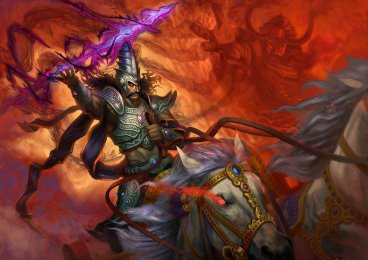
 Ravan received the horrific news of Kumbhkaran’s death. He was told that the half of his dead brother’s monstrous body had sunk into the ocean and the other half, bleeding through numerous cuts, lay astride the gateway to Lanka. Ravan fell down unconscious because of grief. His sons, Devantak, Narantak, Trishira and Atikaye wept piteously on the loss of their uncle.
Ravan felt that he had been reduced to nothing. “Kumbhkaran, my left arm, is gone! With him at my back, I feared neither the devas, nor the asuras,” he wailed. Losing one brother to war, he recalled another brother whom he had lost because he had spoken for peace. He repented his decision to have expelled Vibhishan from his court –
Tasyayamkarmanahpraptovipakoshokdah/
Yanmayadharmikahshriman s nirastoVibhishanah//
I expelled the devout and illustrious Vibhishan from my house, now I have to face the sad consequence of my action.
Balmiki Ramayan/Yuddh Kand/Canto 68(xxiii)
Commiserating with his dejected father, Rakshas Trishira said that the death of his uncle, Kumbhkaran, was indeed a setback for them, but he, the all-powerful Ravan, was still capable of punishing Ram befittingly. He sought Ravan’s permission to take the field for uprooting the enemy. Hearing Trishira’s impassioned speech, his brothers Devantak, Narantak and Atikaye also got ready to join the battle. Ravan detailed two of his brothers, the war-crazy Mahaparshrva and the frenzied Mahodar, for protection of his princes. But like the hopeless condition of a dying man, whose organs perish one after the other, Ravan’s kin were killed along with their myriads of followers as they descended on the battle field.
A desperate Ravan then commanded his surviving son, Indrajit –
Jahi virmahaviyanbhratrouRamLakshmanou/
Adrishyodrishyamanovasarvthatvambaladhikah//
(He said -) “Warrior! May you kill the excessively bold Ram and Lakshman, both the brothers, either covertly or in the open – you are unmatched in your strength and vigour.”
Ibid/Canto 80(iii)
Indrajit bowed to his father and quickly performed a havan before going once again to war. (In his earlier battle he had left Lakshman gravely wounded – see, THE BATTLE HEATS UP, DE, 11 May). Into the sacred fire he plunged a live black billy-goat. Great smoke-less flames rose from the sacrificial pit, symbolising his victory. Riding his four-horse chariot, armed with the weapons such as the Brahmastra and protected by the divine gift of invisibility-at-will, he exclaimed with confidence, “Those who roam in the forests in the fake garb of hermits, I will slay them both – Ram and Lakshman – so as to gift a grand victory to my father, Ravan!”
Roaming invisibly in the sky, he recognised Ram and Lakshman by their well-developed shoulders as they stood on the ground. Deadly arrows began to be shot on both the sides. Indrajit made full use of his invisibility and his magic craft to create complete darkness over the battle-field and shower it alternatively with a hail of stones and rain water. Ram and Lakshman were wounded seriously by his arrows, while he remained unhurt. The Ayodhya princes bled profusely but their resolve to fight him did not waiver in the least. Noticing that, Indrajit gave himself a break and retreated to Lanka.
He had a ploy in mind. With his power of magic, he created an illusory Sita. Carrying her in his chariot, he entered the battle field with a strong force of rakshasas through the western gate of the citadel. The Vanar Sena, with Hanuman at its head, fought them valiantly. Fending off the attacks by his tricks and valour, he taunted Hanuman that the Princess of Videh, Sita, for whom they all were fighting, was in his custody and he was going to kill her before their eyes. Likewise, he asserted, he would kill King Sugriv, Prince Ram, the traitor Vibhishan and all the rest of them. As Hanuman looked on stupefied, Indrajit drew his sword and brought it down heavily on the make-believe wife of Ram. Blood gushed out of the wailing woman as her body was cleft into halves. The rakshas prince yelled at Hanuman triumphantly, “Lo and behold! I have slayed Ram’s beloved wife with my sword. Now, it is fruitless for you to strive in this battle.”
Indrajit’s trick lead to the desired effect. With a heavy heart, Hanuman pronounced to his warriors, “That one has been killed for whom we had been fighting with all our effort, renouncing even the love of life, so we could achieve something dear to Lord Ram. This information should be conveyed to Lord Ram and Raja Sugriv. Whatever retaliation they decide on, that we shall execute.”
Indrajit was so elated by his success that he went straight to the temple of Goddess Nikumbhila to perform an elaborate yagya to express his gratitude to the deity and also to pray for his final victory in the battle.
In the meanwhile, Ram was devastated on hearing the made-up news of his consort’s death. It was none other than Vibhishan who pulled him out of the well of misery. “Lord,” he reasoned with Ram, “I am fully aware of the feelings that the sinful Ravan carries in his heart for revered Sita. He will never allow her assassination…. My nephew, Indrajit, has deluded the vanars. The woman who has been killed was only a make-believe of Sita, not your spouse. Indrajit is now performing a yagya in the Nikumbhala temple. I propose that we should proceed to that temple before he is able to complete his oblations.”
Vibhishan reminded Ram of what Lord Brahma had foretold Indrajit while bestowing on him boons that made him virtually invincible. The only way to finish him off was to kill him before he could accomplish the ritual.
Going by Vibhishan’s counsel, Ram commanded Lakshman to launch an attack on Indrajit and kill him overcoming his magical prowess. Along with Lakshman went Hanuman, Jambwan and Vibhishan as well. The entire Vanar Sena participated in this crucial venture. Guided by Vibhishan, the vanars broke into the ring of the rakshasas crushing them with huge boulders and massive trees. When Indrajit heard that his defences had been broken into, he left the ritual unfinished and rushed towards the enemy in great rage. It was then that Lakshman severed his neck off his body.
Vibhishan rendered a great service to Ram and the latter crowned him the king of Lanka even when the battle was on. But to his own kin, he proved a traitor. Indrajit berated him for his betrayal –
Shochyasatvmasidurbuddhenindniyashchsaadhubih/
Yastvamsvajanmutsrijyaparbhrityatvmaagtah//
O Fool! Discarding your own, you have chosen the servitude of others. Thus, you are condemnable and fit to be mourned by good men.
Ibid/Canto 87/xiii
 Follow our WhatsApp channel
