

Excelsior Correspondent
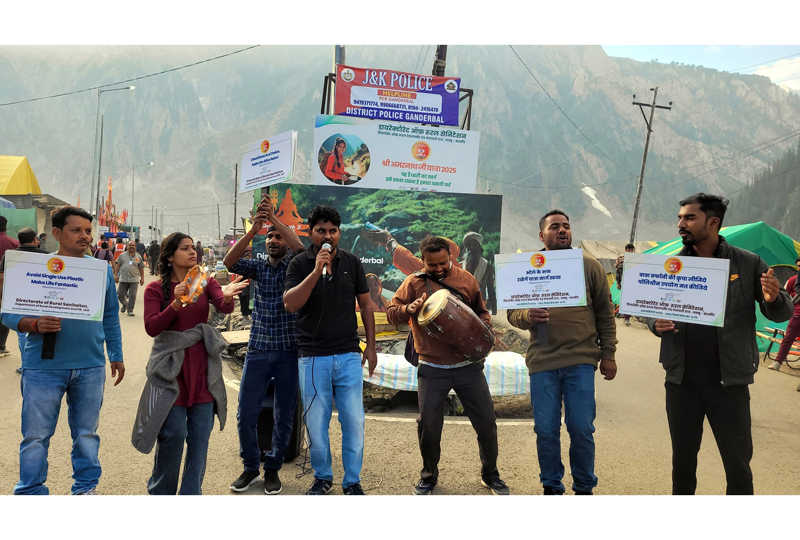
JAMMU, July 5: For the fourth consecutive year, the Indore-based startup ‘Swaha’ has taken the responsibility of making the Yatra route garbage free during this year Amarnath Yatra also.
‘Swaha’ is known for its pioneering waste management initiatives and the monumental task has been entrusted to it by Directorate of Rural Sanitation, J&K Government.
It is estimated that around 550 tons of waste will be generated during this year’s Yatra.
Ejaz Asad, Secretary, Rural Development & Panchayati Raj and Anu Malhotra, Director General, Directorate of Rural Sanitation, shared that earlier, massive amounts of waste were left behind on the hills after each Yatra. However, in the past four years, the scene has transformed remarkably, with the entire Yatra route appearing garbage-free post-pilgrimage.
Swaha co-founder, Sameer Sharma, emphasized that this year too, Swaha is working hand-in-hand with the youth of J&K to clean the mountains and valleys, carrying forward the mission of a zero waste Yatra.
Other co-founders of Swaha, IIT alumni Jwalant Shah and Rohit Agarwal, highlighted the challenge of managing food waste generated by langars. Earlier, leftover food was either thrown into the hills or dumped into the rivers. To tackle this, Swaha is training langar operators to segregate waste at the source, enabling composting. The organization strictly refuses to collect mixed waste, pushing for wet and dry waste separation from the outset.
Additionally, pilgrims are being made aware of sustainable practices and free cloth bags are being distributed from base camps to the holy cave, promoting minimal use of single-use plastics.
This year, Swaha has introduced an innovative mechanical pedal-powered machine, similar to a bicycle, which operates without electricity and is used for waste processing.
“Beyond cleanliness, the initiative also generates employment for local Kashmiri youth, training them and involving them actively in the campaign for environmental protection,” a handout stated.
It further stated that Swaha not only collects and segregates waste but also trains local youth in waste management and recycling.
Compost made from food waste at Langars in Baltal and Pahalgam is distributed to farmers and local municipal councils. Additionally, packets of this organic fertilizer will be given to pilgrims, promoting a circular economy and further reinforcing the message of sustainability.
 Follow our WhatsApp channel
