

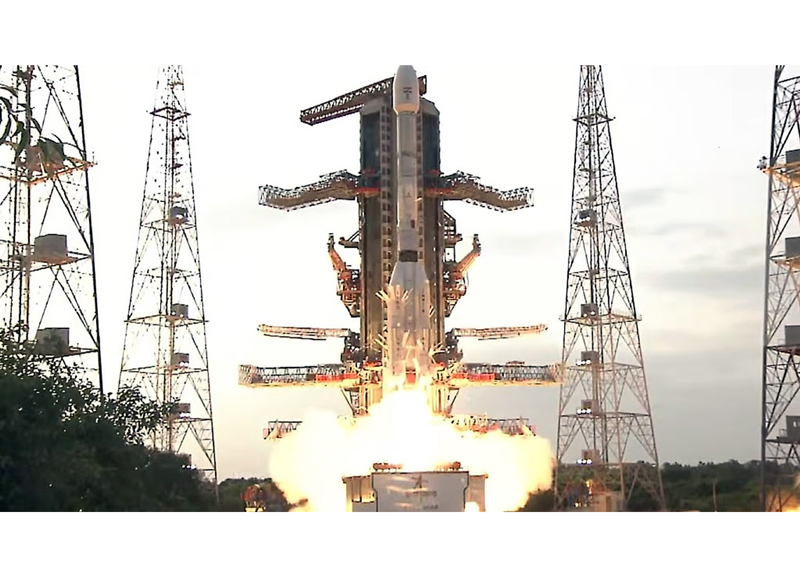
SRIHARIKOTA (ANDHRA PRADESH), July 30: India and the US on Wednesday marked their maiden space collaboration with the successful flight of a GSLV rocket that placed an earth observation satellite, jointly developed by the two space agencies, in a precise orbit.
ISRO’s GSLV F-16 injected NISAR–NASA-ISRO Synthetic Aperture Radar satellite, into the intended Sun Synchronous Polar Orbit (SSPO), after a flight of about 19 minutes and around 745 km.
GSLV “successfully injected NISAR in designated orbit,” ISRO said. Wednesday’s accomplishment follows the unsuccessful PSLV-C61/EOS-09 Mission on May 18, where a faulty PSLV of ISRO failed to deliver the earth observation satellite in the desired orbit.
After successfully launching similar satellites–Resourcesat and RISAT series which were operationally focused on India, ISRO through the NISAR mission is embarking on a journey to study planet Earth.
Follow the Daily Excelsior channel on WhatsApp
At the end of the 27.30 hour countdown, the 51.7 metre tall launch vehicle carrying the 2,393 kg satellite majestically lifted-off from the second launch pad at the Satish Dhawan Space Centre, here, situated about 135 km east of Chennai at a prefixed time of 5.40 pm on Wednesday.
Post the separation from the rocket, the scientists would embark on commissioning the satellite which would take “several days” to position it and meet the mission objectives.
According to ISRO, the S-band Radar system, data handling and high-speed downlink system, the spacecraft and the launch system are developed by the national space agency. The L-band Radar system, high speed downlink system, the Solid State Recorder, GPS receiver, the 9m Boom hoisting the 12m reflector are delivered by US-based National Aeronautics Space Administration (NASA).
“Further, ISRO is responsible for the satellite commanding and operations. NASA will provide the orbit maneuver plan and RADAR operations plan. NISAR mission will be aided with ground station support of both ISRO and NASA for downloading of the acquired images, which after the necessary processing will be disseminated to the user community,” it said. (PTI)
 Follow our WhatsApp channel
