

Prof (Dr) D Mukherjee
mukhopadhyay.dinabandhu@gmail.com
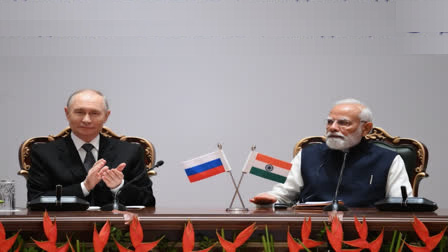
India and Russia have long shared what they describe as a “special and privileged strategic partnership,” a formal designation established in October 2000. Over the years, this relationship has broadened to include defence and security cooperation, economic and trade engagement, scientific and technological collaboration, cultural ties, and extensive people-to-people exchanges. By FY 2023-24, bilateral merchandise trade had risen to USD 65.70 billion, with India exporting goods worth USD 4.26 billion and importing USD 61.44 billion from Russia. This trade pattern has consistently favoured Russia, driven largely by Indian purchases of energy products such as oil, fertilisers, minerals, metals, and other raw materials. Defence remains a central axis of the partnership, with India depending heavily on Russian-origin platforms across its air, land, and naval forces.Within this historical context, President Vladimir Putin’s visit to India on 4-5 December 2025-his first since the Ukraine conflict began-carries exceptional symbolic and strategic weight. Occurring amid global instability, heightened Western scrutiny, and shifting power alignments, the trip reflects a deliberate effort by both nations to reaffirm the depth and durability of their ties. The phrase “Russia-the All-Weather Friend of India” therefore encapsulates a long-standing bond grounded in mutual confidence, converging strategic priorities, and a shared aspiration for a more multipolar international system.
The geopolitical implications of this visit are significant, particularly at a time when the United States continues to send mixed signals toward India. While New Delhi has expanded cooperation with Washington, U.S. policy has often oscillated in response to its own strategic and economic interests. Simultaneously, Russia faces Western sanctions and diplomatic isolation due to the Ukraine war. Against this backdrop, the India-Russia summit conveys an unmistakable message: India intends to safeguard its strategic autonomy and will not allow any external pressure-from the U.S., the EU, or others-to dictate its foreign-policy choices. Hosting Putin underscores India’s ability to engage all major powers independently, without subordinating one relationship to another.For Russia, sustained ties with India offer a crucial strategic corridor at a time when many of Moscow’s partnerships have weakened. For India, Russia’s reliability in defence, energy, and economic spheres remains invaluable. The summit thus reinforces a balanced triangular dynamic wherein India maintains strong relations with both the West and Russia, preserving its flexibility in an increasingly multipolar world.
The core priorities of the Modi-Putin Summit and the message it sends to the world are direct and unmistakable. The 2025 Indo-Russian meeting brings together a broad agenda that reflects both the long-standing foundations of their partnership and the new strategic demands of a shifting global landscape. Defence and security cooperation remain central. India is expected to seek additional S-400 air-defence systems and examine prospects for collaborating on advanced platforms, including next-generation fighter aircraft. Indications that Russia may provide up to 50 percent technology transfer for the S-400-allowing partial production within India-highlight the push for deeper defence industrial integration. Discussions are also likely to cover upgrades to Russian-origin systems such as Sukhoi jets and further development of joint missile initiatives, notably the BrahMos programme.
Alongside these military discussions, both nations are preparing to activate the Reciprocal Exchange of Logistics Support (RELOS) pact, recently approved by Russia’s lower house. This agreement will grant reciprocal access to military bases, ports, and airspace, forming a stronger logistical network for joint exercises, humanitarian operations, and rapid mobility during emergencies. Such an arrangement significantly enhances operational coordination and strengthens long-term strategic mobility.Economically, the summit aims to finalize a 2030 Strategic Economic Roadmap to steer cooperation in trade, investment, energy, technology, and connectivity. With bilateral trade reaching USD 68.7 billion in FY 2024-25, both sides acknowledge the need to broaden engagement beyond defence equipment and energy imports, seeking more diversified and balanced exchanges.In the civilian sphere, the agenda extends to civil nuclear cooperation-including ongoing projects like Kudankulam-along with skilled workforce mobility, space collaboration, and advanced technology tie-ups. These areas reinforce the multifaceted nature of the partnership.Ultimately, the summit delivers a diplomatic signal that far exceeds immediate agreements. By emphasizing mutual respect, strategic autonomy, and sovereign equality, India and Russia demonstrate that partnerships can be shaped by shared interests rather than geopolitical pressure. This meeting thus reaffirms their joint commitment to a multipolar world where India preserves independent decision-making and Russia sustains relevance through stable, long-term cooperation.
The reaction of anti-India or Western nations, including the EU, to the summit is predictable. India’s renewed closeness with Russia is likely to attract scrutiny and concern, particularly from countries that regard Moscow as isolated due to the Ukraine conflict. The approval of the RELOS pact and fresh defence agreements may heighten anxieties about shifting power dynamics in the Indo-Pacific and the potential for regional militarization. Many in the EU and broader Western bloc may interpret the summit as India moving strategically closer to Russia, possibly weakening collective sanctions or undermining pressure mechanisms directed at Moscow. Expanded defence cooperation, joint missile production, and enhanced logistics coordination could be viewed as India challenging Western expectations on arms-control alignment or sanction compliance. India’s neighbours and regional observers may also feel uneasy, especially if strengthened Indo-Russian defence ties translate into more advanced Indian military capabilities. Yet, overt criticism from the West is unlikely, as alienating India would harm their own strategic and economic interests. Instead, responses will likely take diplomatic forms-subtle cautions, reminders about sanctions, and calls for transparency. Overall, the summit underscores the limits of Western influence over India’s sovereign foreign-policy decisions.
The likely U.S. reaction to the summit-especially in the context of India’s continued Russian oil purchases-reveals a complex strategic dilemma. Washington faces tension between its concerns over India-Russia defence and energy cooperation, which it views through the lens of sanctions and great-power competition, and its need to maintain India as a central Indo-Pacific partner. Recent U.S. actions, including punitive tariffs linked to India’s Russian oil imports, suggest that pressure may intensify, possibly through diplomatic warnings or threats of additional trade restrictions. Yet India’s emphasis on strategic autonomy complicates any coercive approach. The summit reinforces the idea that New Delhi will not subordinate national interests to external expectations, a stance that may unsettle Washington. Should India deepen defence deals and continue large-scale energy imports from Russia, bilateral friction could grow in trade and security dialogues. Still, the U.S. may ultimately choose to manage disagreements pragmatically, prioritizing Indo-Pacific cooperation over disputes tied to Russia.
The long-term impact of the 2025 India-Russia Summit on defence strategy and technology transfer is likely to be substantial, particularly given the security challenges in India’s neighbourhood. The defence and logistics agreements concluded at the summit signal a significant shift in India’s strategic planning. The ratification of the RELOS pact will allow both nations to share military bases, ports, and airspace, enabling smoother joint exercises, coordinated responses to regional contingencies, and stronger humanitarian operations. This deepens operational interoperability and broadens India’s strategic flexibility in the Indo-Pacific. India’s expected procurement of additional S-400 air-defence systems, potential collaboration on fifth-generation fighter platforms, upgrades to existing Sukhoi fleets, and advancement of missile programmes-including BrahMos variants and possibly hypersonic systems-could substantially reinforce India’s deterrence architecture. These capabilities are critical in countering persistent threats from neighbouring states such as Pakistan and Bangladesh, which have historically shaped India’s defence posture. Moreover, increased technology transfer and the prospect of domestic assembly or manufacturing of advanced systems can boost India’s defence-industrial base. Such progress reduces vulnerability to foreign supply disruptions and positions India to emerge as a credible exporter of defence equipment. Ultimately, the summit’s outcomes move beyond tactical acquisitions, offering India a pathway toward greater self-reliance, stronger deterrence, and enhanced regional stability.
In an age marked by shifting alliances, geo-economic pressures, and ideological polarizations, the 2025 summit between Putin and Modi underlines the enduring relevance of a relationship built on mutual respect, strategic necessity, and shared civilizational outlook. The deepening of Indo-Russian ties – in defence, energy, trade, technology, and diplomacy – is not simply a bilateral affair. It is a statement: sovereign nations can choose partnership on their own terms, pursue strategic autonomy, and resist coercive alignments.With the “All-Weather” moniker, India and Russia reaffirm that their friendship transcends transient global currents. The summit’s outcomes – whether in S-400 deals, logistics cooperation, economic roadmaps, or technology transfer – will likely reshape not just South Asia’s strategic architecture, but influence the broader contours of a multipolar world.For India, this recalibration is not about antagonism toward any power, but about asserting agency: ensuring security, sovereignty, and a future grounded in dignity, equality, and mutual trust. In that sense, this visit is not just “historic,” but possibly “epochal” – a renewed anchor for a future where India’s foreign policy is anchored in national interest, not external pressure.India may therefore be recommended to strengthen defence self-reliance, deepen strategic partnerships like the Russia alliance, and remain vigilant against anti-India forces. By balancing global relations while prioritizing national security, India can safeguard sovereignty, counter regional threats, and reinforce its role as a stable, independent power in an increasingly uncertain geopolitical environment.
(The author is a Bengaluru based educationist, management scientist, an independent researcher and member (IIMSTC), Bengaluru.)
 Follow our WhatsApp channel
