

Sunny Dua
Sunnydua55@gmail.com
Ekta Nagar, Gujarat: Sardar Vallabhbhai Patel, the Iron Man of India – was born on 31 October 1875 in Nadiad, Gujarat. A visionary statesman and one of the principal architects of modern India, Patel’s indomitable will, unshakeable integrity, and pragmatic wisdom helped lay the foundation of a united and strong nation. His tireless efforts in integrating more than 560 princely states after independence gave India its true shape, geographically, politically, and emotionally. As the country marks his 150th birth anniversary, the celebrations are not merely about honouring a leader from history, but about rekindling the spirit of unity, selfless service, and nationalism that Patel embodied all his life.
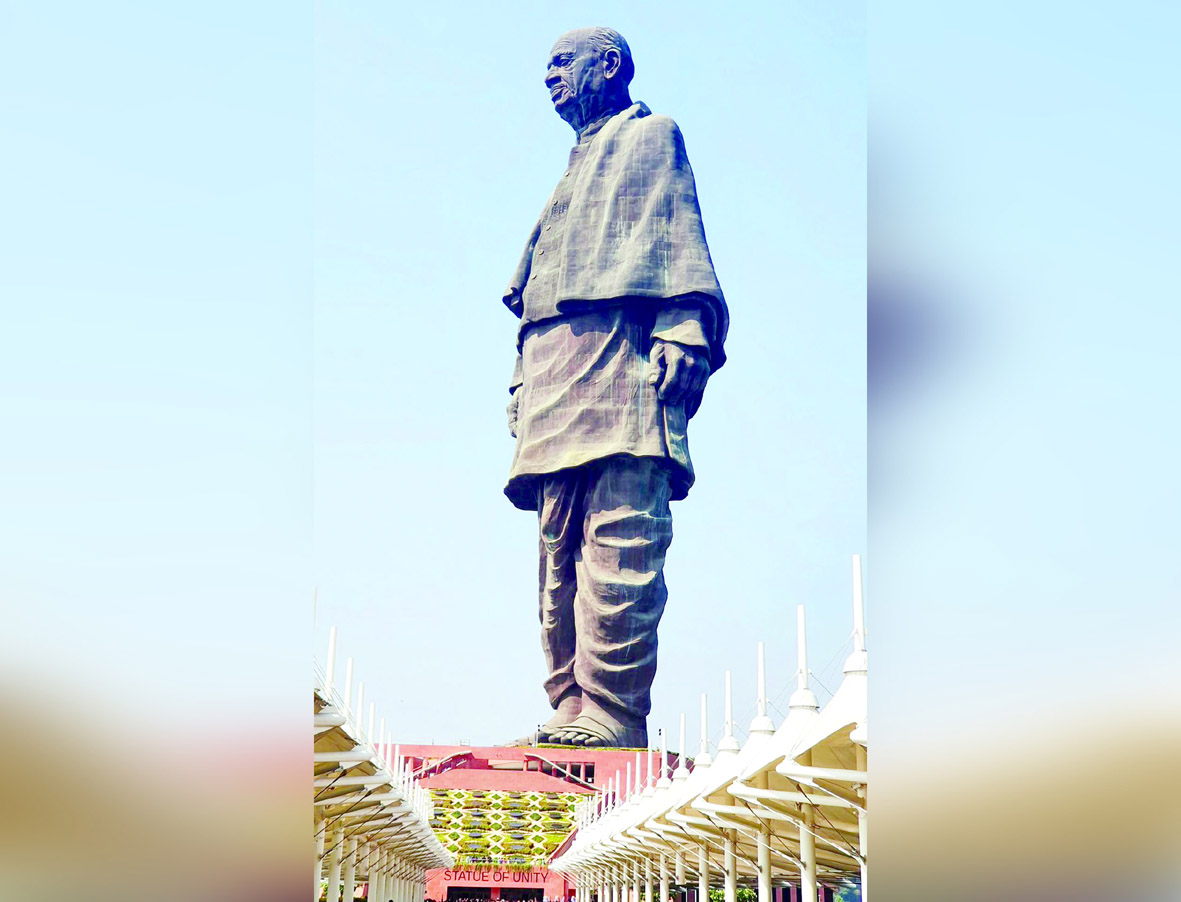
To commemorate this towering legacy, India gifted itself a monument that stands as tall as the ideals of the man it represents – the Statue of Unity (SOU). Standing at an awe-inspiring height of 182 metres on the banks of the Narmada in Kevadia, Gujarat, this colossal statue is a tribute to Sardar Patel’s strength, vision, and determination. Built with the contribution of millions of Indians, it mirrors the same unity that Patel once forged among the nation’s diverse regions and cultures. The Statue of Unity is not just a marvel of modern engineering, but a soulful reminder of what India can achieve when it stands together, bound by a single purpose.
Every Indian must visit the Statue of Unity, not merely because it is the tallest statue in the world, but because it tells the story of India’s resilience and oneness. It is a place that inspires – where patriotism blends with pride, and where the serene surroundings of the Narmada whisper stories of a man who united hearts and lands alike. The statue, grand and graceful, symbolises the eternal message of unity in diversity – a message that continues to define the very essence of India.
India today stands tall on the world map – quite literally – with the Statue of Unity which is a symbol of national integration, a beacon of India’s engineering prowess, and a showcase of how collective pride can build legacies for generations. For visitors, the sheer cleanliness of the town, the well-planned tours, guided experiences, wide roads, manicured gardens, riverfront cruises and even cosy cafés reflect a new standard of hospitality in India – one that fills hearts with joy and respect. “The statue honors Sardar Vallabhbhai Patel (1875-1950), India’s first Deputy Prime Minister and Home Minister, who played a pivotal role in uniting the nation and ensuring its political integration.”
The Statue of Unity is the world’s tallest statue at 597 ft. It rises 177 ft higher than the previous record holder, the Spring Temple Buddha in China’s Henan province. The statue can be seen within a 7 km radius.
A Monument Built by People, for People
When the foundation of this colossal statue was being laid, farmers from across the country came forward to donate their used iron tools. By 2016, a total of 135 metric tonnes of scrap iron had been collected and about 109 tonnes of it was used to make the foundation of the statue after processing. These humble contributions were processed and became part of the foundation, turning the monument into not just an architectural wonder but a people’s movement. This gesture embodies Patel’s own life mission – unity in diversity and the strength of collective will.
Designed by celebrated sculptor Ram V. Sutar and built by Larsen & Toubro, the project took over four years and immense manpower to complete. Over 3000 workers and 250 engineers toiled to shape this marvel, which now attracts lakhs of tourists every year. Inaugurated on 31st October 2018 by Prime Minister Narendra Modi, the statue stands on Sadhu Bet island, facing the mighty Narmada and the Sardar Sarovar Dam – a setting as grand as the figure it immortalizes. Ram V. Sutar is a Padma Bhushan and Padma Shri awardee. He had studied 2000 photographs of Sardar Patel to create the face and finally 5,700 tonnes of structural steel and 90,000 tonnes cement have been used in the statue. 1850 tonnes of bronze cladding was also consumed. It is an earthquake and wind resistant structure.
Experience of a Lifetime
The Statue of Unity is not just to be seen; it is to be experienced. Whether you view it from the land, from a boat on the river Narmada, or even from the air, the sheer scale and splendour make you forget the world for a while. From the feet clad in dhoti and sandals to the stern gaze of Sardar Patel, the detailing leaves one awestruck. Inside, the museum and exhibition halls narrate Patel’s inspiring story, while high-speed elevators take visitors to a viewing gallery at 153 metres, offering breathtaking views of the valley, dam, and river.
But the attraction doesn’t end there. The entire Ekta Nagar township around the statue has been designed to keep tourists engaged. From the Butterfly Garden to the Valley of Flowers, the Sardar Patel Zoological Park, the Glow Garden, river cruises, and even a dinosaur fossil park – the list is endless. Wide, well-paved roads, perfectly managed parking, shuttle services, and a range of hotels make it a world-class destination. And perhaps most remarkable of all is the cleanliness – from the pathways to the eateries, everything shines with meticulous care.
A Trip Worth Planning
For anyone visiting, a word of advice: do not rush. The Statue of Unity deserves at least a two-day itinerary to soak in its grandeur and the many attractions around it. And if time and budget allow, one could easily spend more days enjoying the blend of nature, history, and modern amenities that Ekta Nagar offers. With over 15 million visitors in just five years, it is now one of India’s top tourist spots and a glowing testament to how vision, determination, and people’s participation can create wonders.
Our journey to the Statue of Unity began from Ahmedabad, passing through Vadodara before reaching Ekta Nagar. What made this trip truly special was the warm company of Rajneesh Batra his wife Leena and children Ananya and Avika, who graciously accompanied Manisha and this author throughout. As hosts, they left no stone unturned in turning a simple visit into a cherished memory.
From meticulously booking tickets well in advance to personally driving us to the site, guiding us with patience, and ensuring every comfort at the hotel-rooms that felt more like homes than temporary stays-they took care of every detail. Their thoughtful gestures and hospitality not only enriched the journey but also made the residents of Jammu and Kashmir feel at home hundreds of miles away.
The six-lane highway leading to the site is a delight in itself-lined with gulmohar and other ornamental trees on both sides, dotted with well-planned lay-bys offering every amenity, and designed to make the drive smooth, attractive, and enjoyable. The road feels less like a stretch of travel and more like an experience, preparing visitors for the grandeur that awaits.
At Ekta Nagar, the transformation is immediate. Cobblestone-paved streets, neatly arranged hotels, and a marble-carved map of India at the central square set the tone of unity and artistry. The township is thoughtfully planned, with pink e-rickshaws driven by local women and eco-friendly e-buses shuttling visitors to and from the statue site. The atmosphere is vibrant yet orderly, making one feel they’ve entered a world designed to complement the monument’s significance.
The statue complex itself is an awe-inspiring experience. After a robust security check, visitors are greeted with shaded canopies, sprinklers, escalators, and elevators that ease the journey to the museum and viewing deck. Two lifts inside the statue’s legs take visitors to the gallery at chest level, where sweeping views of the Narmada River and Ekta Nagar unfold. To truly appreciate the world’s tallest statue-its history, scale, and spirit-one must come with ample time, for this is not just a visit, but an unforgettable journey into India’s unity and pride.
Pride of a Nation
The Statue of Unity is not just about its record-breaking height or engineering brilliance. It is about what it represents – India’s unity, resilience, and pride in its history. As one stands in front of this towering figure of Sardar Patel, looking across the Narmada Valley, it is impossible not to feel moved. The monument reminds us that great nations are not built on stone and steel alone, but on shared sacrifices, collective efforts, and the determination to leave behind legacies that inspire. Indeed, if there is one place that captures the spirit of a rising India in all its glory, it is the Statue of Unity.
Then chief minister of Gujarat, Narendra Modi had announced the project on 7 October 2013 to mark the beginning of his tenth year as the chief minister of the state. A society named Sardar Vallabhbhai Patel Rashtriya Ekta Trust (SVPRET) was formed under the chairmanship of the Chief Minister of Gujarat, to execute the project.
The statue has been built to withstand winds of up to 180 kilometres per hour and earthquakes measuring 6.5 on the Richter scale. The total height of the structure is 790 ft with a base of 190 ft and the statue measuring 597 ft. The height of 182 metres was specifically chosen to match the number of seats in the Gujarat Legislative Assembly.
Narendra Modi, then serving as the Chief Minister of Gujarat had laid the statue’s foundation stone on 31 October 2013, the 138th anniversary of Patel’s birth. Construction of the monument was completed in mid-October 2018; and the inaugural ceremony was held on 31 October 2018 – 143rd birth anniversary of Vallabhbhai Patel and was presided over by Prime Minister Narendra Modi. The statue has been described as a tribute to Indian engineering skills.
The Statue of Unity is ingeniously divided into five distinct zones, of which three are open to the public. The first zone, stretching from the base to the level of Sardar Vallabhbhai Patel’s shins, encompasses three levels that include the exhibition area, a mezzanine, and a roof deck. This section also features a serene memorial garden and an impressive museum dedicated to the Iron Man of India. The second zone extends up to Patel’s thighs, while the third reaches the grand viewing gallery situated 153 metres above the ground. The fourth zone is reserved for maintenance, and the fifth – comprising the head and shoulders – remains inaccessible to visitors, preserving the sanctity of this monumental creation.
The museum housed within the first zone offers a vivid chronicle of Sardar Patel’s life and his monumental contributions to the unification of India. Adjacent to it, an audio-visual gallery presents an engaging 15-minute film that not only celebrates Patel’s legacy but also highlights the rich tribal culture of Gujarat. The two massive concrete towers forming the statue’s legs are fitted with high-speed elevators – each capable of carrying 26 visitors to the viewing gallery in just over 30 seconds. At 502 feet above the ground, this gallery can accommodate up to 200 visitors at once, offering an awe-inspiring vantage point.
Since its inauguration, the Statue of Unity has emerged as a marvel of modern tourism. In its very first year, it drew nearly 2.9 million visitors, generating ?82 crore in ticket revenue. By November 2022, the footfall had crossed 10 million, and within just five years, over 15 million people from around the world had witnessed its grandeur. In 2023 alone, the site welcomed more than 5 million tourists – a testament to its ever-growing global allure.
The broader Ekta Nagar complex, within which the Statue of Unity proudly stands, is itself a world of wonder. Its attractions include the majestic Sardar Sarovar Dam – one of the world’s largest concrete gravity dams – and the enchanting Butterfly Garden nestled in the Valley of Flowers, framed by the Vindhya and Satpura ranges along the Narmada River. Visitors can explore the Circular Route that connects several key attractions, wander through the revolutionary Miyawaki Forest promoting urban afforestation, or marvel at the Rajasaurus Narmadensis – a dinosaur species that once roamed the Narmada Valley. The Sardar Patel Zoological Park, cruise services on the Narmada, an aviary, safari zones, and the mesmerizing Glow Garden add to the region’s multifaceted charm.
The museum within the SOU complex beautifully captures the saga of India’s unification. It showcases rare documents, historical artefacts, immersive 3D mapping projections, and holographic displays. Visitors can also experience a captivating film on India’s independence movement screened in the auditorium. The viewing gallery, located at the chest of the statue at a height of 135 metres, provides a panoramic view of the Narmada River, the Sardar Sarovar Dam, and the verdant Satpura and Vindhyachal ranges – a sight both humbling and uplifting.
As dusk falls, the complex comes alive with a spellbinding light and sound show that narrates the story of India’s freedom and Sardar Patel’s pivotal role in shaping a united nation. Projected brilliantly onto the statue itself, the visuals make the colossal structure appear almost lifelike, leaving every spectator deeply moved and filled with pride.
Unlike many tourist destinations in the country, the Statue of Unity complex stands out for its immaculate management. Escalators, lifts, spotless restrooms, easily accessible drinking water points, and well-marked information booths reflect world-class infrastructure. Motorized cleaning systems, efficient crowd control, and courteous staff make every visit seamless and memorable.
Rising majestically on the banks of the Narmada, the Statue of Unity is more than just the world’s tallest statue – it is the towering embodiment of India’s unity, resilience, and vision. It celebrates the indomitable spirit of Sardar Vallabhbhai Patel, whose dream of a united India continues to guide the nation’s destiny. Today, this magnificent monument doesn’t merely attract tourists; it draws hearts from across the globe, reminding every visitor of India’s unmatched blend of history, heritage, and modernity. The Statue of Unity stands as a luminous beacon of national pride – a tribute to the past, an inspiration for the present, and a promise to the future.
(The writer is senior journalist)
 Follow our WhatsApp channel
