

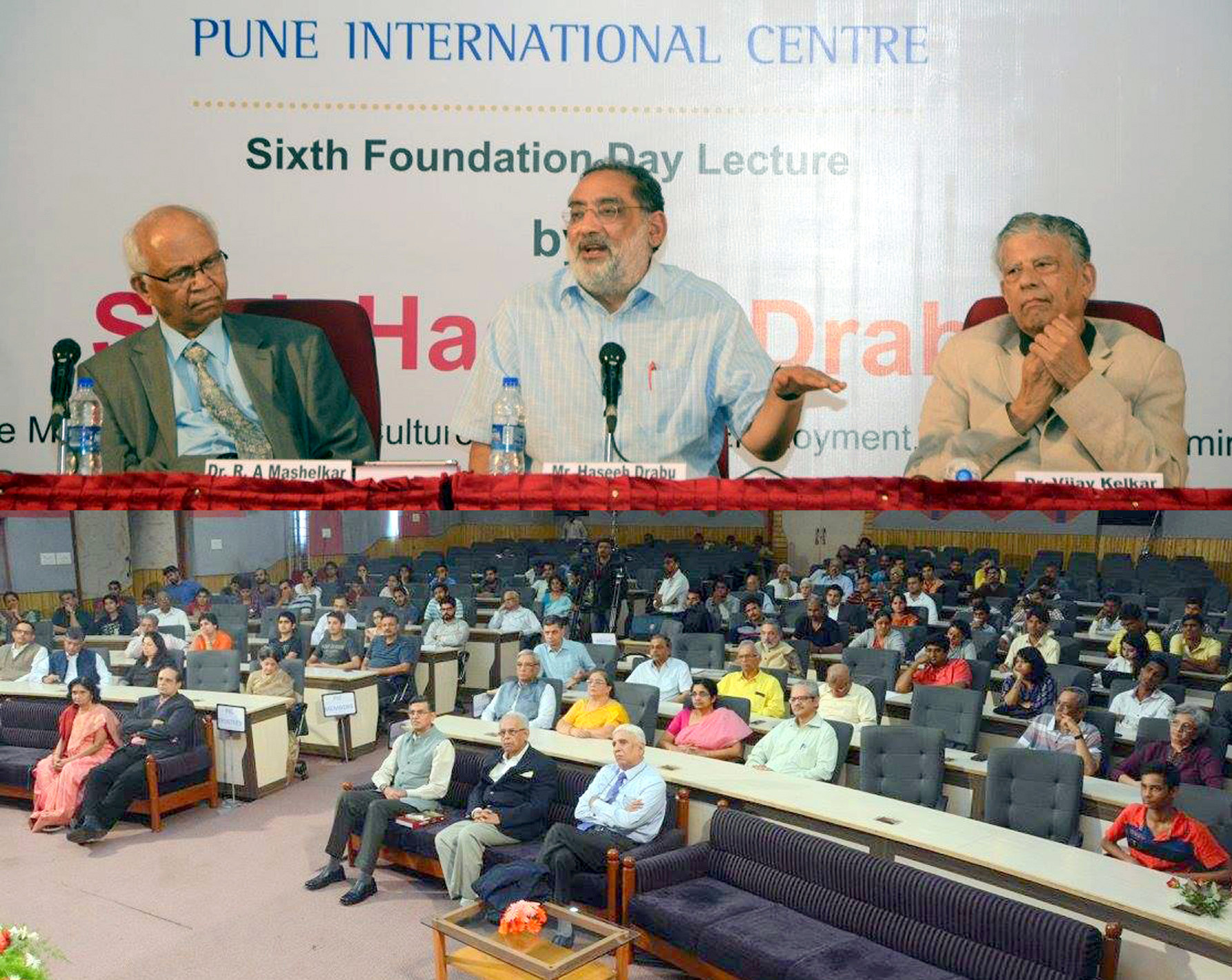
PUNE: The apathy of Indian thinkers and policymakers in understanding the trials, tribulations and social evolutions in Jammu and Kashmir is one of the reasons for the pestering problems confronting the state, Minister of Finance Dr Haseeb Drabu said.
“More than political alienation in Kashmir, it is the disengagement of Indian civil society that needs to be addressed which is a corollary of Indian intellectual’s apathy towards J&K. But it gives us immense satisfaction that these past few years have heightened awareness on J&K across the country,” the Finance Minister said.
Delivering the keynote lecture ‘Growth Prospects for Jammu & Kashmir’ at the 6th foundation day of Pune International Centre , Dr Drabu said the Indian thinkers and policymakers never engage in Kashmir and they are, therefore, unable to understand and often misinterpret the real problems confronting the State and its people.
“JK had the finest, most radical and comprehensive land reforms done by a non-communist regime anywhere in the world, yet there’s no book on land reforms in JK by an Indian scholar while there are hundreds of books on land reforms in Kerala, Bengal, etc,” Dr Drabu said.
Regretting the role of some TV news channels for negatively portraying the situation in Kashmir, Dr Drabu said random slogan of secession lights up television screens across the country. “From Indian civil society’s point, the biggest concern is political and how politics is being played out in J&K. But no one ever mentions this kind of complete apathy of Indian civil society or secession of Indian intellectuals from the society in J&K,” he said.
“India as a nation and not merely as a State has to intervene, react and resolve. Civil society is more powerful and has a more important role in this regard. It can make great changes. It has to relook some of things we have been thinking on J&K in the framework of empowered federalism,” he said.
Dr Drabu said Kashmir issue has now become a social issue and in addressing it, the Indian civil society has much larger role than the government of India. “The way the political problem has seeped into J&K’s social fabric and how it is changing everything in it, Indian civil society needs to take cognisance of it and play a bigger role in recreating the bits of cultural, social and historical uniqueness of J&K which are being lost almost on a daily basis,” he said.
“The loss of our heritage, a unique blend of Sufi-Reshi tradition, is a big loss to the cultural heritage of India, if not the subcontinent and the world,” he added.
“The way forward in addressing political alienation in Kashmir is not possible by having an enclave of federalism in a unitary structure. We have to change that approach,” he said.
.
“Kashmir is seen as a dissenting idea of autonomous or empowered federal unit within the nation state of India, but its preservation is important to retain democracy and diversity in India. No change has impacted the framework within which the Indian intellectual understands J&K.
 Follow our WhatsApp channel
