

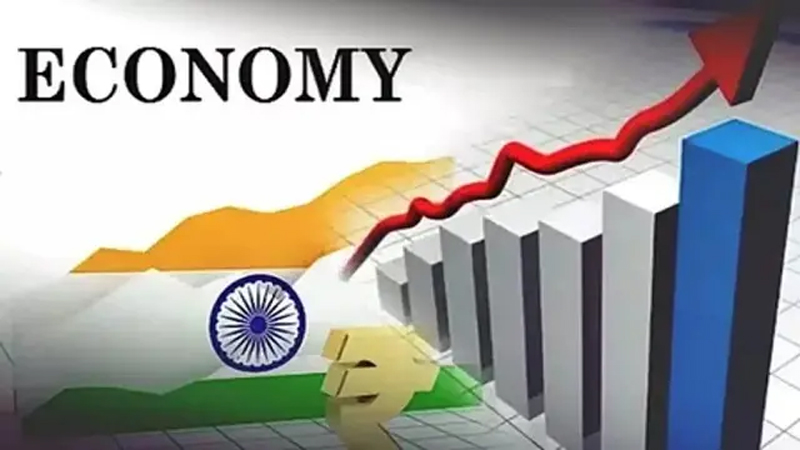
The Economic Survey’s projection of India’s GDP growth at 6.8-7.2 per cent in FY27 may appear marginally lower than the estimated 7.4 per cent for the current fiscal, but viewed in context, it is a strong endorsement of the economy’s underlying resilience. At a time when global growth is slowing, trade protectionism is intensifying, and geopolitical uncertainties are reshaping capital and supply chains, India’s retention of a near-7 per cent growth trajectory signals macroeconomic stability, policy credibility, and structural strength. The Survey makes it clear that India’s growth momentum is not accidental but the cumulative outcome of reforms undertaken over the past decade. GST rationalisation, corporate tax reforms, insolvency resolution mechanisms, digital public infrastructure and targeted production-linked incentives have together strengthened the economy’s supply-side capacity. These measures have also helped cushion the impact of the ongoing global tariff war, particularly the ripple effects of higher US tariffs and trade realignments.
One of India’s most significant structural advantages, repeatedly highlighted in the Survey, is its vast domestic consumer market. Unlike export-dependent economies that are highly vulnerable to external shocks, India enjoys the buffer of strong internal demand. Any genuinely “Made in India” product finds a ready home market, allowing firms to scale up production even when exports face temporary disruptions. This internal demand-led growth has been a key stabiliser in recent years and will continue to anchor economic expansion in FY27.
That said, exports have not collapsed despite a hostile global environment. Merchandise exports grew by 2.4 per cent and services exports by 6.5 per cent during April-December 2025, even as tariffs rose and global demand softened. This indicates adaptability rather than complacency. The Government’s efforts to diversify export destinations, explore non-traditional markets and move up the value chain are beginning to yield results. The recently concluded Free Trade Agreement with the European Union, described as part of the “mother of all deals”, is a significant step in this direction. While the pact will take time to be ratified by the EU Council and rolled out fully, the very fact that such a comprehensive agreement has been clinched enhances India’s credibility as a reliable trade partner.
In today’s tariff-driven world, trade is no longer about altruism but strategic self-interest. Every major economy is seeking alliances to balance its trade and secure supply chains. India, backed by a robust microeconomic base and improving manufacturing competitiveness, is well-positioned to negotiate better trade pacts. The Survey rightly notes that realising the full potential of FTAs will require India to produce competitively, a challenge that policy now squarely acknowledges.
The rupee’s sharp depreciation in recent months has raised concerns, but the Survey offers a nuanced assessment. Importantly, the weaker rupee has not triggered inflationary pressures, partly due to stable crude prices, and has even helped offset some tariff-related shocks. The Government is aware of these “pinpricks” and has already initiated measures to attract long-term foreign investment, including policy stability, infrastructure push and regulatory simplification. Fiscal discipline remains another strong pillar of confidence. This fiscal credibility provides the Government with room to address growth bottlenecks without compromising macro stability.
The tariff war, paradoxically, has also opened new opportunities. As global firms seek to de-risk supply chains, India can position itself as an alternative manufacturing and services hub. This requires accelerated skilling of the workforce, particularly in advanced manufacturing, logistics, digital services and emerging technologies like AI. The Survey’s focus on AI, aviation and gig work reflects an understanding that future growth will be shaped as much by technology and labour reforms as by traditional macro levers.
The upcoming Union Budget will be critical in fine-tuning policies to sustain growth. Addressing residual bottlenecks in logistics, credit access for MSMEs, ease of doing business and labour market flexibility will be essential to achieve the projected growth range. In a fractured global economy where “no one is for anyone”, India’s ability to maintain growth momentum, leverage its domestic market, and forge strategic trade partnerships places it in a relatively strong position. The FY27 growth forecast is not just a number-it is a signal that India’s economic engine remains firmly on course despite formidable roadblocks.
 Follow our WhatsApp channel
