

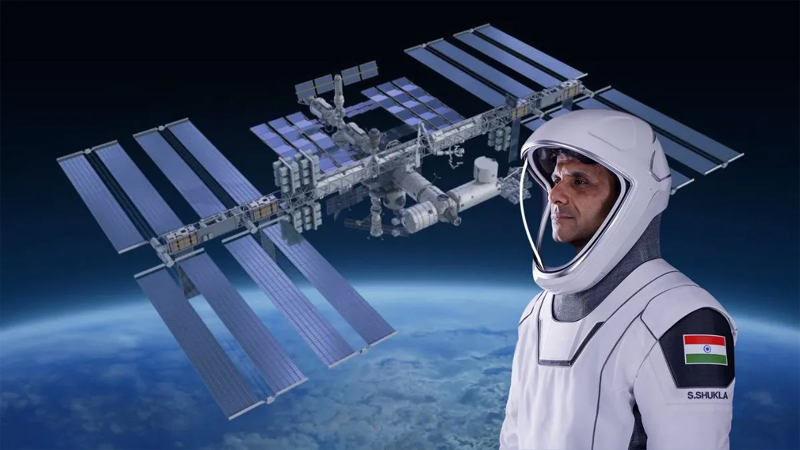
In an extraordinary moment that etched itself into the annals of Indian space history, Group Captain Shubhanshu Shukla launched into space aboard the Axiom-4 (Ax-4) mission, marking India’s return to human spaceflight after a long hiatus of 41 years. Not since Rakesh Sharma’s iconic journey aboard the Soviet Salyut-7 in 1984 has an Indian astronaut ventured into the cosmos. This mission is a triumph of individual perseverance and national pride and a significant stepping stone in India’s aspiration to become a formidable player in human space exploration. The successful liftoff from Kennedy Space Centre aboard SpaceX’s Falcon-9 rocket under the banner of Axiom Space is testimony to how far space technology has advanced – from state-run missions of the Cold War era to today’s private-commercial collaborations. Shukla’s journey is a moment of reckoning not just for him or the Indian Air Force, which has once again proved its stellar contribution to the space program, but for the entire Indian scientific community, which has waited for this day with bated breath.
Despite India’s commendable progress in satellite launches, lunar missions, and Mars exploration, it has yet to launch its own manned mission into space. While ISRO’s Gaganyaan programme remains in development, the Ax-4 mission provides India with a valuable opportunity to learn firsthand the logistics, complexities, and physiological challenges of manned missions – all without the burden of hosting and launching the mission itself. Shukla’s participation in this multinational crew helps bridge India’s capability gap and accelerates the experiential curve. It also enables India to study and internalise the preparatory protocols for manned missions, ranging from astronaut training in microgravity simulators to long-duration quarantines, equipment testing, life-support systems, and emergency protocols – areas where experience is invaluable and error margins nonexistent.
The mission itself is rich with scientific promise. Over their two-week stay aboard the International Space Station, Shukla and his crewmates will conduct around 60 experiments spanning human physiology, nutrition, plant biology, and material science. These are not just isolated tasks but part of a larger global effort to understand how life adapts to the extreme conditions of space. Results from such experiments could influence everything from future food production in space to long-duration crewed missions to Mars or the Moon.
This mission also underscores the growing importance of international collaboration in space. In 1984, India partnered with Russia; now, it turns westward toward the United States. These collaborations are essential – they not only facilitate the exchange of technical knowledge and best practices but also encourage the co-development of new research methods. With space becoming increasingly globalised and commercialised, shared missions are the most pragmatic path forward for countries looking to stake their claim in outer space.
Shukla’s journey also sends a powerful message about the spirit of Indian science and ambition. His selection is a tribute to the synergy between the armed forces and scientific exploration. The IAF, through Shukla, reaffirms its role as a vital pillar in India’s journey toward becoming a space-faring nation. He carries the hopes and dreams of a nation that has long believed in the power of science, despite limited resources. From homemade lunar landers to Mars orbiters built on frugal budgets, India’s space program has always embodied the triumph of brain over budget. Now, with human spaceflight finally entering its realm, India is poised for an even more ambitious future.
This mission is not the culmination but the beginning of something greater. It is a learning curve, a rehearsal, and an inspiration for the upcoming Gaganyaan mission and beyond. As the ISS prepares to welcome its guests and further series of experiments, all eyes are on Shubhanshu Shukla – not just as an astronaut but as a beacon of India’s next big leap into the final frontier. The journey may be long, but the destination is clearly marked. This mission will indelibly enrich India’s space vision, sharpen its human spaceflight roadmap, and inspire countless young minds who dream not just of watching stars but of reaching them.
 Follow our WhatsApp channel
