

GOVERNING FRAME
Some voices have chosen to characterise the current global energy situation as a crisis of India’s making or India’s vulnerability. The facts do not support that characterisation.
India is in a position of deliberate, well-prepared strategic strength, built over twelve years of consistent energy policy. The buffer is real, the supply routes are diversified, and the delivery record is unbroken.
INDIA’S STRONG ENERGY RESERVES
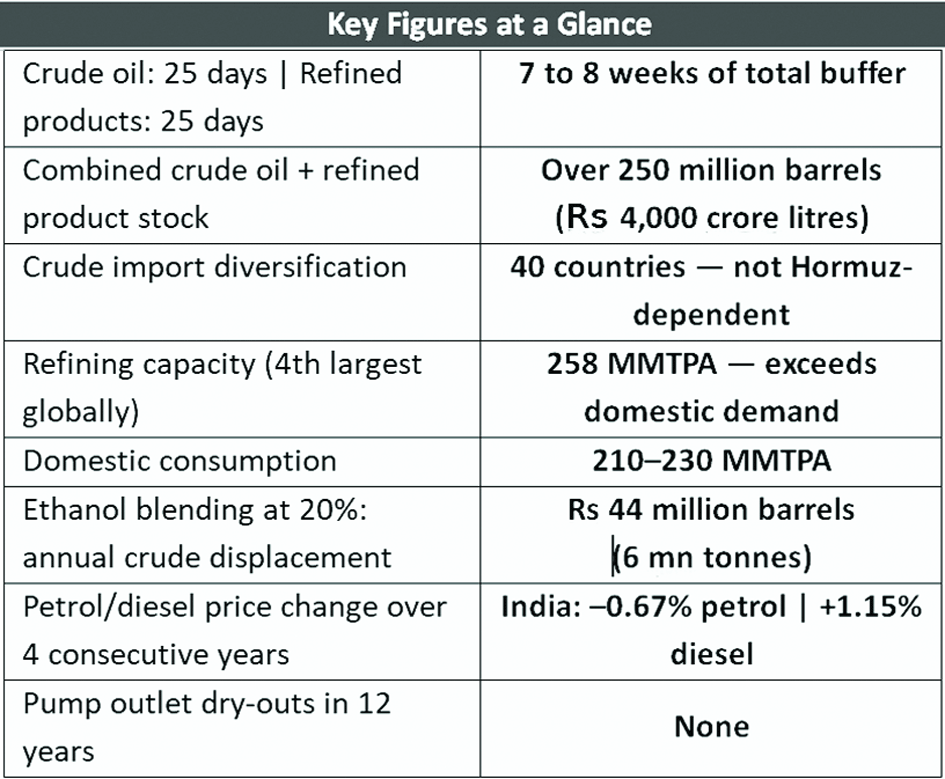 India holds over 250 million barrels of crude oil and refined petroleum products combined – approximately 4,000 crore litres. This translates into 7 to 8 weeks of buffer coverage across the full supply chain. These stocks are not held in a single location or a single form. They are distributed across above-ground storage tanks, underground strategic caverns, pipeline systems, terminal tankage, offshore storage vessels in transit, and the three dedicated strategic petroleum reserve facilities at Mangalore, Padur, and Visakhapatnam. India is well stocked with crude oil, petrol, diesel, ATF, LPG, and LNG, with sufficient inventories to handle short-term disruptions, while continuing to source energy from multiple global suppliers. Claims circulating that global oil supplies have stopped or that India has reserves for only 25 days are incorrect and do not reflect the actual supply and stock position.
This is a buffer, not a timer. It sits on top of, not instead of, daily imports that continue to arrive through multiple routes. Even if Hormuz flows were entirely disrupted, India’s diversified sourcing means the impact would be partial, not total. A predominant volume of India’s crude does not transit Hormuz.
RESILIENT SUPPLY ROUTES BEYOND THE STRAIT OF HORMUZ
Over the last decade, India’s strategic oil diplomacy has expanded its supplier base from 27 to 40 countries across six continents. The days when India’s energy security rose and fell with conditions in a single maritime chokepoint are over. Supply from Russia, West Africa, the Americas, Central Asia, and non-Gulf Middle Eastern routes means that disruption on any single corridor results in a managed sourcing adjustment, not a supply emergency. The Strait of Hormuz is not the only route for India’s crude imports. Only around 40% of India’s crude imports pass through the Strait of Hormuz, while about 60% are routed through other supply routes that remain unaffected. This has ensured that there has been no shortage of energy for Indian consumers even during global turmoil or the pandemic.
Several countries, including Australia and Canada, have also offered additional gas supplies, and India continues to explore alternative sources to further strengthen energy security. India has also recently entered into new energy supply arrangements with partners such as the United States and the United Arab Emirates to ensure stable long-term supplies.
India’s refining infrastructure – 258 MMTPA of capacity, the fourth largest in the world, exceeding total domestic consumption of 210 to 230 MMTPA – is configured to process a wide basket of crude grades. Indian refiners do not depend on a fixed slate from a fixed origin. This flexibility is itself a security asset, and it was built deliberately over the last decade as policy, not as an accident.
India is also the fifth-largest exporter of refined petroleum products globally. When Europe needed fuel after sanctioning Russian crude, it was India’s refineries that bridged the gap. India has never depended on permission from any country to buy Russian oil. India is still importing Russian oil even in February 2026, and Russia is still India’s largest crude oil supplier. For three years of the Russia-Ukraine war, India kept buying Russian oil despite US and EU objections. Imports increased significantly after 2022 due to discounted prices and refinery demand. Therefore, suggesting a short-term waiver “enables” these purchases overlooks that the trade has continued consistently. India is a net exporter of refined products to the world – a position that reinforces, not undermines, its energy security.
DOMESTIC ENERGY PRODUCTION DRIVING SELF-RELIANCE
India’s 20% ethanol blending programme displaces approximately 6 million tonnes of crude oil every year – equivalent to roughly 44 million barrels – that does not need to arrive through any strait, any pipeline, or any tanker route. Over the decade since 2014, the programme has cumulatively substituted over 181 lakh metric tonnes of crude imports, saving Rs 1.36 lakh crore in foreign exchange and channelling Rs 1.18 lakh crore to Indian farmers. India’s domestic production contributes around 15-16% of the country’s energy requirements and is currently operating at full capacity.
Under the LPG Controlled Order, the supply of LPG to industrial and commercial consumers has been restricted to prioritise household cylinder availability. The citizen’s cylinder is the operational priority, and the government has put institutional weight behind that commitment.
STABLE FUEL PRICES, STRONG COMMITMENT
Not one petrol pump has run dry in twelve years. Retail fuel prices have remained stable for 4 consecutive years despite extraordinary global volatility – a claim few of India’s peer economies can make. When global crude prices surged following the Ukraine conflict, IOC, BPCL, and HPCL collectively absorbed losses of Rs 24,500 crore to keep petrol and diesel prices frozen for Indian consumers. That is the scale of the commitment India’s public sector oil companies made to every household.
The table below places India’s record in an international context.
While Pakistan saw petrol rise 55%, Germany 22%, and France 19% over the same period, India’s petrol price moved by less than 1%. The direction of travel for India is unmistakable.
ENERGY PROCUREMENT ANCHORED IN NATIONAL INTEREST
India’s energy procurement decisions are governed by one principle: the national interest. We source crude from wherever supplies are available, competitively priced, and deliverable – and we will continue to do so. This has been our consistent position across administrations and across geopolitical cycles.
AFFORDABLE, AVAILABLE, AND SUSTAINABLE ENERGY FOR ALL
Every decision this government takes in the petroleum sector is tested against three criteria: affordability, availability, and sustainability. These are not aspirations. They are operational commitments with auditable outcomes.
On LPG: even as Saudi CP benchmark prices rose 16% between November 2025 and February 2026, domestic LPG prices remained unchanged. IOC, BPCL, and HPCL absorbed losses of approximately Rs 40,000 crore last year to protect the domestic LPG consumer. For PMUY households, the effective price has been reduced by about 39% – from Rs 903 in August 2023 to Rs 553 in February 2026. The cost of clean cooking for a PMUY household now works out to approximately Rs 7.31 per day.
Today, India has over 33.3 crore LPG consumers, including 10.53 crore PMUY beneficiaries, and over 1.6 crore households connected to PNG for uninterrupted cooking energy.
NDA’S RECORD OF BALANCED ENERGY MANAGEMENT
The appropriate comparison is not against a snapshot of global turmoil. It is against the pattern of governance over time. Under the previous UPA government (2004 to 2014), petrol prices rose 112% and diesel 155%. The fuel price regime was supplemented by Rs 1.5 lakh crore in oil bonds issued to PSU oil companies – deferred liabilities that required principal and interest repayment between 2021 and 2026, constraining subsequent fiscal space. Under the NDA since 2014, the increases have been 33% for petrol and 58% for diesel – during a period that included a global pandemic, a European land war, and the highest crude price volatility in decades.
The contrast between state-level pricing also reflects the governance choice. In states where the government reduced VAT following central excise duty cuts in November 2021 and May 2022, consumers saw relief. In states where the VAT reduction was not passed on, citizens paid more – a matter of political will, not energy markets. (PIB)
 Follow our WhatsApp channel
