

Maj Gen Sanjeev Dogra (Retd)
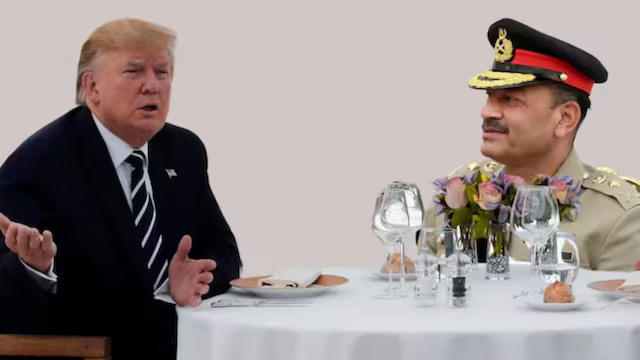
Just weeks ago, General Asim Munir-mastermind of the Pahalgam attack-was a pariah in global diplomacy. Today, he shares a luncheon table with Donald Trump. Pakistan, long backed by China, is now gravitating towards the U.S. Iran, once a vocal supporter of Pakistan during Operation Sindoor, finds itself cold-shouldered as Islamabad denies any nuclear commitment. Meanwhile, the Israel-Iran conflict has erupted into a dramatic military escalation. Over 125 U.S. aircraft joined Israel in a joint bombing operation-“Midnight Hammer”-on Iran’s nuclear sites, triggering missile retaliation, symbolic strikes on U.S. bases, and widespread regional anxiety. And yet, in the middle of this chaos, most Islamic nations have chosen silence. The diplomatic world is shifting, not in decades-but in days.
What we are witnessing is a surge in the standard deviation of diplomacy. The volatility and volume of influencing variables-public sentiment, technological triggers, leadership pivots, regional realignments-have expanded dramatically. Traditional doctrines of alignment are being replaced by reactive, transient arrangements. Yesterday’s adversary is today’s partner; today’s partnership might not survive tomorrow’s headline. This accelerating realignment of national interests is driven by three forces: the compression of time in decision-making due to digital media, the multiplying influence of real-time public perception, and the growing interdependence of security, economy, and technology. What was once a decade-long posture can now shift in a matter of months.
To steer through today’s geopolitical turbulence, India must fuse two decisive strategic lenses-Fluidity Theory and the OODA loop. Fluidity Theory posits that modern states behave based on evolving incentives rather than fixed doctrines or ideological anchors. Simultaneously, the OODA loop-Observe, Orient, Decide, Act-emphasizes compressed decision cycles to outpace adversaries. When combined, these models urge India to watch the horizon sharply, make sense of fast-changing patterns, choose timely actions, and act before competitors can react. In a fluid world, shortening the diplomatic OODA loop becomes vital. Lag is liability.
This environment also demands that India adopt a Bayesian mindset, where policies are continuously revised based on new evidence. Instead of clinging to fixed assumptions or historical postures, we must be open to change-probabilistically forecasting outcomes, regularly updating our strategic priors, and being comfortable with ambiguity. Working with Iran on logistics while engaging the U.S. on maritime security is not a contradiction-it’s calibrated realism. Sitting with China in BRICS while countering its assertiveness through QUAD is not confusion-it is strategic duality. India must become adept at managing overlapping interests across domains without being boxed into ideological labels.
To convert this complexity into advantage, India must now execute a structured yet flexible foreign policy reset, anchored in five key principles.
First is Anticipatory Diplomacy. India needs a dedicated Strategic Foresight Cell within the Ministry of External Affairs that integrates AI-powered analytics, behavioral modelling, and scenario mapping. This unit should anticipate not just military risks but emerging tech disruptions, regime changes, supply chain vulnerabilities, and shifts in global public opinion. In a world where alliances can be disrupted by a drone strike or a presidential tweet, foresight is national security.
Second is building Modular, Domain-Specific Partnerships. India must move beyond bloc-centric diplomacy and form flexible, issue-based coalitions. Defence ties with France, the U.S., Russia, and Israel; energy partnerships with Russia and the Gulf; technology collaboration with Israel and Japan; and trade connectivity with Iran and Southeast Asia must be pursued. These engagements should remain modular-reversible, interest-driven, and free from ideological rigidity-enabling India to pivot swiftly in a dynamic global environment.
Third is Decentralized Diplomatic Execution. Our embassies, regional envoys, and domain experts must be empowered with decision-making autonomy. Bureaucratic lags and hierarchical bottlenecks must give way to field-level responsiveness. Just as the military deploys Quick Reaction Teams in volatile zones, the foreign policy apparatus must operate with similar agility-especially during crises or strategic opportunities.
Fourth, India must elevate Public Diplomacy as Grand Strategy. In an era where perceptions shape policy, narrative becomes a weapon. Diplomats must now be communicators, story-crafters, and reputation managers. India must proactively shape global opinion-counter disinformation, present its moral clarity, and lead conversations through thought leadership. Soft power is no longer supplementary; it is strategic capital.
Fifth, India must evolve into a Global Norm-Setter. Instead of reacting to frameworks set by others, we must shape emerging global norms-on AI ethics, digital governance, multilateral institutional reform, data sovereignty, and climate justice. We have the civilizational depth and democratic legitimacy to frame these conversations-and the strategic need to ensure they don’t evolve without our voice.
In conclusion, the world is no longer guided by predictable patterns-it spins on fast-changing screenshots. The Trump-Munir meeting, U.S.-Iran escalations, and silence from the Islamic world are not permanent shifts-they are transient configurations. The real lesson for India is not to react to every headline, but to anticipate the arc behind it.
We must become the axis around which change stabilizes-not by resisting the flux, but by mastering it. In this age of volatility, the winners will not be those who shout the loudest or hold the oldest doctrines-but those who adapt the fastest, think the clearest, and act with both agility and resolve.
(The author is an expert in Operations Research and Systems Analysis)
 Follow our WhatsApp channel
