

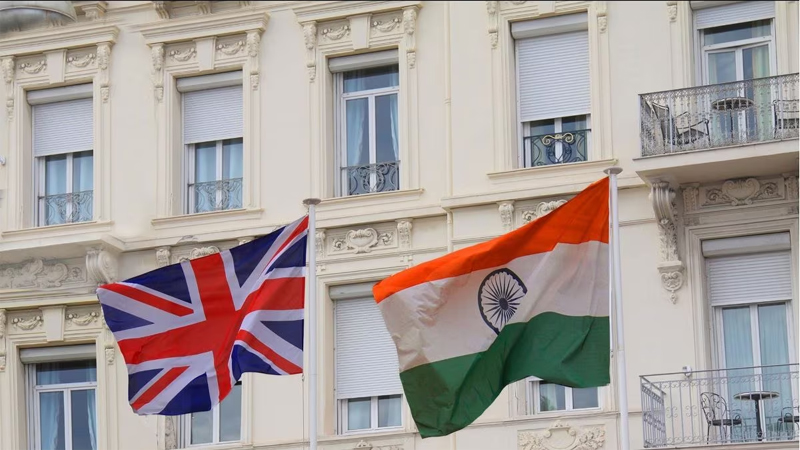
The inking of the India-UK Comprehensive Economic and Trade Agreement marks a defining moment in India’s economic diplomacy and its evolving strategic footprint on the global stage. With the UK being an advanced economy and a key technological power in Europe, this pact not only unlocks trade and investment opportunities but also positions India as a serious contender in shaping the new global order driven by pragmatic economic alliances and multipolarity. At its core, this FTA is a robust tool for doubling bilateral trade by 2030. For India, it opens immediate access to a major Western market, cutting tariffs across 99 percent of its export lines, ranging from textiles and footwear to gems, seafood, engineering goods, and processed foods. This gives Indian exporters a much-needed edge, especially in sectors where countries like Bangladesh and Pakistan have historically enjoyed duty-free access. With these barriers lifted, India stands to gain at least 5 percent more market share in the UK within the first 1-2 years.
But the impact isn’t merely sectoral or economic-it’s strategic. As the US threatens higher taxes and trade frictions loom, India has smartly expanded its trade architecture. The FTA with the UK is a gateway to European markets, offering a template for further agreements with the EU and other Western economies. From a macroeconomic lens, this deal is remarkably balanced. The UK, having exited the EU, is searching for independent trade channels. India, with its young population and cheap, skilled labour, becomes an ideal partner. For instance, Indian IT giants like TCS and Infosys benefit as the agreement removes mandatory social security contributions for temporary Indian workers in the UK-lowering costs, boosting competitiveness, and enhancing mobility of services.
The UK, in turn, gains phased access to India’s enormous and fast-growing consumer market. Tariffs on Scotch whisky and automobiles, long a point of contention, will gradually decrease, with a focus on high-end vehicles and luxury products-thereby protecting India’s mid- and small-segment automotive industry. This nuanced calibration ensures India’s domestic sectors are not undermined, even as the economy becomes more open.
What elevates this FTA from a trade pact to a geopolitical masterstroke is its timing and context. As tensions rise globally-whether due to the US trade war, the Ukraine conflict, or the West Asia instability-India is tactfully broadening its alliances. It is already an active member of BRICS and the Shanghai Cooperation Organisation, aligning with Eastern powers. But by engaging deeply with the UK, India also signals its readiness to integrate with Western economies on equal terms, not as a subordinate, but as a partner asserting its interests. This strategic duality-eastward and westward outreach-allows India to maintain sovereignty over its trade policy, avoiding overdependence on any single bloc. With the US threatening punitive trade actions, this FTA strengthens India’s hand by presenting alternative routes to growth.
Beyond economics and strategy, the FTA also underscores soft power diplomacy. Modi’s gift of a tree sapling to King Charles III under the “Ek Ped Maa Ke Naam” initiative adds a symbolic layer to the relationship. Discussions on Yoga, Ayurveda, and environmental sustainability further anchor the India-UK partnership in shared human values and long-term collaboration in wellness and education. The Vision 2035 roadmap is poised to steer this partnership beyond the transactional. It envisions sustained cooperation in higher education, green energy, AI, innovation, and health technologies-domains where the UK has a comparative advantage and India has scale and execution strength.
Practically, the India-UK FTA is far more than a tariff-cutting agreement. It is a strategic alignment of two democracies, each recognising the imperatives of recalibrated global partnerships. As international trade routes are redrawn and protectionist winds blow stronger, India is making bold, intelligent moves to diversify its trade relations, safeguard its interests, and seize global opportunities. The FTA is a major step forward, and its impact will be both immediate and long-lasting-setting the stage for India’s emergence as a global economic powerhouse rooted in strategic clarity and mutual gain.
 Follow our WhatsApp channel
