

Excelsior Correspondent
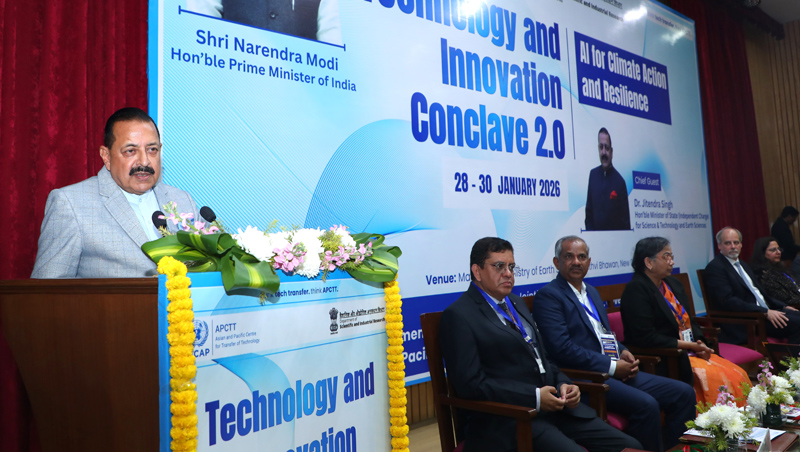
NEW DELHI, Jan 28: Union Minister of State (Independent Charge) for Science and Technology and Earth Sciences, Dr Jitendra Singh, today said that India is ready to play a larger global role in Artificial Intelligence (AI) -led climate action.
However, the Minister hastened to add, Artificial Intelligence must be deployed alongside human judgement, institutional cooperation and global partnerships if it is to effectively address climate change and build resilience against extreme weather events.
Speaking at the Technology and Innovation Conclave 2.0, jointly organised by the Asian and Pacific Centre for Transfer of Technology (APCTT) of the United Nations Economic and Social Commission for Asia and the Pacific (ESCAP) and Department of Scientific and Industrial Research (DSIR) Govt of India, Dr Jitendra Singh said climate change was “too serious a subject to be left to one nation alone” and could not be mitigated unless countries worked together across borders.
The conclave, themed “AI for Climate Action and Resilience”, opened with the introduction of innovators and startups, followed by a high-level inaugural session that brought together senior Indian officials and United Nations representatives, reflecting the growing convergence between national science priorities and global climate action. Speakers highlighted the role of technology, international cooperation and innovation ecosystems in responding to climate challenges faced by vulnerable regions.
As part of the programme, Dr. Jitendra Singh inaugurated the exhibition of innovations, walked through the displays and interacted with young innovators from participating member states. He later presented awards to winners of a hackathon focused on AI-driven solutions for climate and resilience challenges.
During the inaugural session, DSIR and APCTT formally announced the launch of “SANKALP” (Synergy for Advanced Networks, Knowledge, and Academia-Industry Learning Progress), a new lecture series aimed at strengthening structured engagement between academia, industry and policymakers, and accelerating the translation of research into real-world applications.
In his address, Dr. Jitendra Singh said the era of working in silos was over, stressing that climate action required collaboration across scientific disciplines, public and private sectors, and even between science and non-science institutions. Innovation, he said, could no longer succeed in isolation and needed early and sustained linkages with industry, markets and technology transfer mechanisms.
Highlighting India’s evolving global role, the Minister said the country was no longer inward-looking and was increasingly expected to contribute ideas and solutions to international efforts on climate and technology. India’s geographic diversity, he noted, offered a unique advantage in studying climate impacts and developing adaptable solutions that could be shared with other countries.
Dr. Jitendra Singh linked artificial intelligence with India’s broader technology roadmap, noting that the country was among the early movers in emerging areas such as quantum technologies, having already launched a national quantum mission. Artificial intelligence, he said, was similarly transformative and had become critical for analysing climate data, forecasting disasters and managing resources.
Citing practical examples, the Minister said AI-based models were already being used in disaster response and environmental monitoring, including the analysis of extreme weather events. He also referred to the use of AI in healthcare, where diagnostics that earlier took days could now be completed in minutes, and in drug trials, where technology was improving both speed and precision.
Secretary, DSIR and Director General, CSIR, Dr. N. Kalaiselvi, described the conclave as a significant milestone for both DSIR and APCTT, noting that the second edition reflected a growing and structured partnership focused on AI for climate action and resilience. She said artificial intelligence should be viewed as a powerful tool guided by human and natural intelligence, enabling better understanding of climate impacts.
The high-level inaugural session was attended by senior Government and United Nations officials, including UN Resident Coordinator for India Stefan Priesner, Secretary, Ministry of Earth Sciences Dr. M. Ravichandran, Head of APCTT Dr. Preeti Soni, Joint Secretary, DSIR Mahendra Kumar Gupta, and senior officials and scientists from DSIR and CSIR.
 Follow our WhatsApp channel
