

K N Pandita
In its session on July 7, 2025, the UN General Assembly passed a resolution on the Afghan situation. A UN press release said, “The General Assembly adopts a resolution titled “The situation in Afghanistan” calling on Afghanistan to uphold human rights, adhere to international law and take decisive action against terrorism, amid a worsening humanitarian crisis, rising numbers of returnees and the enduring impact of decades of conflict. The resolution was adopted by a recorded vote of 116 in favour to 2 against (Israel, United States), with 12 abstentions. India was among the abstainers.
Critics will no doubt question India’s decision to go against a majority of 116 countries voting in favour of the resolution. Therefore, it is necessary to understand India’s standpoint and the consequential abstinence in voting.
For many decades foreign powers have been meddling in the affairs of a sovereign Afghanistan. More prominent among them were Pakistan, the erstwhile Soviet Union and the US, primarily to secure political space and strategic clout in a region of historical importance.
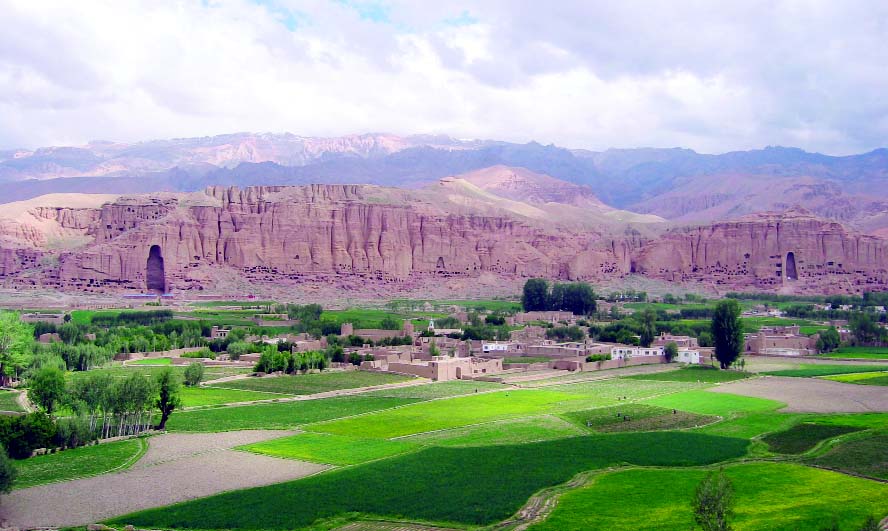
India has been considerably visible in Afghanistan, not only in the post-independence period but also before that. If we go back to antiquity, say Vedic times, we will find Indo-Afghan relations are traceable in the hoary past. The celebrated Buddhist university was in Takhshashila (modern Taxila), the magnificent Buddhist temple Nava Vihara (Nav Bahar) was built in Balkh, and the 175 feet, the tallest Buddha image ever known was carved in the rocky mountain of Bamiyan close to Balkh (known as Bakdi in Rig Veda)
Landscape and Archaeological Remains of the Bamyan Valley (photo: © UNESCO/G. Gonzales Brigas)\
Moving away from this brief reference to historical ties between India and Afghanistan from times immemorial, we would like to reflect on some sections of the text that indicate palpable imbalances.
Speaking on the occasion, India’s Ambassador explained India’s unconditional support to Afghan people in various areas, particularly the infrastructural development, supply of food grains and meeting her pharmaceutical and educational needs.Thousands of Afghan students are provided admission to a host of Indian institutions, in most cases including scholarships. It is surprising that while the resolution recognizes, and rightly, the role of two neighbouring countries of Afghanistan in accepting thousands of Afghan refugees on their soil, it does not speak a word about India’s decades-long investments in building essential infrastructure like roads, bridges dams, schools, hospitals and the designing and building the Afghan parliament house. Not thousands but millions of Afghan nationals would benefit from India’s support. India’s example of supporting a neighbour will be emulated by others. The sponsors of the resolution did not feel it necessary to put in a word of appreciation for what a non-aligned country, the largest democracy in the world, voluntarily fulfilled its responsibility of lending support to a needy member of the UN.
The Russian representative speaking on the draft resolution put her finger exactly at a place where malaise lay. She said,” “What we are witnessing here is a hypocritical shifting of responsibility. Ironically, the custom of swiftly unfreezing Afghanistan’s assets is ignored knowing that the country needs funds for quick economic recovery – to build roads, schools and hospitals, and the issue of lifting unprecedented unilateral sanctions. “Because of the biased position favouring one group of countries and open disregard for proposals supported by regional States, we ended up with an imbalanced document,” she said. She is very right because, for example, India is investing in transforming Afghanistan’s infrastructure to help her with economic recovery but other powerful countries have frozen Afghanistan’s assets subjecting her population to abject deprivation.
The OIC is an important affiliate of the UN. It comprises 57 member states, 48 of which are Muslim-majority. The organization claims to be “the collective voice of the Muslim world” with aims to “safeguard and protect the interests of the Muslim world in the spirit of promoting international peace and harmony”. The impropriety and illegitimacy of the organization will be understood by its accepting Russia as an observer state with just a sprinkling of the Muslim population in the Russian Federation. But the OIC rejected India with the second largest Muslim population in the world after Indonesia, as a member observer. This belies the so-called publicized intent of “safeguarding the interests of the Muslim world. “It is biased against India and that is why we say it is illegitimate. The question is what is the justification for the UN to grant affiliation to an organization that is supposed to safeguard the interest of the Muslim world but singles out a country with the world’s second-largest Muslim population? This dichotomy must be ended. The UN should cancel the affiliation of the OIC until India is formally given the Observer status like Russia.
The resolution states, “The 193-member General Assembly reiterated its “serious concern” over continuing violence and the presence of terrorist groups such as Al-Qaida, Islamic State in Iraq and the Levant (ISIL/Da’esh) and their affiliates ISIL-Khorasan and Tehreek-e-Taliban Pakistan, and “demanded” that Afghanistan not be used as a safe haven for terrorist activity.”
Just note the blatant bias in this vague and unsubstantiated GA’s statement. It speaks of continued violence and the presence of terrorist groups in Afghanistan. We may ask the UN where was Osama bin Laden found and killed while in October 1999, the same United Nations designated al-Qaeda as a terrorist organization. Why didn’t the UN ask that country why a designated terrorist was found a few miles away from its General Headquarters and declare it a terrorist state?Which is the country in the sub-continent whose at least five out of nine major terrorist organizations have been proscribed by the UN or the State Department? Which country’s Defence Minister told Yelda Hakim, the anchor of Sky News in reply to her question, “Well, we have been doing this dirty work for the United States for about three decades, you know, and the West, including Britain.”
This analysis of the text of the resolution very emphatically suggests that Taliban Afghanistan has been targeted only to oblige the real epicentre of international terrorism. India does not succumb to such bullying.
India has been maintaining cordial relations with Afghan people through thick and thin. These relations have no political strings. It is India’s sustained effort to give proper value to the rich legacy of trust and friendship. Recently, Moscow announced that it would accord recognition to the Taliban government in Kabul. India should not be the third but the second country to recognize the Taliban and work hard to bring Afghanistan into the comity of nations as an independent sovereign state. India’s closer ties with Kabul are further necessitated by a prospect leading to the independence of Baluchistan. India will strive every nerve to ensure peace and tranquillity in her close neighbourhood. India must gear up to the fast-emerging phenomena in Baluchistan.
 Follow our WhatsApp channel
