

Japan to invest Rs 60,000 cr in India over a decade
Modi, Ishiba firm up 13 key pacts
TOKYO, Aug 29: India and Japan on Friday strongly condemned the Pahalgam terror attack and called for the perpetrators, organisers, and financiers of this reprehensible act to be brought to justice without any delay.
Follow the Daily Excelsior channel on WhatsApp
In a joint statement issued after the summit talks between Prime Minister Narendra Modi and his Japanese counterpart Shigeru Ishiba, the two countries also called for concerted actions against all UN-listed terrorist groups and entities, including Lashkar-e-Toiba (LeT), Jaish-e-Mohammad (JeM) and their proxies.
“The two Prime Ministers unequivocally and strongly condemned terrorism and violent extremism in all its forms and manifestations, including cross-border terrorism,” the joint statement said.
They condemned in the strongest terms the terrorist attack in Pahalgam, Jammu and Kashmir on April 22, and took note of the UN Security Council Monitoring Team Report of July 29, mentioning The Resistance Front (TRF).
Prime Minister Modi explained that the TRF had claimed responsibility for the attack that claimed 26 lives. Prime Minister Ishiba noted this with concern.
“They called for the perpetrators, organisers, and financiers of this reprehensible act to be brought to justice without any delay,” the statement said.
“They also called for concerted actions against all UN-listed terrorist groups and entities, including Al Qaeda, ISIS/Daesh, Lashkar-e-Toiba (LeT), Jaish-e-Mohammad (JeM) and their proxies, and to take resolute actions to root out terrorists’ safe havens, eliminate terrorist financing channels and its nexus with transnational crime, and halt cross-border movement of terrorists,” it added.
The two Prime Ministers also expressed support for a just and lasting peace in Ukraine in accordance with international law, including the UN Charter. They welcomed the ongoing diplomatic efforts by various countries to achieve a just and lasting peace, the statement said.
They reiterated their commitment to peace and stability in the Middle East, calling on all parties concerned to show restraint, protect civilians, comply with international law, and refrain from taking actions that could further escalate the situation and compromise regional stability, it said.
Voicing grave concern over the humanitarian situation in Gaza, the two leaders strongly stressed the importance of reaching an agreement among the parties concerned regarding the release of all hostages and the immediate and sustainable ceasefire, as well as addressing the deteriorating humanitarian situation.
Meanwhile, Japan on Friday set an investment target of 10 trillion yen (approx Rs 60,000 cr) in India over a decade and the two sides sealed a raft of big-ticket pacts, including a framework for defence ties and a 10-year roadmap to largely boost economic partnership — decisions that came amid turbulence triggered by Washington’s trade policies.
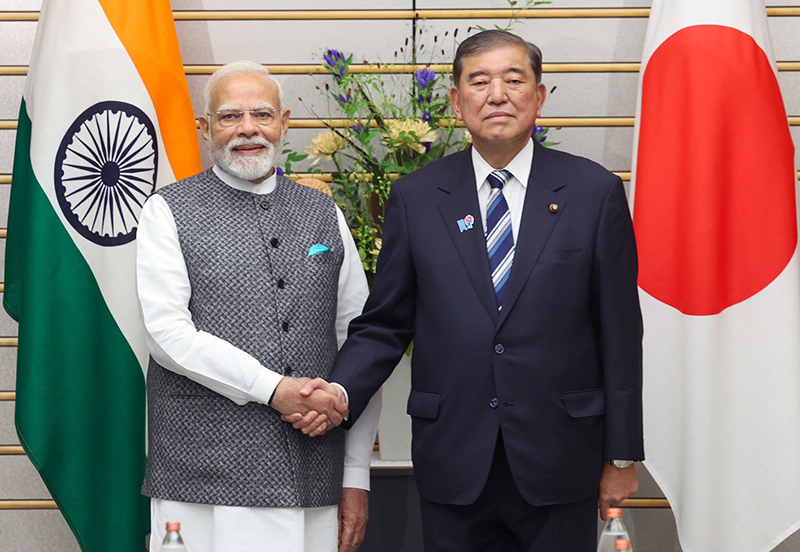
The new measures to further expand India-Japan special strategic and global partnership were unveiled following summit talks between Prime Minister Narendra Modi and his Japanese counterpart Shigeru Ishiba.
The two sides firmed up 13 key pacts and documents and announced the launch of several transformative initiatives, including an economic security architecture to promote supply chain resilience in strategic sectors such as semiconductors, clean energy, telecom, pharmaceuticals, critical minerals and new and emerging technologies.
“We both agree that as two major economies and vibrant democracies, our partnership is very important not only for our two countries, but also for global peace and stability. Strong democracies are natural partners in shaping a better world,” Modi, flanked by Ishiba, said.
“Today, we have laid a strong foundation for a new and golden chapter in our Special Strategic and Global Partnership. We have set a roadmap for the next decade.”
“We have set a target of 10 trillion yen investment from Japan in India over the next ten years,” Modi said.
Of the agreements, one relates to promoting mobility of 50,000 skilled and semi-skilled personnel from India to Japan in the next five years, while another agreement will advance collaboration in digital public infrastructure.
The 10-year roadmap features several key pillars such as economic security, mobility, ecological sustainability, technology and innovation, health, people-to-people exchanges and engagements between Indian states and Japanese prefectures.
Another key pact was to advance cooperation in supply chain resilience for critical minerals, including through the development of processing technologies, joint investments for exploration and mining and efforts for stockpiling critical minerals. A separate declaration was sealed for promoting projects on hydrogen and ammonia.
The pacts signed also featured one on a joint crediting mechanism and another on cooperation between the Indian Space Research Organisation and Japan Aerospace Exploration Agency for a joint lunar-polar exploration mission. (PTI)
 Follow our WhatsApp channel
