

Excelsior Correspondent
NEW DELHI, Jan 7: “This day will go down in the history as India enters an era of ‘Clean, Green Highways’, with the successful Technology Transfer titled “Bio-Bitumen via Pyrolysis: From Farm Residue to Roads”, an indigenous innovation developed by CSIR Central Road Research Institute (CSIR-CRRI) New Delhi and CSIR Indian Institute of Petroleum Dehradun (CSIR-IIP)”.
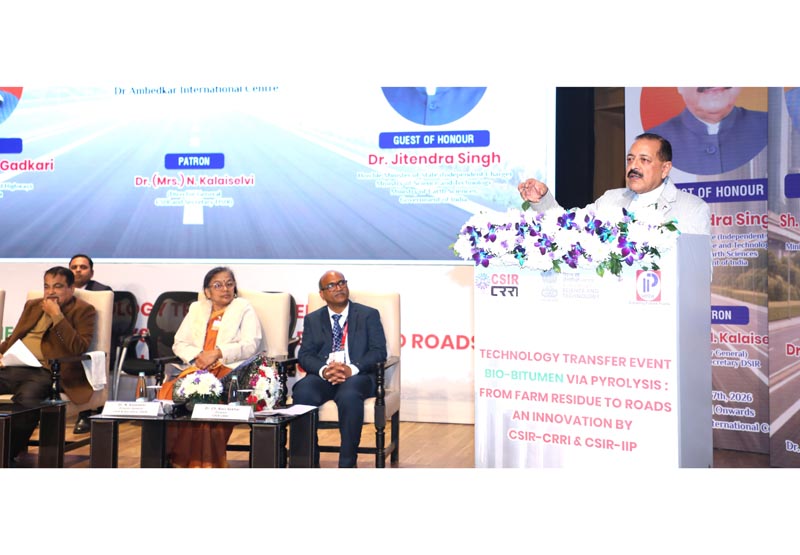
This was stated here today by Union Minister of State (Independent Charge) for Science & Technology, Earth Sciences, and Vice-President, CSIR, Dr Jitendra Singh, while addressing the Technology Transfer ceremony titled “Bio-Bitumen via Pyrolysis: From Farm Residue to Roads”.
Dr Jitendra Singh said, the day would be remembered as a historic milestone, stating that India’s highways are now transitioning from fossil-fuel dependency to bio-driven, regenerative, and circular economy solutions. The roads constructed using this technology will involve lesser budget , have a more sustainable lifespan, and will also be free from the hazard of causing environmental pollution.
He described the initiative as a Whole-of-Science, Whole-of-Government and Whole-of-Society effort, which together represents the Whole-of-Nation approach envisioned by Prime Minister Shri Narendra Modi for building a Viksit Bharat.
The Minister underlined that technologies such as bio-bitumen demonstrate how scientific research can directly serve national missions including cleanliness, Atmanirbhar Bharat and economic self-reliance. Stressing the importance of communication and outreach, he said innovation must be articulated in a manner that enables wider stakeholder understanding and adoption.
Dr Jitendra Singh further highlighted that while each of CSIR’s 37 laboratories have strong success stories, the last decade has focused on opening science to citizens, industry, and states alike. Referring to the waste-to-wealth approach, he noted that bio-bitumen addresses multiple challenges simultaneously, from stubble management and environmental protection to reduction in imports. He observed that India currently imports nearly 50% of its bitumen requirement, and innovations like bio-bitumen would significantly reduce foreign dependence while strengthening domestic capabilities.
The event showcased the industrial-scale technology transfer of Bio-Bitumen produced via pyrolysis of farm residue. The process involves collection of post-harvest rice straw, palletisation, pyrolysis to produce bio-oil, and subsequent blending with conventional bitumen. Extensive laboratory validation has demonstrated that 20-30% of conventional bitumen can be safely replaced without compromising performance. The technology has undergone physical, rheological, chemical, and mechanical characterisation, including rutting, cracking, moisture damage, and resilient modulus tests. A 100-metre trial stretch using bio-bitumen has already been successfully laid on the Jorabat-Shillong Expressway (NH-40) in Meghalaya, confirming field-level feasibility. A patent for the technology has been filed, and multiple industries have been onboarded for commercial deployment.
Director General, CSIR & Secretary, DSIR, N Kalaiselvi, termed the occasion a proud moment for Indian science, noting that India has become the first country in the world to take bio-bitumen technology to industrial and commercial scale within the same year. She explained that pyrolysis of biomass yields multiple value streams, bio-binder for roads, energy-efficient gaseous fuel, bio-pesticide fractions, and high-grade carbon suitable for batteries, water purification, and advanced materials, making the process emission-free, cost-effective, and future-ready. She also proposed policy-level blending of bio-bitumen to enable pan-India deployment.
 Follow our WhatsApp channel
