

Prof. D. Mukherjee
mukhopadhyay.dinabandhu@gmail.com
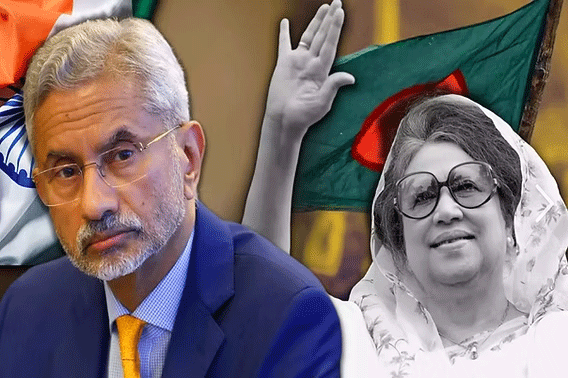
The passing of Begum Khaleda Zia, former Prime Minister of Bangladesh and long-serving chairperson of the Bangladesh Nationalist Party (BNP), on 30 December 2025 has reverberated across South Asia, drawing renewed attention to Bangladesh’s political landscape. At 80, her death marked the end of an era defined by intense political rivalry, landmark elections, and enduring debates about the country’s democratic path. Her state funeral in Dhaka was not only a moment of national mourning but also a platform for diplomatic engagement, highlighted by the visit of Dr. Subrahmanyam Jaishankar, India’s External Affairs Minister. He represented the Indian government and delivered a condolence letter from Prime Minister Narendra Modi to Khaleda Zia’s son and BNP acting chairman, Tarique Rahman, signalling the importance of India-Bangladesh relations and regional diplomacy. Khaleda Zia’s political journey was closely tied to Bangladesh’s democratic evolution. Following the assassination of her husband, former President Ziaur Rahman, she rose to become the country’s first female prime minister, winning multiple elections in 1991, 1996, and 2001. Her tenure was defined by a longstanding rivalry with Sheikh Hasina, shaping the nation’s political culture for decades. Her death prompted an outpouring of respect across social and political divides, with hundreds of thousands attending funeral prayers and delegations from across South Asia paying homage, reflecting her enduring influence in the region
India’s decision to send Dr. S. Jaishankar to Dhaka highlights the evolving and sometimes complex ties between the two neighbours. In a letter delivered to Tarique Rahman, Prime Minister Narendra Modi described Khaleda Zia as a leader of “rare resolve and conviction” and recalled personal interactions with her, including his 2015 visit to Dhaka. Modi expressed India’s heartfelt condolences and emphasized hopes for “new beginnings” in bilateral relations, signalling New Delhi’s intent to overcome recent strains and foster cooperation. This diplomatic outreach comes amid significant political shifts in Bangladesh. In August 2024, mass protests demanding reform led to the ouster of Sheikh Hasina’s long-standing government, and an interim administration was formed under Nobel laureate in Peace , Dr. Muhammad Yunus as Chief Adviser. He was tasked with overseeing governance and preparing for national elections. Political polarization has remained high, with ongoing debates about electoral fairness, party participation, and legitimacy. The general elections are scheduled for 12 February 2026, marking the first polls since Hasina’s removal.
In this scenario, the BNP, led by Tarique Rahman, is set to play a pivotal role in Bangladesh’s political future. After 17 years in self-exile, Rahman’s return positions him as a key contender in the upcoming February 2026 elections, with the BNP poised to potentially assume a central role in the next government. This resurgence marks a significant shift in the country’s political dynamics, raising questions about the direction of domestic policy and the future of Bangladesh’s foreign relations, particularly with neighbouring India. Historically, the BNP’s relationship with New Delhi has been tense at times, especially when Dhaka’s policies favoured other international partners.
Bilateral ties between India and Bangladesh have seen periods of cooperation and friction. During Sheikh Hasina’s tenure, the partnership was robust, encompassing economic, security, and cultural collaboration, including progress on water sharing, energy, and infrastructure projects. However, the transition to an interim government under Dr. Muhammad Yunus has introduced diplomatic challenges, with issues like governance, minority rights, and policy divergence complicating relations. India’s decision to send Dr. Jaishankar to Khaleda Zia’s funeral reaffirmed New Delhi’s respect for Bangladesh’s evolving political landscape and commitment to sustained dialogue.
Dr. Jaishankar’s brief but symbolically charged visit to Dhaka was welcomed by observers in both capitals as a potentially stabilizing act that could serve as a foundation for future cooperation. Upon his arrival, he met with Tarique Rahman and handed him the letter from Prime Minister Modi, expressing confidence that Khaleda Zia’s vision and values could help guide the development of renewed partnership between India and Bangladesh. Beyond this meeting, Dr. Jaishankar’s presence at the funeral brought together senior diplomats and representatives from neighbouring states, including Bhutan, Nepal, Sri Lanka, and the Maldives, underscoring the regional significance of Bangladesh’s political transition and the broad interest in maintaining constructive relations in South Asia.
The diplomatic engagement surrounding Khaleda Zia’s passing carries significant geopolitical implications. Bangladesh’s strategic location in South Asia, with extensive land and riverine borders with India, makes it central to regional connectivity and security considerations. Its internal stability influences not only bilateral ties but also the broader regional balance, affecting major powers like China and the United States. In recent years, China has expanded its economic and strategic footprint in Bangladesh through trade, infrastructure projects, and diplomatic initiatives, a development closely monitored by India. In response, New Delhi has aimed to balance its interests by fostering economic cooperation, promoting connectivity, and supporting shared security objectives, while respecting Dhaka’s sovereign right to diversify international relations. In this context, Dr. Jaishankar’s visit signals India’s commitment to active engagement while acknowledging Bangladesh’s evolving political realities.India’s approach to Bangladesh also reflects its broader foreign policy philosophy, which combines principled engagement with strategic restraint. Even in tense moments, India prioritizes dialogue over confrontation, a strategy occasionally criticized domestically for perceived caution. Advocates argue that careful, consistent engagement strengthens bilateral ties and supports democratic processes. In a politically fluid Bangladesh, India’s measured outreach demonstrates respect for sovereign transitions and the need for regional stability without imposing external solutions.
The domestic debate over India’s foreign policy is not unique to Bangladesh’s context. Across South Asia, varied political climates, historical legacies, and competing external influences create a mosaic of opportunities and challenges. Within India, public discourse around foreign relations often reflects a tension between aspirations for assertive global leadership and recognition of the delicate diplomacy required in neighbouring states. The response to Khaleda Zia’s death-and India’s role in the funeral ceremonies-offers a microcosm of these broader debates. While some voices within India emphasize strategic caution, others argue for a more proactive posture to assert national interests. Yet in a region where historical grievances, economic ties, and cultural bonds are deeply intertwined, the value of respectful, sustained engagement cannot be discounted.
Internationally, India’s outreach to Bangladesh in this period sends multiple signals. To partners such as the United States and European nations, it demonstrates India’s capacity to act as a stabilizing force in South Asia, even amid political transitions. It underscores India’s preference for diplomatic engagement over acrimony and positions New Delhi as an interlocutor willing to engage with diverse political configurations. At the same time, the gesture communicates to China and other external actors that India remains committed to maintaining strong relations with neighbouring states, even as strategic competition evolves in the Indo Pacific. By participating in key diplomatic rituals like Khaleda Zia’s funeral and offering words of condolence and hope, India asserts its presence in the regional order while reaffirming the importance of respectful dialogue.
As Bangladesh prepares for its historic elections in 2026, the international community remains attentive to how the political landscape will shape future policies-both domestic and foreign. Jamaat e Islami and other parties have signalled openness to broader coalitions following the elections, indicating potential shifts in polity and governance that could influence alliances and diplomatic priorities. The BNP’s reemergence as a major contender raises questions about policy continuity and the direction of Dhaka’s engagement with external partners. In this context, India’s diplomacy must remain adaptive, balancing support for democratic processes with respect for Bangladesh’s sovereign choices.
Looking ahead, India has several avenues to strengthen its relationship with Bangladesh. Beyond high level diplomatic gestures, sustained cooperation on economic development, connectivity projects, cultural exchanges, and people to people ties will be essential. Continued engagement with all political stakeholders in Bangladesh, coupled with support for inclusive, transparent electoral processes, could help stabilize relations and promote mutual trust. Additionally, leveraging regional forums that include Bangladesh-such as BIMSTEC and SAARC-can provide platforms for constructive dialogue and collaboration on shared challenges ranging from climate change to trade facilitation.
The visit of Dr. S. Jaishankar to Dhaka following the death of Begum Khaleda Zia represents more than a diplomatic ceremonial duty; it reflects the evolving contours of India-Bangladesh relations at a historically significant moment. By carrying Prime Minister Modi’s letter of condolence to Tarique Rahman, participating in state funeral rites, and engaging with regional counterparts, India reaffirmed its respect for Bangladesh’s political institutions and its commitment to continued bilateral engagement. Amid a period of political in Bangladesh, multilateral interests in South Asia, and shifting global dynamics, this gesture exemplifies the careful diplomacy required to navigate complex relationships. As Bangladesh moves toward its next chapter, India’s approach-rooted in respectful engagement, strategic patience, and a recognition of shared history-will likely shape the trajectory of one of South Asia’s most important bilateral partnerships. This moment of reflection, respect, and renewal could catalyse a deeper understanding and cooperation between two of the region’s most influential neighbours
(The author is an educationist, management scientists, independent researcher and Member- IIMSTC-Bengaluru)
 Follow our WhatsApp channel
