

NEW YORK, Mar 12: India on Wednesday joined over 130 countries in supporting a resolution at the United Nations Security Council (UNSC) condemning Iran’s recent “egregious” attacks against Gulf nations and Jordan.
The resolution denounces Iran’s attacks and calls for an immediate end to hostilities. It also condemned any actions or threats by Iran aimed at blocking, disrupting or interfering with international shipping through the Strait of Hormuz, as well as any moves that could endanger maritime security in the Bab Al Mandab.
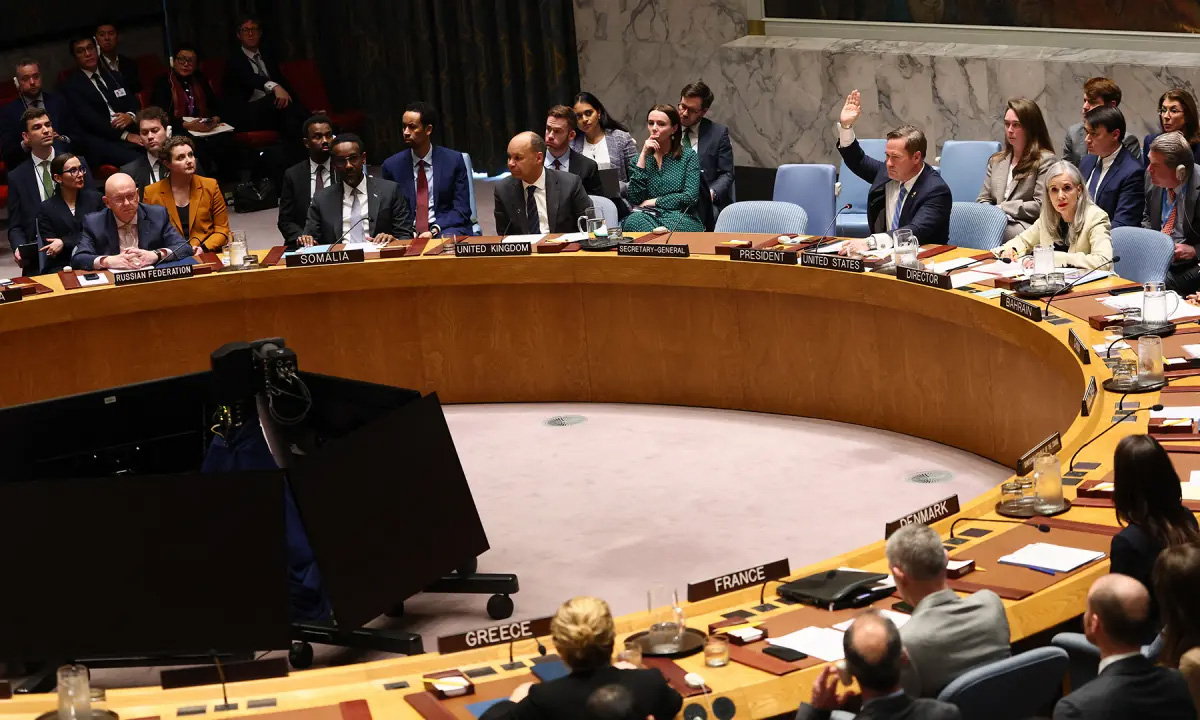
The resolution, introduced by Bahrain, was adopted by the 15-member Security Council with 13 votes in favour. No country voted against it, while China and Russia abstained.
The Bahrain-led resolution was co-sponsored by India along with more than 130 nations, including Australia, Austria, Bangladesh, Bhutan, Canada, Egypt, France, Germany, Greece, Italy, Japan, Kuwait, Malaysia, Maldives, Myanmar, New Zealand, Norway, Oman, Pakistan, Qatar, Saudi Arabia, Singapore, Spain, Ukraine, the United Arab Emirates, the United Kingdom, the United States, Yemen and Zambia.
With a total of 135 cosponsors, the resolution reaffirmed strong support for the territorial integrity, sovereignty and political independence of Bahrain, Kuwait, Oman, Qatar, Saudi Arabia, the United Arab Emirates and Jordan.
It condemned in the “strongest terms the egregious attacks carried out by Iran against the territories of these countries, stating that such actions constitute a breach of international law and pose a serious threat to international peace and security.
The resolution demanded the immediate cessation of all attacks by Iran against GCC countries and Jordan. It also urged Tehran to “immediately and unconditionally” stop any provocation or threats toward neighbouring states, including the use of proxies.
The representative of the United States, serving as Council President for March, said that Iran shoots in all directions.
While Denmark’s representative said that at this “crucial moment, it is imperative to listen to the voices of the region.
The resolution also reaffirmed that merchant and commercial vessels must be able to exercise their navigational rights and “freedoms in accordance with international law, especially along vital maritime routes.”
It further recognised the right of member states, under international law, to “defend their vessels from attacks and provocations, including those that undermine navigational rights and freedoms”.
It called on Iran to immediately refrain from any actions or threats in line with international law and urged Tehran to comply fully with its international obligations, including international humanitarian law, particularly regarding the protection of civilians and civilian infrastructure during armed conflict.
US representative to the United Nations Ambassador Mike Waltz said the adoption of the resolution “is a direct and unequivocal statement from the Gulf countries condemning the brutality of the Iranian regime, whose practice of targeting civilians and civilian infrastructure is reprehensible, and the entire world is calling it out for what it is”.
Waltz said President Donald Trump and his team had exhausted every attempt at diplomatic negotiations.
“He sought peace and to end 47 years of hostility and attacks, while Iran only sought more missiles, more drones, and a pathway to nuclear Armageddon. President Trump has drawn his red line here. Iran crossed it once again, and now the world is facing the consequences.
“And these consequences the United States does not bring alone,” Waltz said, expressing gratitude to the 135 countries that co-sponsored the resolution.
Iran’s permanent representative to the UN, Ambassador Amir Saeid Iravani, criticised the council’s move, describing it as “unjust and unlawful” and inconsistent with the United Nations Charter and international law. He said the resolution ignores established principles used to determine acts of aggression and breaches of peace.
“Make no mistake, today it is Iran; tomorrow it could be any other sovereign state,” he said.
Iravani reminded the Security Council that since the conflict began on February 28, ongoing military strikes by the United States and Israel have killed more than 1,348 civilians, including women and children. He added that over 17,000 civilians have been injured, while 19,734 civilian sites have either been destroyed or damaged.
He said that damaged or destroyed sites include 16,191 residential homes, 1,617 commercial and service centres, 77 medical and pharmaceutical facilities, 65 schools and educational institutions, 16 Red Crescent buildings, and several energy infrastructure facilities.
“The scale and systematic nature of these attacks clearly constitute war crimes and crimes against humanity,” the Iranian envoy said.
Iravani said Iran “remains committed” to maintaining “friendly relations” with countries in the Persian Gulf region, based on “mutual respect”, “good-neighbourliness”, and respect for “sovereignty and territorial integrity”.
He also stressed that Iran has consistently “honoured its obligations”, upheld “international law”, and respected “freedom of navigation” in the Strait of Hormuz, adding that claims the country has closed the Strait are “simply untrue”.
“Iran reemphasises that its defensive operations targeting United States military bases and facilities in the region are in no way against the sovereignty and territorial integrity of the regional countries,” he said.
“Although the Israeli regime has succeeded in dragging the US into a regional conflict, Iran’s relations with its neighbours are rooted in long-standing historical, cultural, and geographical ties. Once the current tensions diminish, Iran and its neighbouring countries will inevitably return to their traditional relations of cooperation, mutual respect, and good neighbourliness,” he added, accusing Israel of dragging the US into the conflict.
(UNI)
 Follow our WhatsApp channel
