

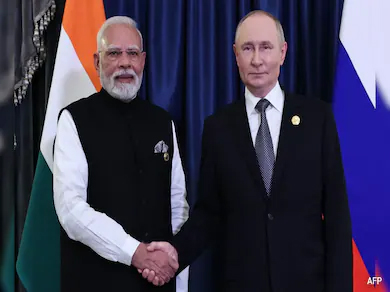
Putin visit to India
Dr D K Giri
Russian President Vladimir Putin’s visit to India is being closely watched by world leaders on two counts. Russia is engaged in a heavy war in Ukraine since 2022. While the latest peace talks are being carried out as Putin has just threatened Ukraine, “roll back or be ready to be wiped out”. At the same time, serious efforts are being made at the behest of America to end the war. Talks are being held regularly with multiple formulas and options to bring about a ceasefire.The American President Donald Trump put a 28-point plan on the table to end the war. After first round of discussion in Geneva last month with Ukrainian President and his delegation, the plan was reduced to 19 points. However, New Delhi will be the centre of the world attention this week for Modi-Putin bilateral meeting.
An op-ed critical article in a leading Indian newspaper titled, “World wants the Ukraine war to end, but Russia does not seem serious about peace”, written by Philipp Ackermann, Thierry Mathou and Lindy Cameron, the Ambassadors of Germany and France respectively, and Cameron, the British High Commissioner in Delhi. In a strongly worded article, they have accused Russia of an unprovoked war on Ukraine, raised the violation of fundamental international principles of national sovereignty and territorial integrity. They hinted that Russian appetite for territorial expansion and global destabilisation goes beyond Ukraine. The article read, ‘Russian fighters are making dangerous and escalating incursions into European space’.
Characterising Putin’s invasion of Ukraine as a humanitarian catastrophe and sets a precedent for small independent countries to be vulnerable to such aggressions from bigger powers. They have cited examples of forcible transfer and deportation of children to Russia. They wondered how Russia has escalated the aggression since the latest peace talks began by launching 22 of his largest air attacks and the last week alone, 1200 drones and over 60 cruise and ballistic missiles.
The article ends by reaffirming their countries’ unwavering commitment to support Ukraine both with military and non-military means. The Ministry of External Affairs has issued a mild reaction suggesting that such articles, just on the eve of a visit of foreign dignitary to India as an invited guest, is “unusual and unacceptable diplomatic practice.
America has been highly critical of India’s buying of Russian oil despite the war and the sanctions. President Donald Trump had imposed additional 25% tariffs on Indian exports to USA. In his inimitable temperamental style, he had said, “India and Russia, two dead economies, cannot make any impact”. In the meantime, Indian purchase of Russian crude oil has dipped since last August. It was 17% less by September and could fall to a record low in December.
India was buying 1.8 m barrels per day (cbpd) crude oil. It is estimated to be 60,000-65,000 bpd in December. Indian refineries including the one owned by Ambani have begun reducing their purchase of Russian oil to avoid violation of American, European and British sanctions. According to Helsinki-based Centre for Research on Energy and Clean Air (CRECA), India has been the second largest importer of Russian oil preceded by China with 7.75 b USD.
Let us scan what is on Putin’s mind during his two-day visit to India, 4-5 December; what does he seek to achieve? How does India navigate its foreign policy while deepening ties with Russia? Some analysts anticipate strengthened ties and closer collaboration, while quite a few others including myself are scepticalof Russia’s intentions of meeting potential benefits, and are questioning the current partnership.
To read between the lines of two statements, one by Dimitry Peskov, the Kremlin spokesman in a virtual press interaction with Indian media, and another by the President Putin himself, Peskov said, “We are looking forward to ensuring our rights to sell to those who want to purchase oil and their rights to buy our oil”. He added that Russia is willing to address India’s concern over the ballooningtrade deficit. India’s trade deficit stood at record high as India 68.7 billion, India exported to Russia$5 billion worth goods in trade and imported 63.7 billion out of 68.7 b total trade in 2024-25. Bulk of the trade consisted of India’s purchase of Russian oil and defence items under the ‘Special and Privileged Strategic Partnership’.
Putin said about the purpose of his visit, “main part of the plan on India visit is to elevate cooperation with India and China to qualitative new levels”. He added that “he would discuss expanding Indian imports to Russia”. What raises the hackles of analysts and strategists is Putin hyphenating India and China. Since early this year because of Trump’s tantrums, New Delhi seems to be moving closer to Russia and China. One would have thought the bonhomie with the latter (China) is symbolic and for optics. But Putin’s statement indicates a possible Troika (India-China-Russia) vis-à-vis USA and Europe.
That is risky and serious shift in India’s foreign policy since the first NDA government under Vajpayee and even 10 years of Manmohan Singh which marked a steady growth in India-America bilateralism. The jury is still out whether Narendra Modi can balance the two rival blocks America and Europe vs Shino-Russian forever-pact. I tend to believe that it will be a hard and tortuous path to tread upon. New Delhi will have to eventually choose either or.
On bilateral issues, Putin will be co-chairing with Modi the 23rd India-Russian annual bilateral Summit. The annual bilateral Summit between the two countries began in 2000. During the visit, talks will include renewed cooperation in trade, defence, energy, political, economic, scientific and people-to-people ties. New Delhi is likely to ask for the safe return of Indian nationals recruited in Russian military.
Another significant deal would be the signing of an Agreement in order to enable India’s skilled and semi-skilled professionals to work in Russia which is desperately short of man- power in various sectors. Formal negotiations on such an Agreement started with signing of the TOR in August 2025. India’s new Consulate General in Russia’s Yekaterinburg will deal with the mobility issues of suchworkers going to Russia.
Another important item on the agenda would be a Free Trade Agreement with Euro-Asian Economic Union (EAEU), comprising Russia, Armenia, Belarus, Kazakhstan and Kyrgyzstan. A bilateral trade under the FTA is aimed at $100 billion by 2030. Currently, India has a large deficit with EAEU mainly due to heavy Indian imports of Russian oil. FTA is supposed to address this imbalance.
The discussion on Ukrainian war will be what the world is pontificating on. Whether Ukraine will figure in public joint communiqué made by the two leaders, is also a question. If it does, it will have significant implications for India. If it does not, then also India would be a subject of criticism by Western powers. Let us watch and wait. (INFA)
 Follow our WhatsApp channel
