

Excelsior Correspondent
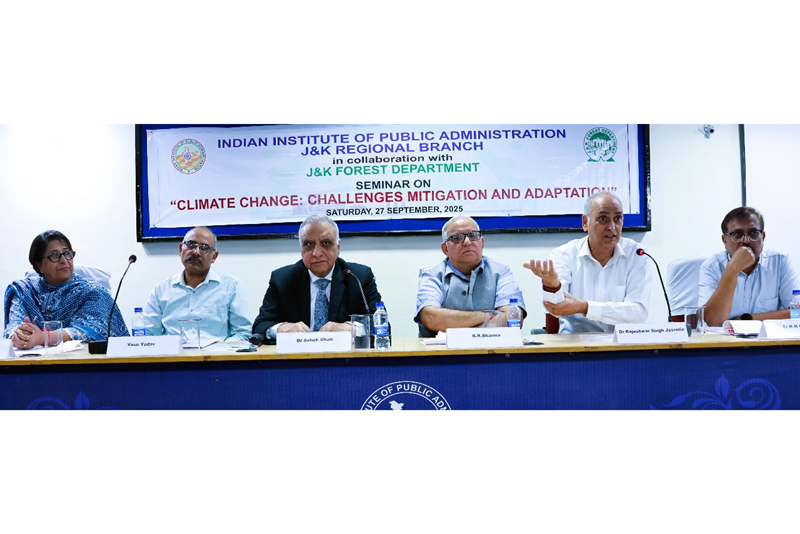
JAMMU, Sept 28:The Indian Institute of Public Administration (IIPA), J&K Regional Branch, in collaboration with the J&K Forest Department, organised a seminar on `Climate Change: Challenges, Mitigation and Adaptation’ last evening.
Vasu Yadav, Chairman, JKPCC and Dr RS Jasrotia, former CCF gave their presentation on the topic. BR Sharma, Chairman of IIPA J&K Regional Branch, was the chief guest while Dr Ashok Bhan, Patron of IIPA J&K Regional Branch, presided over the function.
Yadav, made a distinction of climate change and the politics of it and said that climate change is not a new phenomenon and validated his views with references to holy scriptures like Ramayana and Mahabharata. He explained that climate change has been seen all through human history and said that it had never been static. While the recent massive socio-economic development, has decidedly contributed to the current ecosystem, it needs to be understood that climate change cannot be avoided as we learn from history. When development would take place with the use of modern gadgets for comfortable living, the temper is bound to increase, he added.
Explaining the recent devastation yadav said that it is a grim reminder of the changing weather pattern. Recently we have seen 19 western disturbances which are unprecedented. Monsoon resulted in incessant rainfall, cloud burst and floods taking a heavy toll of life, property and public infrastructure.
Dr Jasrotia, delved upon the unusual and weird climatic events witnessed during last few decades across the globe, and said that he successfully demonstrated the meteorological aberrations manifesting in form of erratic rainfall, intense heat waves, severe droughts, frequent hurricanes, typhoons, cloudbursts etc. He also underlined the various facets of climate change and their impact on pattern of precipitation; melting and receding of glaciers; reduced water availability; rise in sea levels; loss of biodiversity etc.
B R Sharma said the world is currently facing one of the gravest multi-pronged challenges in climate change which he described as crisis of science, policy framework, ethics, spirituality and civilisational. Its threat loomed large over mankind. Quoting Ban Ki-moon, he said that climate change has no borders and as such required global solidarity to respond to it.
Dr Bhan said humans have proved unequal to meet the “challenge” set by the Kyoto Protocol and Paris Agreement. He said that the goal of Paris Agreement was to hold “the increase in the global average temperature to well below 2°C above pre-industrial levels” and pursue efforts “to limit the temperature increase to 1.5°C above pre-industrial levels.” However, 2024 was more than 1.5°C warmer than pre-industrial times but that did not mean that the Paris Agreement threshold has yet been breached because the target referred to a 20-year average, and not a single year.
Earlier, Prof Alka Sharma, Hony Secretary welcomed the guests and explained the importance of the topic of the seminar and MM Gupta Director Seminars presented the formal vote of thanks.
 Follow our WhatsApp channel
