

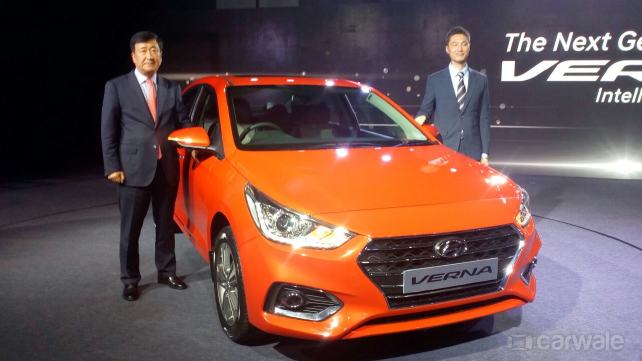
MUMBAI: The second largest car-maker Hyundai India today rolled out its 5 millionth car, a new generation Verna.
Commenting on the milestone, Hyundai Motor India managing director and chief executive YK Koo claimed that this is the fastest growth in the domestic car space.
“Today we are very happy to roll out the 5 millionth car with the NextGen Verna, the fastest in the industry symbolising our long-term commitment to this market. We will continue this momentum with strong efforts towards customer delight,” Koo said in a statement.
Hyundai, which is also the largest exporter from the country rolled out its 1st millionth car, a Santro, in April 2007 in eight years and seven months since beginning of production in 1998.
It rolled out the three millionth car in July 2013, and reached the 4 million mark in November 2015, it said.
Hyundai has 480 dealers and over 1,260 service points, including 422 rural outlets and sells the Eon, Verna, Creta, i10 Grand, Elite i20 & i20 Active, Xcent, Tucson, Elantra and Santa Fe.
The Santro, its launch model which became a runaway success has been discontinued some time back. Most of its models are assembled at its Chennai plant.
Being the largest car exporter, Hyundai currently ships its models to around 87 countries across Africa, Middle East, Latin America, Australia and the Asia Pacific. (AGENCIES)of the other planets in our solar system.
Around one million years ago, during the MPT, the period of the cycles abruptly changed to every 100,000 years.
However, this transition is not accompanied by a change in the nature of the orbital cycles and so represents a significant challenge to the Milkovitch Theory to explain ice age cycles.
“We know from bubbles of the ancient atmosphere trapped in Antarctic ice cores that changes in atmospheric CO2 accompanied the more recent ice age cycles,” said Tom Chalk, a post-doctoral fellow at the University of Southampton.
“CO2 was low when it was cold during the glacials and it was higher during the warm interglacials – in this way it acted as a key amplifier of the relatively minor climate forcing from the orbital cycles,” said Chalk, who jointly led the study published in the journal PNAS. (AGENCIES)
 Follow our WhatsApp channel
