

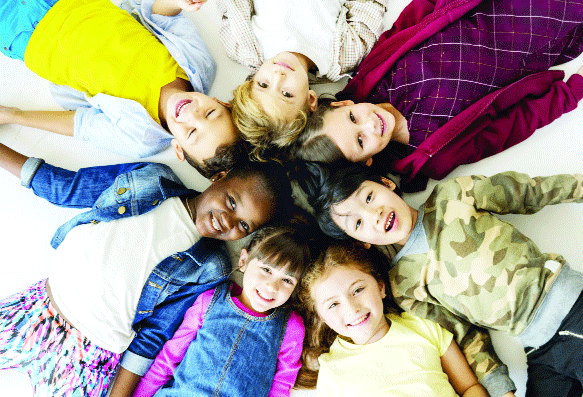
True joy for children begins with inner balance and awareness in parents
MAAsterG
Most parents often wonder- How to raise happy children in today’s times.
When the word happy arises, its opposite-sad-inevitably follows. Happiness and sadness are two sides of the same coin. If you experience happiness, sadness will also come, because happiness is not a permanent state. One is always followed by the other. When someone agrees with us, we feel happy; when they do not, we feel sad. Such happiness and sadness belong to the outer world and are dependent on external situations.
Therefore, the more relevant question for parents is not how to make a child happy, but how to help a child reach a state of bliss. Happiness fluctuates; bliss remains. Bliss is a spiritual state where life moves evenly-without extreme ups and downs, without emotional turbulence. In a state of bliss, both happy and sad moments may arise, but they remain external. They cannot disturb inner peace.
Bliss can be understood through a simple analogy of the sea. On the surface, waves continuously rise and fall, but deep within, the sea remains silent, calm, and stable. Similarly, within every human being, there exists a stable consciousness. Happiness and sadness arise from external subjects-people, places, or events-but when one is rooted in bliss, the inner life remains untouched.
In the outer world, happiness and sadness resemble the tides of the sea-unceasing motion. But through an understanding of inner stability and silence, one can experience a deeper and more enduring joy. Blissfulness is a state where happiness naturally abides, and even sadness dissolves into it-just as the sea absorbs all impurities and yet remains vast and pure.
This bliss emerges from spirituality, which deals with the inner world-consciousness, inner life, and subtle energy. The first question spirituality asks is: Who am I? In the context of parenting, this question becomes even more important. If parents themselves are not peaceful and content, how can they expect their children to be so? Children learn far more from what parents are than from what they say. Only when parents cultivate inner happiness can children naturally reflect it.
Spirituality connects us with the inner force that animates the body-the energy that enables us to breathe, move, and live. While modern life equips us with extensive knowledge of the outer world, it offers very little understanding of our inner life. Once this inner knowledge is attained-the knowledge of life itself-happiness arises effortlessly. Children absorb this state not through instruction, but through vibration and presence.
Through one person’s bliss, not only their own children but countless others are touched. History offers many such examples-Buddha, Mahavira, Jesus, Prophet Muhammad, Kabir, Farid, Guru Nanak Dev, Ramakrishna Paramhansa, Sai, Meera, Sahajo, Lalla, Lao Tzu, and Socrates. They were not parents to one or two children, but to billions of souls. Their love was universal, and their presence radiated peace. Whoever came near them felt uplifted, calm, and joyful.
When parents move toward inner bliss, children naturally grow up in a harmonious atmosphere. They absorb this state like a fragrance in the air. Over time, they may begin to walk the same path of inner joy. Beyond that lies their destiny, their individual journey. But the foundation must be laid by the parents themselves-through self-awareness and spiritual understanding.
Those who genuinely inquire-Who am I? Why are these children mine? Why are these my parents? Why do happiness and sadness arise?-find that this thirst for truth accelerates inner growth. Listening to spiritual teachings and reflecting deeply upon them brings clarity. Slowly, one begins to understand what true happiness really is.
In today’s world, most people chase money and material comforts, believing these will deliver happiness. Yet lasting happiness remains elusive. The reason is simple: we do not understand life itself. When we begin to understand the life within-the energy that sustains and animates us-lasting happiness naturally follows.
This inner understanding benefits not only parents and children, but everyone who comes into contact with such a person. Their presence becomes soothing, positive, and uplifting. In this way, raising happy children does not begin with external achievements, but with inner transformation-the spiritual way.
 Follow our WhatsApp channel
