

Anushree Bhattacharya
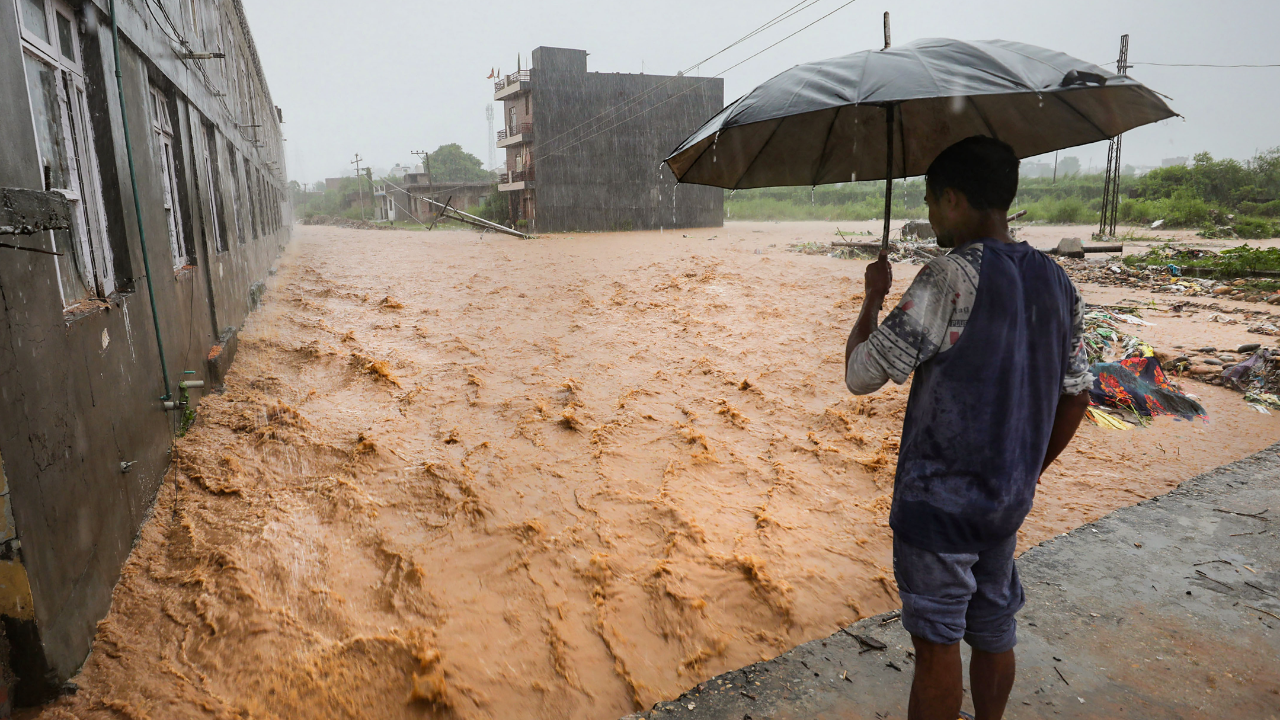
Since last week, Jammu has been facing numerous calamities with a raging sky. Continuous rain has swelled rivers to its extreme, roads are getting ripped, bridges collapse that connect the Union Territory with the rest of India, along with the living casualty. It is becoming a crisis for us as we haven’t seen this form of nature in a few years. Landslides on the Vaishno Devi route, highways shut down, a portion of the road near Jammu’s Fourth Tawi bridge crumbled. The major collapse of the Jammu–Kathua–Pathankot bridge is the most striking, it just did not cut off a route to the city or a district but choked the entire nation by blocking the corridor of trade, travel, and economy. For safety, all transportation has been suspended, no train, road or flight services can be obtained in this situation.
Now this is not merely a regional matter it has become a national concern. Jammu is the prior gateway to Kashmir and a way that links Punjab, Himachal, and beyond cities. When bridges collapse and roads wash away, all the import and export services are on hold which means it’s an economic, social, and emotional shock for India.
Within the past 24 to 48 hours, severe rainfall has been witnessed with landslides across the region, most tragically near the Vaishno Devi shrine route in Reasi, dozens of pilgrims were harmed, rescue teams are continuously active and taking efforts. Authorities halted the yatra, closed education institutes, announced closed public as well as private offices, and deployed the Army, NDRF, and local agencies for evacuations and road clearance as well as advised all the citizens to stay at home, take precautions and help if required. Networks were damaged so the government allowed ICR (Intra Circle Roaming) within the territory which explains that if your network is not working you can easily switch to other network operators and connect to your family and friends, reducing the distress of families trying to reach their loved ones.
Over the past few days, Jammu has witnessed:
Record-breaking rainfall in nearby districts like Udhampur, Kathua, Doda, Samba and Jammu that has not been seen since the early 1970s. The Tawi river gets swelled to its extreme which causes the red alert within the city.
Heavy landslides and bridge collapse on the Jammu – Srinagar National Highway (NH44) near the hospital AIMS, Vijaypur resulted in shutting down the only highway that connects other districts of Jammu with Jammu. This highway has never been closed in the past few years.
In Reasi, pilgrims who were on their way to Vaishno Devi were now buried under some landslides. Families are mourning for their loved ones who left home on a spiritual journey but never returned.
The collapse of Tawi bridge affects the commuters and transporters, some get injured too and our rescue team is untiringly doing their job.
The major collapse of the Jammu–Kathua–Pathankot bridge, the only bridge that links Jammu with Punjab and other northern as well as southern markets, brings huge economic and infrastructural loss.
Homes destroyed and families displaced especially in low-lying regions, waterlogging turned the colonies into pools. Now for them survival means finding a temporary shelter with their family, desperately waiting for relief, and even wondering how to rebuild from nothing. Families whose breadwinners drove trucks or worked in roadside dhabas are suddenly stranded, without income, and finding it difficult to feed their family. Railway and air transportation are also either cancelled, diverted or halted.
Economical Impact
Jammu is a hill geographical area mostly its economy relies on tourism, pilgrimages, horticulture, and services that all depend on open roads and predictable weather.
The condition is like if the Vaishno Devi yatra halts then the livelihoods get paused too like hotels, dhabas, taxi bookings, small vendors all lose their sole reason for daily income. In a typical year, the shrine draws nearly 9.5 to 9.7 crore devotees; even a few days of closure during the peak season causes a loss of huge earnings across hospitality, transport, and retail industries in the region. And now by observing the current scenarios the yatra gets halted again which means huge economic loss for Jammu. Ambulances also cannot reach the afflicted on time for their relief. Due to the massive rainfall networks around the area goes down which means digital payments stop or get affected due to the network, this affects the digital economy of the state as well as the nation.
Road closures that were the vital import-export route meant delayed or interrupted supply of Petroleum products and LPG cylinders, Vegetables, fruits, milk, and poultry products, Apples, dry fruits, handicrafts from Kashmir that headed to the mainland markets.
When these trucks stop moving, prices rise everywhere, not only in Jammu in the entire nation. In Jammu, vegetable prices have already spiked, essentials like petrol and LPG cylinders are rationed, and in cities like Delhi or Chandigarh, apple consignments face delays that reduce its freshness and quality along with the price touches the sky.
A single day choke on NH-44 during harvest season becomes a national supply-chain shock. Even a 3–5 day shutdown in this corridor can cost a loss of crores of rupees in trade. Perishable items get rot, cold storage units overflow, transporters bleed money for idle trucks, and insurance claims pile up. The most affected people are the middle-class families across India. They observe inflation (price increases), but can’t do anything and are forced to cut back on basics to run their households.
Why the rest of India should care
Jammu is the mouth of a long trade route from Kashmir. When NH-44 shuts, much of what moves into and out from Kashmir Valley stops. That includes perishables (vegetables, milk, poultry), essentials (LPG, petrol, medicines), and most importantly at this time of year the horticulture produced goods.
Consider apples. Kashmir accounts for the lion’s share of India’s apple production (roughly 70–75% depending on the year), with harvests ramping up from August through autumn. If trucks cannot reach mandis or cold storages on time, farmers face quality losses; if they can’t exit the Valley promptly, prices swing or produce rots en route. And the effects hit on the transporters, commission agents, packaging suppliers, and cold-chain operators across North India as they got a chance to earn bonus commission.
Train disruptions also add to one of its effects as all passenger trains from the north were canceled or terminated for a duration, which means dozens of services that depend on the railways stall and the workers will suffer alongwith the passengers. The trains carrying goods from the other side to Jammu also stop, which means they have to reschedule it as soon as the situation recovers, resulting in raising costs. Due to this bad condition air links also suffer from the same issue which needs a large amount of money to renormalise the work.
What needs attention – “Now and Next”
Keep the corridor breathing
Prioritizing the rapid recovery on NH-44. Clearing the traffic and starting the ongoing trade with alternate routes if possible should be the first priority. Every hour saved prevents the spoilage of products and stabilizes prices in the market.
Immediate relief for survivors
Shelter, food, and medical aid must reach every displaced family, not just in Jammu but in the nearby remote villages also where the damage has been seen worse.
Quick restoration of transport
As more than one bridge collapses, alternate routes must be provided for the commuters and rapidly start the rebuilding of the bridges with stronger materials and better drainage. As now we know that this type of calamity can happen anytime so we must be ready for it.
Price control mechanisms
Authorities must monitor essential commodity prices, so that it doesn’t worsen the pain of the citizens.
National solidarity
The rest of India must see this situation as a nation’s crisis not just a Jammu’s crisis. It is an urgent matter that affects our shared economy, culture, and humanity.
My final words
Numbers only convey the scale, but not the pain that the families are facing, separated by blocked roads, pilgrims grieving in the rain, drivers stuck on the road and sleeping in cabs on a highway that has turned into a queue. When the NH-44 reopens and the first truck moves, when the yatra resumes and hotels lights up again, Jammu will do what it always does, Get Back To Work.
 Follow our WhatsApp channel
